
Translated material
A couple of words about Zaha Hadid
The Hermitage is an exhibition of architect Zahi Hadid . What you need to know and understand about it?
The humanistic message of the architecture of postmodernism Charles Jenks saw in the ability of her examples to contact the metaphor. In the silhouette of, say, TWA Eerro Saarinena, a simple city dweller can guess the soaring bird, and the facade of the building made of concrete grilles can be compared with a grater for cheese. The more metaphors come to the mind of the viewer, the more successfully the building is integrated into the urban environment, writes Jenx. It is certainly possible to interpret the buildings of Zahi Hadid according to this principle, but metaphors from everyday life like cheese tear are not suitable. In order to “understand and accept” Hadid buildings, the inhabitant of the urban environment must have a little different horizons and look for suitable comparisons within the film and digital world. For example, it can be visualized by a molecule with the help of 3D graphics, to have the image of a spaceship (the Patterns hybrid-from Star Wars to the Interstellar), to admit in the imagination that a certain biomorphic structure can be lively and mobile, etc. It is assumed that for the viewer the figurative series of the “stranger” is more familiar than the type of the same grater, for nothing that grated cheese is now sold back.
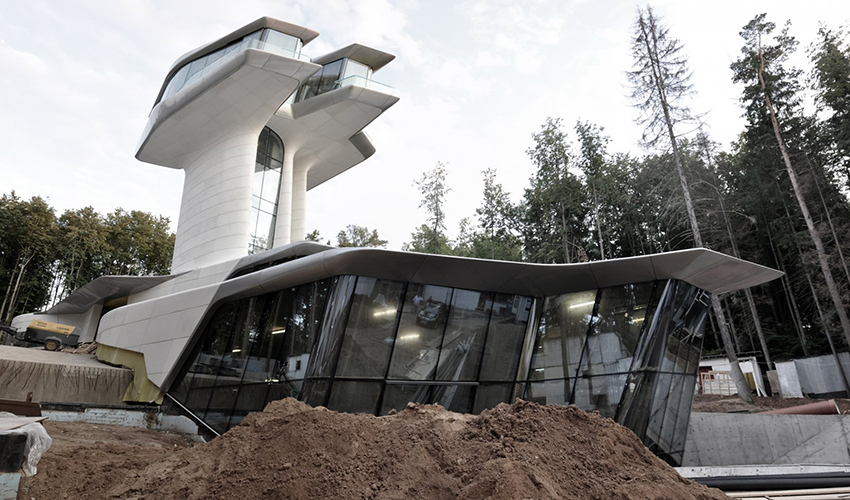
It is not surprising that the bureau of Zahi Hadid never engaged in residential construction. The forms chosen by her are too far from the philistine experience. To live in the dancing house of Frank Heri, similar to a visual interference or a picture distorted by a bug, is one thing, but to settle in the mansion, the form of which resembles a fighter, will agree that the Russian billionaire will agree.
This isolation from everyday experience makes Hadid's work especially attractive to the conservative Hermitage. Opening such an exhibition is an important gesture for the museum and because Hadid is considered the successor of the constructivist project, which is especially felt in her early works. In 1992, she issued the exhibition "Great Utopia" at the Guggenheim Museum in New York: In the spiral space of the Wright Rotonda, she built installations based on the Tatlin’s “Tower” and her own student project “Tectonik Malevich”, through which the public climbed the upper floors. In 2004, she wished to organize a ceremony of presenting her to the Prittskovsky Prize in the homeland of the Russian avant -garde - in St. Petersburg. Since then, the museum has dreamed to expose Hadid - and did it after 11 years in the Nikolaev hall of the Winter Palace on June 26.
The exposition solution was fully developed by Khadid and its co -author Patrick Schumacher and is a snow -white pavilion - a kind of dynamic structure of spirals and rapid sharp corners. This form resembles the early projects of Hadid, including its first building - the fire station of the company "Self" (1990-1993).
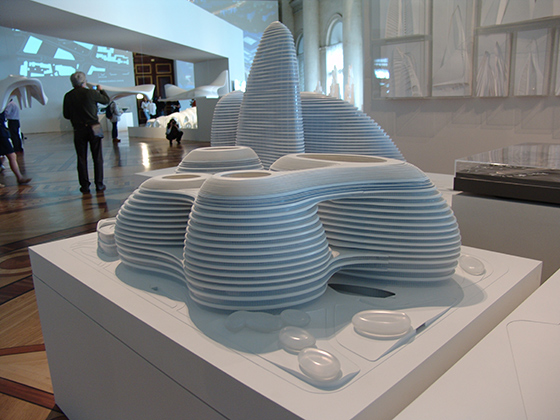 © Olga Ryabukhina Exhibition of Zahi Hadid in the Hermitage. Type of exposure
The exhibition consists of studies, paper layouts, sketches and drawings of Hadid, starting with its pre-diploma hotel project with a club on the 14-level bridge over the Thames in London “Tectonik Malevich” (1976-1977) and the first competitive project, which received world fame, is the PIK leisure club (1982-1983). Here you can also see later layouts of skyscrapers and design objects - shoes, cars, dishes: non -profit series, a kind of field for testing architectural ideas.
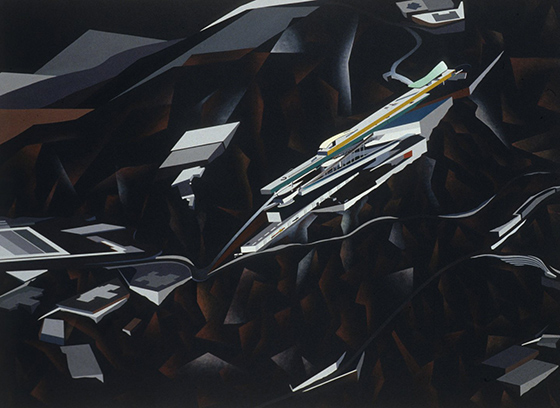 © zaha-hadid.com Linge Club "Peak" in Hong Kong. Competitive project, I prize. (1982-83)
The colliding planes suspended in the air of the spirals, the denial of gravity and any relations of the construction with its basis - Hadid learned about these techniques from her teacher Rem Kolkhas, who, in her youth, was a regional museum of Steedelike, where the through the efforts of the director of Wilem Sandberg were collected an extensive collection of the Russian avant -garde. The motive of the frozen movement, the main of Hadid, in its early projects, and remaining unrealized, was rather a kind of absolute idea. In the 1990s, the plan finally began to embody. The fire station of the company "Spring" was erected from concrete without using the color: red fire engines were to be a bright accent. When they appear, the station seems to be gaining a finished look.
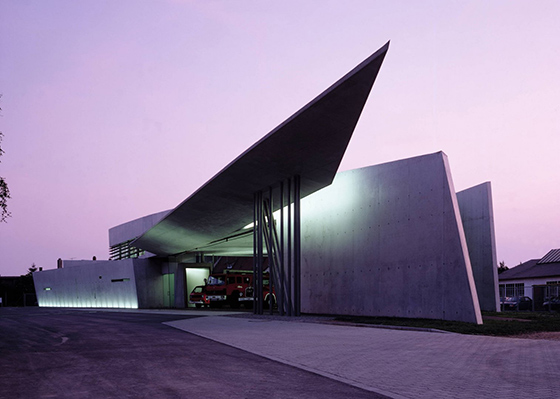 © zaha-hadid.com Firestation of the company "Self", Vile-on-Raine, Germany (1990–93)
The buildings of the 1990s are distinguished by a natural desire to merge with the surrounding landscape. The roof of the Garden Exhibitions Pavilion in Vile-on-Raine, covered with gravel, gradually becomes the surface of the earth, the curl of the ski springboard in the Innsbruck abruptly breaks down, the broken lines of the transplant station in Strasbourg transmit the movement of cars, trams, bicycles and pedestrians. These projects unite the modernist principle, according to which the simplicity and dynamism of forms are due to the function of buildings.
 © zaha-hadid.com Pavilion of Garden Exhibitions, Vile-on-Raine, Germany (1999)
In the future, fluid in the buildings of Hadid remains, but rather as a corporate visual effect. The form is no longer a function, but the will of the architect. More large -scale projects begin: scientific centers, office buildings, private orders and, of course, museums of contemporary art. In a word, everything that makes up the main front of the work of deconstructivist architects, who declared themselves in 1988 an exhibition in MOMA , and a decade later turned into world celebrities . Frank Geri, Zakha Hadid, Rem Kolkhas, Peter Eisenman, Daniel Libeskind here and there are designed cultural centers-manifestos, which do not have to be human in the sense that, according to Jenx, was laid down in the buildings of contextualists-Ralph, Kroll, Arau group. Those sought to enter their work in the surrounding landscape, including social, attracting to the design of local residents. The buildings of the deconstructivists, on the contrary, re-say the modernist hegemony of the creator-creator, only now capital comes into business. The handwriting of the architect, so appreciated by Le Corbusier, becomes a template, is replicated-and is dearly bought by the leadership of a state that belongs to the enlightened one.
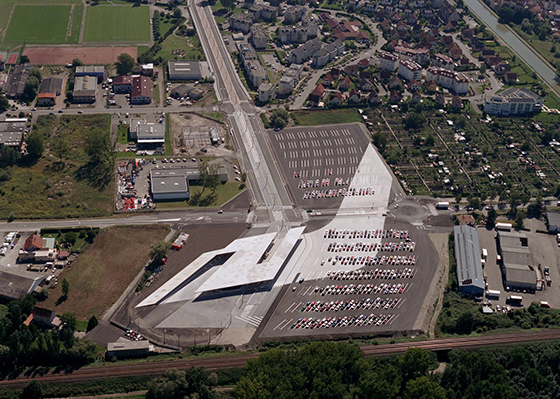 © zaha-hadid.com Station Henhaim-Nord, Strasbourg, France (1999-2001)
“World -famous architect” and “specific architectural philosophy” are nothing more than tags to attract large buyers. In Russia, only billionaires that were discussed above can become them so far. By the way, the release of the only book about Zaha Hadid in Russian, written by the architectural historian Alexander Ryabushin, was sponsored by Vladislav Doronin. The pathetic name “peering into the abyss” and a high -floor syllable (“architecture of passion”, “projects hit the current”, “crushing radicalism and boiling over the edge of the energy”, “whirlwinds of the flying universe”) give a certain engagement of the author. Underestimated in the Fatherland, the Russian avant -garde found an understanding in the person of the Iraqi architect - the joy of Russian architecture history on this subject knows no boundaries and, perhaps, exaggerates her participation in this project somewhat (“Zaha Hadid is Konstantin Stepanovich Melnikov today,” the preface says. Isn't it too much?).
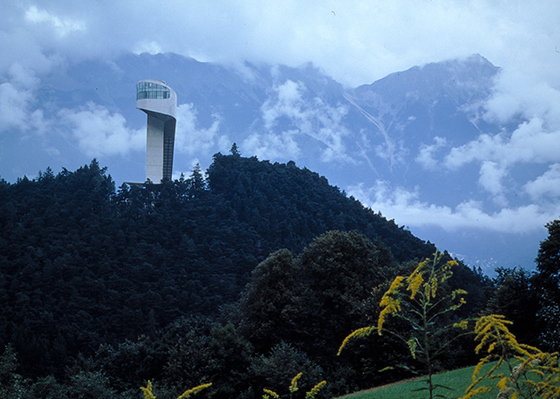 © zaha-hadid.com ski springboard in Innsbruck, Austria
In an interesting way, the beginning of the era of star architects coincided with the general construction of museums of contemporary art around the world . The countdown can be carried out from the opening in 1997 of the Guggenheim Museum in Bilbao under the project of Frank Heri. The same moment, by the way, Hadid calls the key when she was noticed and began to take her seriously. In 2003, she builds her first museum of contemporary art-the Rosenthal Center in Cincinnati, Ohio. Concrete slabs rounded at the corners, as it were, roll out a 7-story building from the horizontally concrete beams in the urban space of the city.
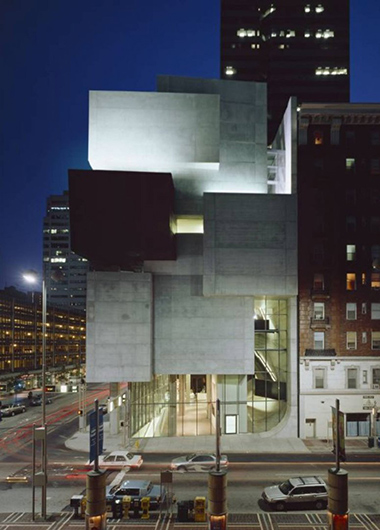 © zaha-hadid.com Lewis and Richard Rosental Center of Modern Art, Zincinnati, Ohio, USA (1997-2003)
The growth of Hadid glory is directly proportional to the increase in the total area of all exposition centers in the world. She worked on the expansion of the Museums of Victoria and Albert, Ordruppgori in Copenhagen, the Museum of Queen Sofia and the Prado Museum in Madrid. Five years ago, Hadid completed the construction of the XXI century museum in Rome with an area of 27 thousand square meters. Where is it more? It turns out that there is where: in 2012, the Heydar Aliyev Center with an area of more than 57 thousand square meters grew up in Baku.
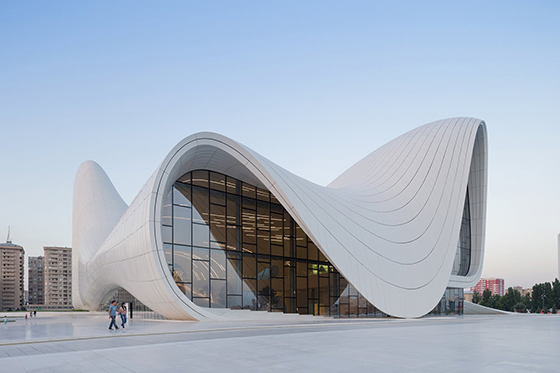 © zaha-hadid.com Center Heydar Aliyev, Baku, Azerbaijan (2007–2012)
But is it worth building a new one if you can rethink something already available? An important stage in this sense is the reconstruction of the restaurant “Seasons” for the “garage”. The handwriting of Rema Kolkhasa, by the way,, unlike his colleagues in the deconstructivist sandbox, is very difficult to describe through memorable forms. He does not use any “branded signs” like spirals and corners of Hadid or worried titanium sheets in Gory. In a sense, he works as a contextualist and rather undertake to disassemble the rubble of local history, which rushes to build a new temple of art.
The next Huggenheim museum is likely to appear in Finland soon. The project was chosen and has already been partially approved. Initially, the Helsinki government was against construction, explaining that it is more important for the country to develop local art than investing in an international project. Now they are waiting for the consent of the city hall. If nevertheless there is a refusal, then it will be possible to seriously say that the project of globalization by means of contemporary art is leaning towards sunset. What will happen next? Maybe the time of new provinciality will come, when locality is in the price , albeit naive and devoid of ambitions, and the race for international influence will lose any meaning. But how will Zaha Hadid fit into this world?