
Translated material
Jewed and game
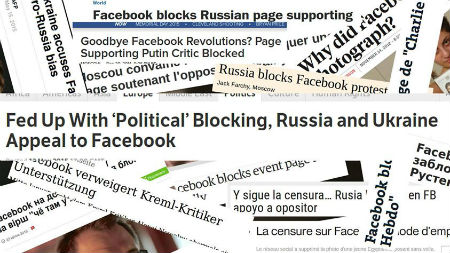
Moderators are rampant in Russian and Ukrainian Facebook. Removing posts for "bad words", blocking of top bloggers have become absurd everyday life. Prominent Putins in anger leave Facebook. But mostly liberals fall under the blow, which do not lose hope of reaching Mark Zuckerberg.
Almost 15 thousand people signed a petition against political locks on Facebook , but the administration has so far limited to unsubscribing, and the situation worsens every day.
Dublin censors of the Russian -speaking Facebook concentrated on the "language of hatred" - jargon words, which by which Russians and Ukrainians call each other. Even comic and parody texts and quotes of classics of world literature fall under the ban.
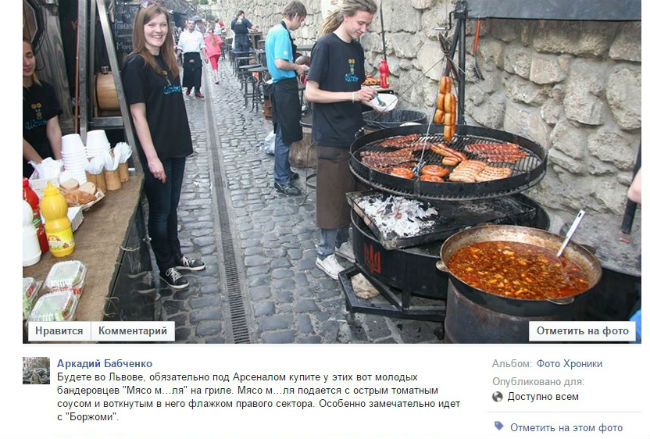
On June 3, journalist Arkady Babchenko published a photograph from Lviv, in which Grille merchants offered the public a dish called Moskal Meat. After 18 minutes, he received a message that he complained to him "for images of violence scenes, including the image of harm to anyone or something, or the promotion of vandalism." Babchenko replaced with dots several letters in the word "Moskal".
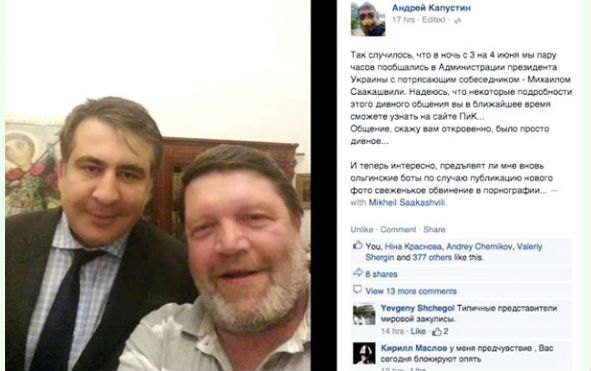
On June 5, the account of Ukrainian journalist Andrei Kapustin was blocked for a photo with Mikhail Saakashvili. Previously, Kapustina was already blocked, therefore, publishing this picture, he wondered if they would declare his pornography. The result was a month lock.
On June 29, the writer Eduard Bagirov used the expression "unfortunate crests" and was blocked for a week. On this occasion, the leadership of Roskomnadzor turned to the Facebook administration. В полученном ответе говорилось, что "слово "хохлы" в такой подаче подпадает под использование таких слов, как "ниггер" и другие, и нарушает правила сообщества".
On June 6, an hour after unlocking, Bagirova was blocked for another month: in his post, Bagirov reproduced the title of Izvestia newspaper: “Facebook began to block Russians for the word“ Khokhly ”. After that, Bagirov announced that he would leave Facebook and would use Russian social networks.
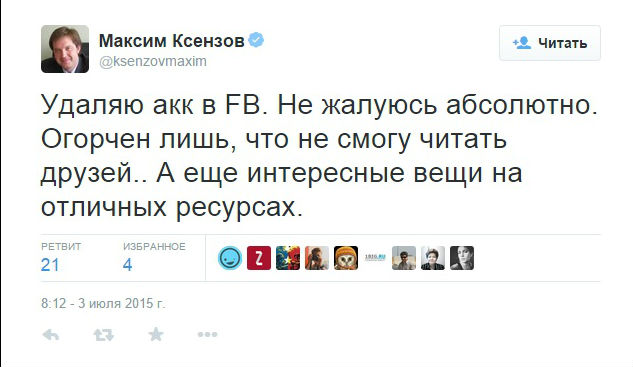
On July 3, Maxim Kzenzov’s deputy head of Roskomnadzor blocked the “Khokhlov” page. He also left Facebook.
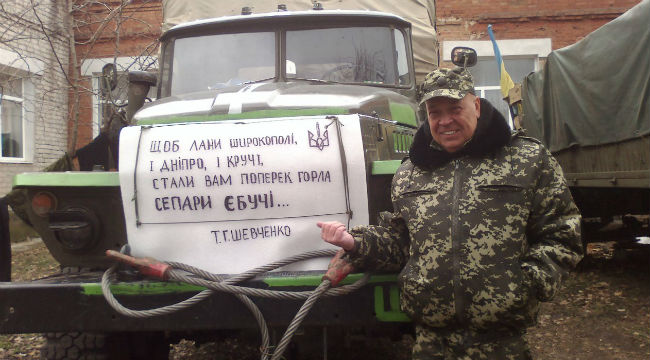
A whole series of blocking occurred due to quotes of classics of Russian, Ukrainian and American literature. On May 4, the head of the Lugansk Military Civil Administration, Gennady Moskal, was blocked for a photograph with a poem by Taras Shevchenko, in which one word was fixed:
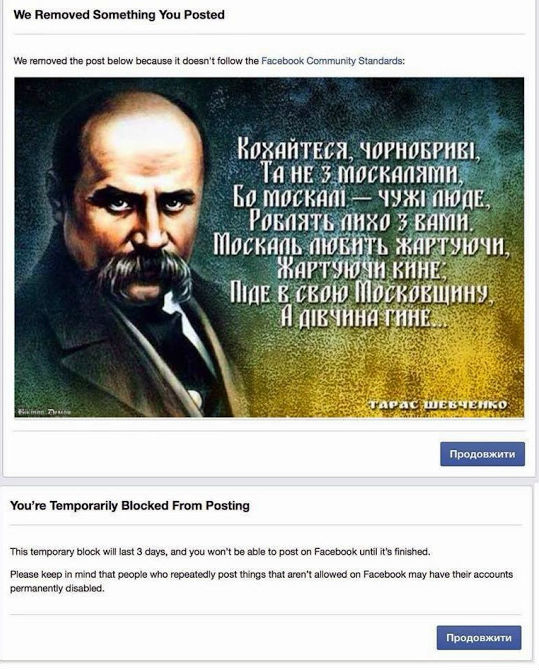
Several users also blocked another, literally quoted poem Shevchenko:
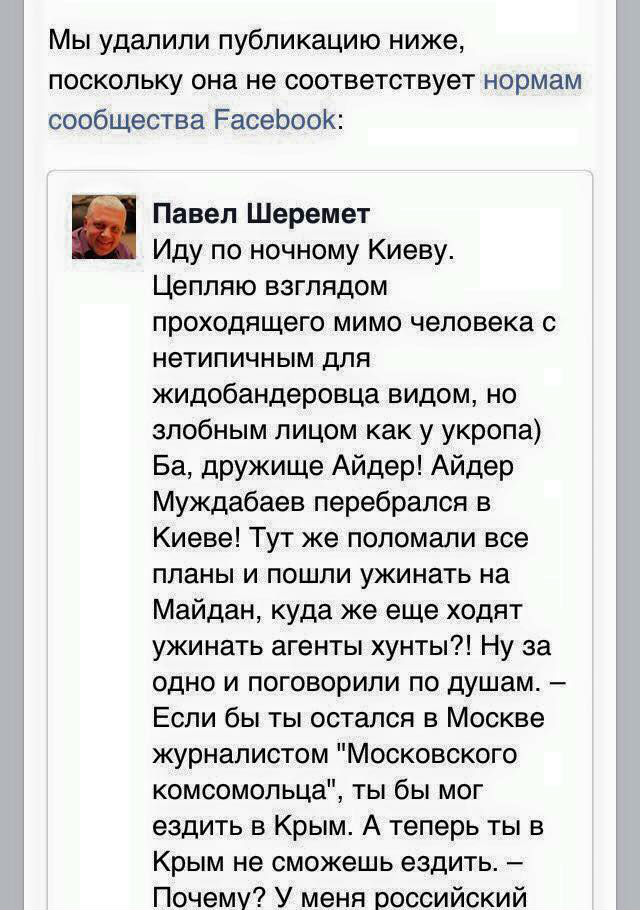
The IT facelor Andrei Annenkov conducted an experiment by placing quotes from Dahl, Gogol and Mark Twain, which mentioned, respectively, “CHOHOL”, “JR” and “Negro”. Annenkov asked the Ukrainian colleague to write a complaint about him, as a result, on July 2, the publication was removed. According to Annenkov, "here we have by no means curious, but a completely arrogant encroachment on culture." “It doesn’t matter why Facebook burns Gogol, Dahl and Mark Twain,” the author believes. “It matters that this obscurantism is akin to the obscurantism of the Nazi or medieval. The books cannot be burned, whether it is even“ Hammer of Witches ”or“ Main Campf ””.
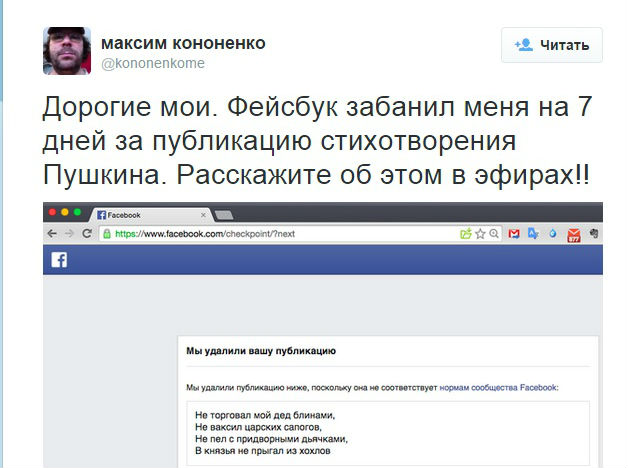
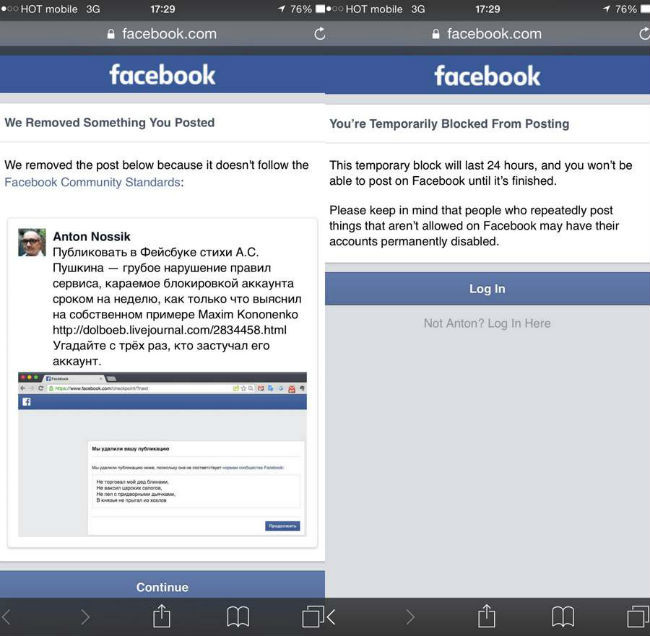
On July 6, journalist Maxim Kononenko also conducted an experiment and was banned for a week for publishing an excerpt from Pushkin’s poem “My Pedantine” (“He did not jump from the crests”).
Anton Nosik, who reported the results of this experiment, did not use the words "crest", but on July 7 was banned for 24 hours. As the nose itself suggests - "for doubts about the correctness of such a policy." Nosik believes that Facebook decided to "provide a defiantly low quality service in the Cyrillic segment, since" the Russian and Ukrainian market is not important to him. "
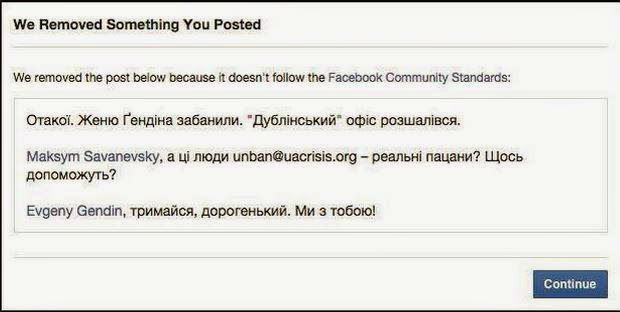
The users in which some users indicate the blocking of others, while themselves without using prohibited expressions, became commonplace.
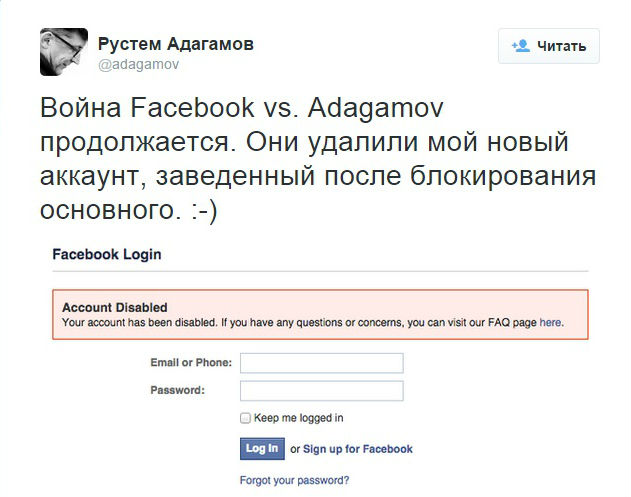
In the petition, against political locks, an example of unreasonable blocking that has already become a “classic” example is given. For a photograph of Norwegian Christmas tree toys, fake-on censorship blocked not only the main account of Rustem Adagamov, but also a spare, in which the top blogger urged to fight locks.
The representative of the Russian Foreign Ministry, Maria Zakharova, stigmatizes the "playful and very dangerous" censorship . The nose does not consider it possible to "teach Tsuckerberg how to correctly steer Facebook." “Facebook is a private enterprise, albeit a public company,” writes an Internet expert. “If its leadership has made a fundamental decision about the Cyrillic segment of the“ plague for both of your homes ”, then this is their purely and sovereign right.”
Such a decision is a serious blow to the Russian civil society, for which Facebook until recently was the main platform for free discussions and self -organization.