
Translated material
Rest as a skill

"It is not so easy to organize a worthy leisure for yourself, about which you will not regret that the summer has passed, but the void remained"
Summer camps for children have ceased to be a place of passive relaxation, in any case, those that were created in recent years, and did not continue Soviet traditions, when the camp was often (however) was considered as a way of vacant storage of a child.
True, the former non -enordity has been preserved - good camps with a developed sports base and numerous circles belonged to large prosperous enterprises, dull, with jelly and semolina - small and poor institutions. Today, a lot depends on the family budget, although the parent can choose in his price category.
True, in addition to financial preferences, now there are more important things that every parent should determine for himself: whether he wants to spend time with his child, and which camp is best suited to his child. The times of the general hobby of language camps have passed, and advanced parents perfectly understand that the holidays are a great reason to get out of the skills that their son or daughter personally needs at school.
About how the modern summer camps of Radio Liberty were arranged by the psychologist of the Center "Perekrestok" Artem Kondrashkin , the head of the Mosaicum laboratory Andrey Komissarov and the head of the "country of children" Philip Bakhtin .
"Mosaicum": camp as a game
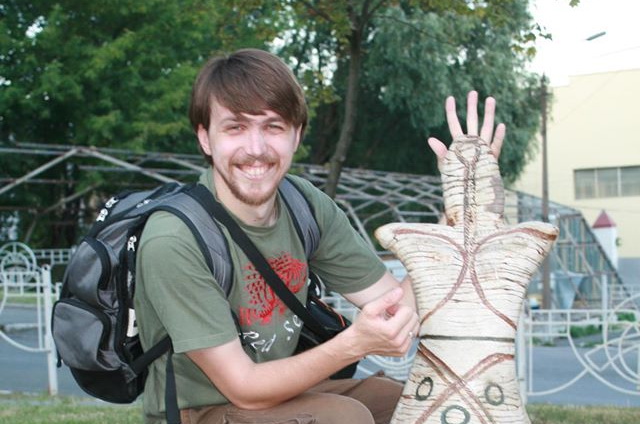
Andrey Komissarov :
- Our camp is also called as our laboratory - “Mosaicum”, and we are mainly engaged in the creation of interactive educational environments, the development of training games. Therefore, in the camps we use the same interactive methods, trying to involve both parents and children as much as possible. There is a separate project for older children, for younger children, for parents, but somewhere these projects intersect in the fabric of the game, somewhere they go separately.
Often in the relationship of children and parents there are problems that can be very well smooth in such a camp and show how to continue to work with this at home. Very often, parents suddenly see their child in principle in a new way, new relationships begin, and this is one of the main goals for which we started all these camps. For example, we are very actively contributing to solving the problem of computer dependence, gadget dependence, problems of asociality of children, transitional age, when parents sometimes completely lose contact with the child, problems associated with money, when children perceive parents as a wallet. We analyze all these things in detail and neatly in a playful way, and as a result, the communication of parents and children is much more interesting. In many families, after our camps, new children appear, because, of course, several children are much easier to educate than one is an indisputable fact.
We do different camps every time, last year, for example, there was the theme of the "creators of the worlds", and the children were divided into teams. And the game was to gradually create its own worlds, which would function according to the real laws of physics, logic. We went with them some things related to astronomy, geography, biology, their relationship, gave them the main system equipment, and all this went through the game through the theater. We have quite a lot of theatrical pedagogy, a lot of work through labor.
The camp of this year is called "Your Kingdom", and here children are also divided into teams, but this is already a role -playing strategic game. Each child has his own role, and this role is given after a sufficiently detailed testing, which shows which play role will be as comfortable as possible so that the child is completely revealed in what he likes.
If we talk about the theater, then parents and children always participate in it, and this is the improvisational theater. As for role -playing games, here parents participate at will. This year the main character is the king, and his courtiers are played by parents. And this will become an unknown element for children, that is, what is not included in the rules, and what is born by the efforts of parents during the game. The game lives his life.
"Kamchatka": camp as creativity
Philip Bakhtin :
- One of the features of our camp is that artists, directors, writers, and different creative people who are full of ideas work as counselors. We come with a finished program and offer the guys something new every day, 5-6 events per day. And we are trying to make the program in such a way that the whole team of counselors who work with children is most interesting to participate in this. That is, they actually come up with entertainment for themselves, and children are taken as associates for a joint occupation of different types of creativity.
It is clear that there are some restrictions, but the difference between children and adults is very ephemeral. The only difference is that adults, as a rule, have a little more experience in some situations and a little more techniques for taking out from them. We now work with adults using the same technologies, made a family shift on New Year's Eve, and I see that both children and adults have seen little in their lives, tried and with the same pleasure are admitted to all the adventures that we offer.
The restrictions here are the most universal. I understand that I can offer an adult group to go to a neighboring city, without caring about security, food, drink, it is more difficult with children. But there are very few such restrictions. All games, scripts, technologies that we offer are equally interesting to both children and adults, we specially care about it. For them, this is often the only time of the year when a common interest appears. Teenagers and adults at some point diverge in different directions, and children are interested in everything that adults prohibit. Finding a common place for co -creation and friendship is very difficult, and we offer them it.
The attractiveness of the family shift is precisely in trying to make a movie, participate in the play, play a thousand games - adults often do not have such an opportunity. Try to play with your child just to football in Moscow - for this you need to find a stadium, rent it, find a form, find a ball so that no one is late, collect money, pay ... This is a whole story! And we are much more complex games than football, we spend 50 shifts in 12 days. For them, of course, it is incredible enthusiasm and incredible intensity of interaction with your own child, whom you can only check whether he had left or without a hat for years, he ate or if he had a “three” in a quarter, and this is a forerunner of parental attention.
"Crossroads": camp as a skill
Artem Kondrashkin :
- The main idea around which we built a city camp was that its program is determined by participants. There are, of course, the boundaries of the choice, but then everyone decides what to do. Technically in the morning there is a point of choice when they think: today we have such options for the day, so where are we going? Swim or ride a bicycle? To the museum or to the zoo? True, all the same, several participants said every evening that "we do not like that you have a program, you drive us into the framework, and we want on our own." And we made so that one of the days the guys formed the entire program themselves. They made a list of places where they would like to go, and by voting they chose the most popular.
We have a base with which we go on a trip and where we return, where we discuss everything in a common circle in the evening. We made so that everyone could share the experience that he acquired in a day. Everyone is given some kind of task for the day-to observe the part of the city that we see every day, but we do not pay attention, for pedestrians, clothes, for cyclists ... and they are divided in the evening. For example, there was a task - to observe unusual signs, and one girl said: “I saw a lot of different signs today, and I really liked it, there it was written“ Heaven ”and an arrow up.” Such a cute detail of the city, which we usually do not notice, but there are many of them.
Our task, as psychologists, is to help the guys be friends, relatively speaking. Someone is better, someone is worse, but in general they can do it. You just need to create a safe supporting environment, and then they already do everything themselves. It seems to me that in our camp, rest is also a skill, because you need to learn to rest. It is not so easy to organize a worthy leisure for yourself, about which you will not regret that the summer has passed, but the void remained.