
Translated material
"Mount Olympus": Revolution endlessly
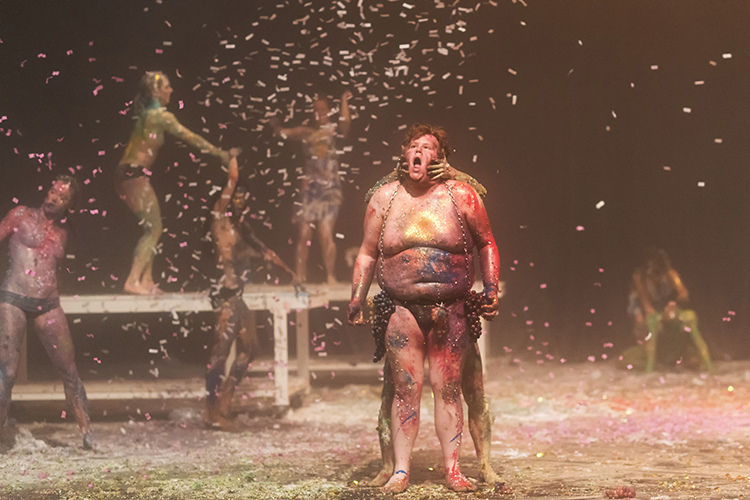
After the standing ovation was burdened in the huge hall of Berliner Festspiele , accompanied by a desperate Tverk artists on the stage and spontaneous dance of spectators in the stalls, on stage, shaking his hips, a wife -like Dionysus came out. "Do you think this is the end?" He asked. And he answered himself: "There should be no end at all." Then there was a crafty monologue of the Olympic: “ Enjoy your OWN Tragedy ! " Further, another ovation, gradually turning into Dionysian audience. Nothing of the main platform of the two most important theatrical festivals of the German capital - Theatertreffen and Foreign Affairs - had never seen before.
Now, when the incredible marathon of Fabra has become the property of the newest, but still stories, this deafening triumph seems completely logical. The experiment, meanwhile, could end a deafening failure. Simply put, he could end in an empty hall, and the Fabr was clearly ready for this outcome. He was pretty nervous all these 24 hours: he wandered along the lobby, drove away from the doors of the stalls of the spectators who went to the smoke break, restlessly examined the ranks early in the morning-does someone sit there or no? He played wa-bank.
The total revolution of Fabra is in the endless daily liberation from the Put. Including from the Put of New Freedom, new cliches, new convenient schemes, new slogans and slogans.
But now we can firmly say how the real theater avant -garde of the 21st century differs from its glossy, assembled, like a Lego designer, likeness or from a children's scream on the lawn. The real vanguard today is not only an experiment on the viewer. This is primarily an experiment on oneself. This is not only a test of the strength of ideological dogmas, art cliches, and audience preferences. This is a test of the strength of themselves. In the case of Mount Olympus , the check is also in the most direct, physical sense of the word. Fabra performers every now and then make traveled Hercules exploits on stage - they run to exhaustion on the spot, jump through heavy chains, shouting the river, and the “Grand Prix” of bloody ancient Greek disasters is stolen. They are agile acrobats and more resilient than the Olympic, even if not gods, but certainly champions. Only the champions are running to win and before victory, and the performers of Fabra - to exhaustion. Until they fall on the stage from fatigue. Then they come to their senses, get up and jump again, run, twist Fuete. The driven horses are shot, isn't it? You gratefully applaud the Fabra’s performers. The contemplation of their stage self -torture clearly has a catharsical effect. In any case, when they fell on the floor, there was a feeling that I myself ran (jumped, danced) with them. This amazing sense of ownership does not even partially give experiences about the fate of the unfortunate Oedipus or terrible incidents in the house of the atriads, which we will be told about here too. But, before analyzing what you saw, let's say a few more introductory words.
 © Wonge Bergmann
So, what you need to know about the play of Fabra besides that you already know about it.
1) He was rehearsed for a whole year.
2) it consists of 15 parts, each of which refers us to famous mythological plots.
3) The marathon begins at 16:00 and all 24 hours go without intermission - until 16:00 the next day.
4) you can enter the hall and get out of it at any time; A special bandage like a rag is tied into the hands of the audience - it becomes a pass to the Olympus Mountain.
5) At night, you will be offered sleeping bags in the hall and tents in the shady courtyard of the theater, and in the morning toothpaste and even a free breakfast, but it is not necessary to stay in the theater at night. You can go home and return in the morning. Only all the time it will seem to you that you missed something important. It will seem right. Fabr does not protect the most spectacular episodes for the Prime Time. He can put a stunning scene at six in the morning and arrange quiet meditation closer to the final. Yes, and the very consciousness that you are here (for example, in a hotel) go to bed, and they (on the stage) are still backwards, also part of his total performance.
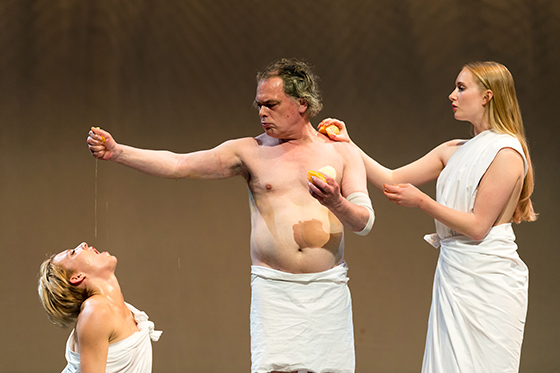
6) there are almost no costumes in the play. Instead of costumes - white sheets. They can become one, and a savana, and just a sheet - sometimes it is necessary to sleep a bit.
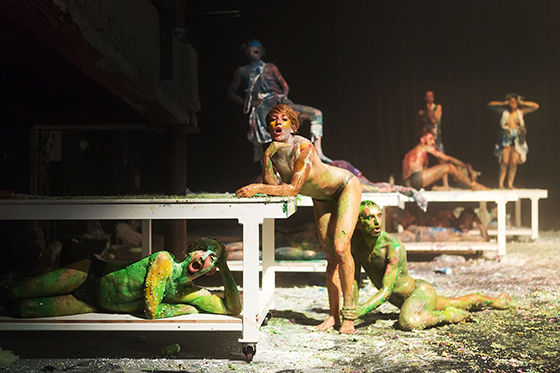
7) By the way, about sleep. The artists in Mount Olympus also have small recreation areas. Only they do not go backstage, as one could assume. They simply take sleeping bags onto the stage and fall asleep. Fabr - by the way, he is also an artist who ended the Royal Academy of Fine Arts in the Antwerp - so he puts stage light that even this post -removal rest of his Favnov fascinates. And many spectators remain in the hall during unnecessary intermission, contemplating how the participants of the marathon are peacefully sniff in sleeping bags.
 © Wonge Bergmann
"Mount Olympus" genetically dates back to the two other famous opuses of Fabra. The first of these works is the world's aatrical fame “Theater Madness ” released in 1984 and brought the master of theatrical extreme fame . Power of Theatrical Madness " ). He was not twenty-four, but only four with a small hour, but the repeatability of exhausting physical actions also underlyed it. The artists awarded each other in the face, beat the plates, undressed and dressed, fell, got up again and now and then shouted the names of the great directors of the twentieth century. In the “Theatrical Madness”, the Fabr debunked the factory of illusions called theater, and at the same time respectfully bowed his head in front of her. Any most absurd action, he insisted, acquires a sacred, more precisely, quasisacral meaning if it is performed on the stage. Theater illusion is one of the most powerful illusions in the world. But this is still an illusion. She subordinates us. She manipulates us. Wagner, who brought it to perfection (after all, he came up with the light to turn off the effect of the effect in the auditorium), was honored with the Fabra of special attention: the performance ended with the tango scene , which under the Wagnerian “funeral march of Siegfried” was performed by a couple of naked monarchs. The power of theatrical illusion must be brought to the point of absurdity in order to understand its power. And then you need to overthrow it, as they overthrow kings and tyrants.
Following theatrical illusions and cliches, Fabr encroached on life illusions. The second performance, which, of course, rises “Mount Olympus”, is, of course, “an orgy of tolerance” (2009), an eccentric whirlwind that refers once to a sexual revelry in the spirit of the Marquis de Sad and to the Pyelinov -style “satirikon” in the style of Petronyev. The artists in the orgia metaphorically copied with a bag L Ouis v Uitton and metaphorically seduced the CHEsterfield sofa, arranged a photo shoot with the Savior, which the zealous designer tried to put a cross in his hands more beautifully, and reached the peak in the scene of surrealistic children. Three pregnant women, puzzled on store trolleys, in torment - shouting and moans - were allowed from burden with a means to clean the toilet or a weighty piece of ham. And then all together circled in these same carts under the "Tales of the Vienna Forest."
 © Wonge Bergmann
In the “Olympus”, mythological characters intercede in the place of inhabitants. But it turns out that they are no better than you and me. And if you look in the eye, so, perhaps, worse. All their great establishments, all their valor, all their heroism and, in general, all the revered “classic” now-this is just painted wildness. Antique myths collected in one long series do not cause sacred horror, but a banal scrap. Beligation, children and materials, dissected, hecatubes, human sacrifices committed by heroes when connivance, approval and direct complicity of the gods- here it is, your excellent antiquity. Achilles, Ajaks, Odyssey, living with illusions about glory and male valor, are as similar to heroes as bloody butchers. Pieces of meat are scattered here everywhere. The artists pull them out of the bosom, beat them in their chests, put them on a white sheet, impregnate them with blood toars and savana. The orgy of tolerance continues, only now it becomes bloody. Everyone can be killed, everything can be copied with everything. Even with flower bushes. Fabra artists are almost always naked and almost always ready for sexual joys. For nothing, or something, on his Olympus, a mocking Dionysus refuel everyone.
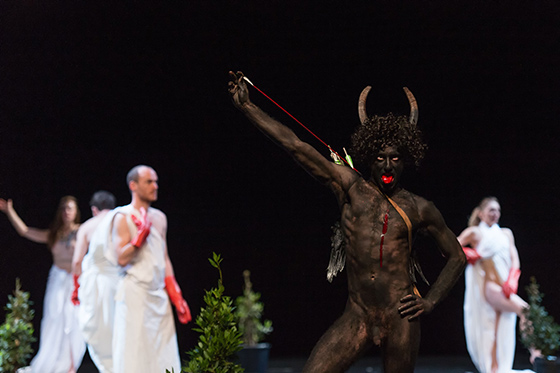
" Mount Olympus " is, of course, Paradise " Paradise Now » Famous The Living Theatre . But the Fabr does not just hold out the hand of the vanguard of the 1960s, it goes on. The avant-garde of the 60s defended freedom with truly bestial seriousness. The Fabr shows how freedom itself hardens the person. How he becomes her hostage. In part, this thought sounded already in Richard Shechner, which was set in 1969, which was set in 1969, but it was only a foreboding, a foreboding of the threat. And the Fabr is diagnosed. His Dionysus is not just a god. He is a true lord of this world. It is more important than Zeus and cunning Hermes. It has the charm of Sabbath, murderous irony, suicidal misanthropy, bewitching energy and dangerous ambivalence.
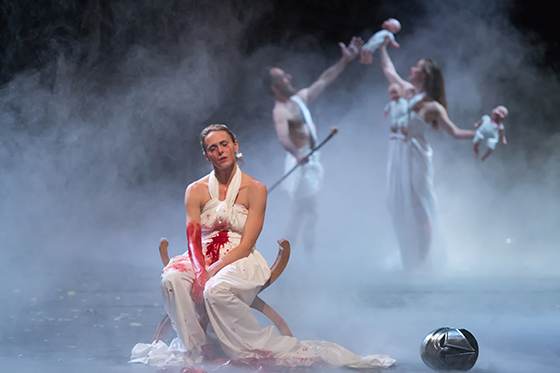 © Wonge Bergmann
At the dawn of the cinema, the Great Griffith struck the world with “intolerance”, clearly and aesthetically stunningly showing how destructive for humanity - for its history and morality - this is the same intolence . Almost a century passed, and tolerance finally took its own. A person not only should not be shy of his obscene urge - he must even be obliged to obey him. And the more often, the more bore, the more selfless, the more heroic. Tolerance has become a European symbol of faith. Total psychosis. Fabr told us about this in his "orgy tolerance." And in “Mount Olympus” he showed how the advanced European consciousness closed with the bloody and heroized archaic.
He laughs at the machism of ancient plots, where the gods and heroes every now and then are measured by the detergent organs. And then his fragile Electra goes on stage, and between her legs the member dangles: female nature is sacrificed to the laws of the masculine world.
But in the same way he laughs at the feminism of our time. And then a masculine Clytemnestra, drew up under Maria Callas, whose divine voice sounds at that time a phonogram comes to the stage. Clytemnetra talks about how men usurped women rights, but when she lifted the hem of the dress, we see that her legs are no longer dumped, but a real male member.
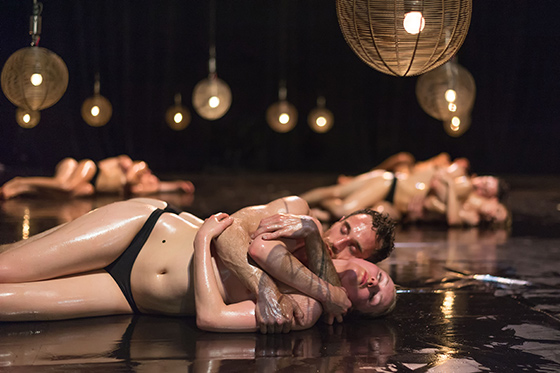 © Wonge Bergmann
The whole performance of the Fabra is endless shifts: tolerance is reflected in non -recovery, feminism in patriarchate, the past in the present. Everything that was recorded on the tablets turned out to be a bloody trash. But what is written on top of the old records is also no good. Does this mean that we need new tablets? Of course not! This means that any recording is soon or later subject to revision.
The total revolution of Fabra is in the endless daily liberation from the Put. Including from the Put of New Freedom, new cliches, new convenient schemes, new slogans and slogans.
In the performance, it seems that the idea that a dream is taking away part of our life is not related to a bloody whirlwind. But she is not accidental. In essence, the grandiose anti -utopia of the Fabra is one of the most utopian projects that I had to see. The frantic Belgian is so cynical that he does not believe in any of the slogans, and so naive that he believes in the eternal transformation of the world by the power of art. In the ability to change it not on mental even, but at a physiological level. You just have to stop. 24 hours is not the limit. This transformation, according to the sly Dionysus, should not have the end.