
Translated material
Greek porridge
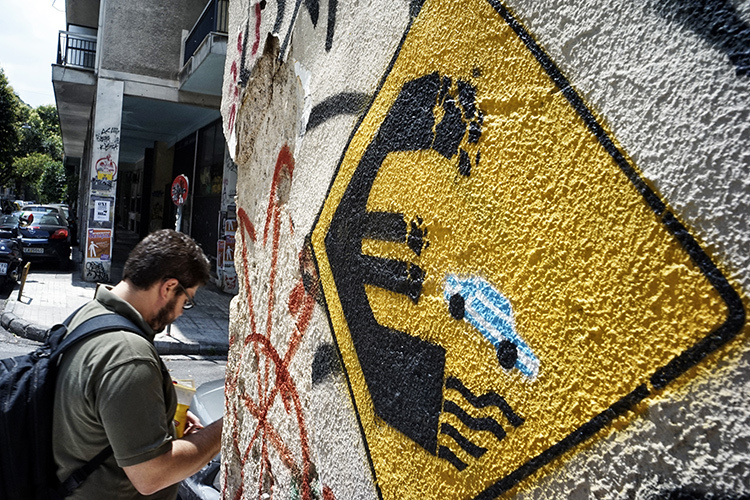
Regarding the events in Greece in world media, complete chaos reigns, the collapse of the information system on the verge of hysteria. It seems to me that it would be nice to clarify a few points. I do not pretend to be an expert assessment, but at least some gaps in the coverage of the Greek crisis hope to make up for.
The history of events is described in sufficient detail here . Like any economic crisis, its roots are political: it is not a population at all signed agreements with international creditors. Since the end of World War II, the country has been in a very uncomfortable political limb: a buffer country between East and West, one of the key participants in NATO, a powerful movement of communists and socialists for decades opposed the conservative religious majority in the province of the country. This confrontation led to open bloodshed during the ultra -right junta of “black colonels”, but even after its overthrow continued to make itself felt. For decades for decades, the dominance of several political elite clans has been supported with a certain share of artificiality in the country, the economy has passed from brief periods of boom (in the field of marine transportation) to long stagnation periods.
In this state, Greece in 1999 entered the eurozone, adopted by its other participants, again for political reasons. The government has lost control of an important lever of influence on the economy - inflation. Quickly enough in the budget, holes began to form, which the authorities preferred to close the most affordable way for them - through preferential long -term loans from European banks, mainly German (in particular, Bundesbank). An interesting detail: international audit agencies have repeatedly noted how opaque and, most likely, the credit reporting provided by the Greece Government is unreliable. Nevertheless, this did not prevent banks for many years with suspicious self -confidence to provide Greece with giant loans. This self -confidence was based on the fact that the European Union served as the guarantor of the country's creditworthiness - and it was from its general tax box office that banks initially planned to get their money back.
From the very beginning, Siriza was ready to accept European loans. The International Monetary Fund also planned to extend the credit period of the debtor country. Since both sides agreed the a priori - where did the excitement come from?
Thus, in reality, the global financial crisis of 2008, when the most profitable sectors of the Greek economy - tourism and cargo transportation - went bankrupt, and the country's credit rating fell from A+ to VBV, played only a formal role. “Extend and PretenD” - this name received in the lips of economic experts the continuous infusion of money into the Greek economic bubble, and according to the general plan, it should continue to continue unhindered - only now at the expense of European taxpayers. The key condition was only the preservation of the accommodating political elite, ready to participate in this scheme and sign any necessary agreements “in the name of saving the country”.
For decades, the country has been ruled by a triumvirate of three parties, which were in opposition to each other, but in a dense way connected with each other. The New Democracy party plays a role that the “Christian democratic” parties of the establishment play in the rest of Western Europe, albeit with some reservations: as they often say about them, these are “right-wing conservatives with an admixture of gallism”. The second ruling party-Pasco-Social Democrats. In the same way as most other social-democratic parties, they were formed as an “acceptable alternative” extremely influential from the Second World War of the Communist Party of Hellas. After the fall of the dictatorship, the Pasco was in power for the longest time, the real dynasty of the prime ministers-Papandreu was associated with this party. It was Georgios Papandreu that was in power in 2010, when it was time to sign the papers for a loan from the European Union - which he did successfully. The decision was so contradictory and unpopular that he even openly made the initiative of the national referendum "take or not take a loan?" (yes, it was then that the idea of the referendum sounded for the first time)-and then immediately took off his authority and washed his hands. Then the referendum did not take place.
The third batch of the establishment, “sweets”, appeared only in 2014 as a project of “left -barrel” alternative and attracted votes through anti -corruption rhetoric - while it was strongly connected with two other parties and invariably entered the coalition with them.
Thus, oddly enough, all three main ruling parties, which replaced each other at the helm of the country's leadership for 30 years, position themselves as left. Left conservative alternative, left social democratic alternative and left liberal alternative. An alternative to whom is clear. The Stalinist Party-Rogue, the KPE, which is gaining stably its 10 percent of the votes in all elections and always occupies the position of non-proceedings and denial (which, most likely, predetermines the fidelity of its electorate).
A referendum is not about the whip and not about the gingerbread. Then why was he needed at all?
Finally, a few years ago, the fourth alternative began to be issued on the political scene. For the past ten years, the “coalition of the radical left” devoted to the fact that she gathered around her various political groups that had not entered for some reason into the framework of the established system or broke away from it. Its composition is very heterogeneous - there are people with the Trotskyist, and with Stalinist, and with anarchic, and with a patriotic past. In fact, this is an artificial front of outcasts preparing to take the parliament with a taran during the crisis - and they succeeded. In 2012, Siriza became the main opposition party, and at the election held in January, she almost gained a parliamentary majority and, in coalition with National Populists from the Little Party, “Independent Greeks”, the government formed. It was this “breakthrough” that became the real reference point of the current situation: it was obvious from the very beginning that the EU functionaries would not want to negotiate with these people, and if they want, the representatives of the “Siriza” will have to accept the conditions incompatible with their election program with which they won. The national referendum was an ideal way out of the situation, and both parties unequivocally benefited from it.
What was the referendum in reality and what consequences can we expect now?
Naturally, Siriza from the very beginning was and remains ready to accept European loans on almost any conditions of saving measures. This became known on Thursday before last, when an open letter of the Prime Minister of Tsipras was published to representatives of the European Commission and the International Monetary Fund. In turn, the International Monetary Fund immediately published its report on the state of Greek debt, in which he unequivocally indicated that the “haircut” of the debt and the extension of the credit period were planned by him in relation to the debtor from the very beginning. Obviously, the intrigue does not concern money at all, since both sides of a priori agreed with each other: where did the whole excitement come from?
I made an interesting observation in the Athenian press center, to which the journalists who illuminated the referendum were attached-there were hundreds of them, and all seemed completely confusing. On one of the walls of the hall hung a cyclopic scoreboard, which simultaneously broadcast the news of nine main Greek channels. All these channels are private and belong to companies affiliated with three parties of the opposition, former ruling. The collapse of the economy was predicted on all channels, the exit from the European Union and seriously discussed the threat of national security. At the same time, the official reports of the press center was the Siriza information service. All this together was a parody of the power of new media. Within four days, all world media have received the official point of view of the government - namely the endless line of exalted tweets about the dignity of the nation and the call of the Euroburocrats along with jokes and photojabs. Representatives of information agencies repeated all this - and in combination with messages from the TV, all this created an apocalyptic picture of panic and collapse.
Naturally, in fact, life in Athens goes on its own way, I saw the city many times and in much worse state. There are famous queues for ATMs in the center, there is a person there are five, approximately like in any other city on weekends. I did not see the ATMs in the sleeping areas of the queues. Products in stores have become a little more expensive than last year, but not catastrophically.
Instead of relaying nonsense, I talked with people from the leadership of the warring parties in Greece and was even surprised how pragmatic they were. Representatives of Siriza again assured me that the government was ready to accept “strict standards of savings” in order to achieve an agreement with the European Central Bank. Representatives of the opposition calmly said that if the current government does not succeed, replacements in the office will be replaced, the coalition government will be formed, and it will be re -go to negotiations and will certainly receive money. At the same time, the opposition will not object to Tsipras remained against the nominal prime minister: after all, this is the choice of the Greek people, and there is no money for new elections now.
Hearing my question how Greece plans to repay debts, the speaker of the Poti party was surprised: “What you are asking about - this question is not worth it!”
This is an absolutely sound position: Siriza itself, as already mentioned, consists of many different groups, and behind the back of the charming premiere are people who are deep in 50. The secret of Siriza (which she herself does not like to advertise) is that she is not such a young party. After 2012, a continuous stream of people from the PACS, who lost popularity after the years of the crisis, went to it: this applies to voters (in the next elections, “Siriza” scored exactly the same amount of more votes as she lost), and functionaries. Sustainable rumors cruise that a week before the referendum, a powerful moderate fraction in the party tried to achieve the cancellation of voting - they say that it almost reached hand -to -hand. The opposition can easily agree with these people, and the fact that the European Union is probably ready to talk with the coalition government, confirms the fact that the President of the European Union Jean-Claude Junker last Thursday even gathered an emergency meeting with the leaders of the opposition, his former partners.
That is, in reality, the referendum is not about the whip and not about the gingerbread. Then why was he needed at all? The answers suggest themselves. Sirise was needed to obtain a symbolic mandate from the population. Now, whoever has to re -introduce a “economy policy” - the current or coalition government, Tsipras will only divorce with his hands. The opposition, that is, the three former ruling parties, used the hysteria around the “Greek disaster” in order to prevent new people from the “Siriza” in the domestic political arena - and actually return to the management of the page.
In a more general sense, against the backdrop of a crisis in Greece, another “reboot” of the “left” occurred (whoever ranks himself to them, including the former ruling parties). But not only initiative people from the fading pasket, but even the reformists from the Communist Party, also now tried to enter the establishment - and thanks to the successful outcome of the referendum for them, it seems that they succeeded. And most importantly, this is not the first time that is happening: none other than the current deputy prime minister Dragasakis, then the member of the Communist Party, was in 1991 the mediator of negotiations between the Great Compromise-when for the first time in the history of the Communists entered the Government of “New Democracy”. The then office did not last long and fell apart due to internal contradictions-after 20 years, Dragasakis seemed to achieve his.
One of my interlocutors, a lawyer of an international company, is actively gesticulating: “These communists in the old and new appearance must finally be eliminated from government! All the years after the dictatorship, they somehow influenced our policy, inhibited the development of the country. Because of blackmail and pasco, and the “new democracy” had to constantly make concessions-we have never even had a real right-Clibal party! ”
The foreign policy consequences of this cunning chess party can be quite large, but in the long term. As for the Greek debts - to my question, how Greece plans to give them to its historical growth of GDP of 1.5-3 percent, the speaker of the Puti party was surprised: “What you are asking about - this issue is not worth it now! In any case, we will have the deadline for paying about 30 years - during this time anything can change in the world, asking about it is simply naive. ”