
Translated material
Postfold state
Europe is ready to continue negotiations with Greece
“The agreement is still possible. France wants Greece to remain in the euro zone, ”said President Francois Hollande, clearly referring not only to France. On July 12, the leaders of the EU countries gathered for an unscheduled summit in Brussels to study the “new proposals” of Athens to fill the budget. But even a cursory gaze is enough to understand: no real reforms are talking about in them 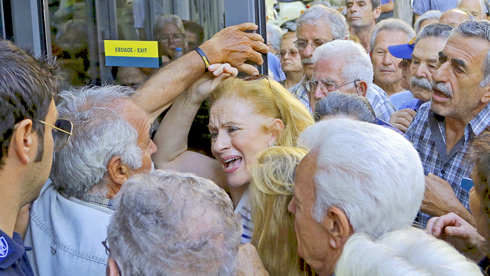
The “Tsipras Plan” of the All -Greek plebiscite, in which the opponents of the agreement with creditors gained more than 61 % of the vote (voted “for” a little more than 38 %), decided for the left -winging cabinet of Alexis Tsipras a number of problems.
Firstly, he “formally” justified by Greece on June 30 default in front of the IMF, when Athens did not pay € 1.6 billion, and thereby opened the path to non-payments for other obligations. Secondly, he confirmed the mandate of the confidence of the Greeks himself Tsiprase and set the cross on the hope of Europeans to see a more reasonable negotiator. Thirdly, he transferred from the government to the population responsibility for the consequences of the probable economic devastation. And fourthly, in many ways prepared public opinion in Greece itself for the country's exit from the euro zone.
Today's tactics of Cipras is obvious: to ensure the most unfavorable scenario for the development of events as a pressure tool on creditors. It is quite natural that instead of “48 hours”, for which Tsipras was going to agree with them, after the referendum, he turned out to be almost a week only to formulate new proposals for budget savings. And although some of the proposals can quite satisfy Europeans, for example, an increase in VAT on hotel services (in Italy and France, such a tax is 10%), the preservation of benefits for the island part of the country (where 11% of GDP is created) and the stud (navigable) companies, as well as the invariability of pension provision principles, give little hope for the success of negotiations.
You can be sure: in the end, Europe will not give consent to the new plan of Athens, and Greece will begin to plunge deeper into default for all its obligations. It seems that this is the “Tsipras Plan”: the situation both around the country and inside it will continue to inflate for at least another few weeks, if not months; The default looks more and more obvious, and against this background, Greece's obligations begin to become cheaper, and lenders (as they are calculated in Athens) - become more accommodating.
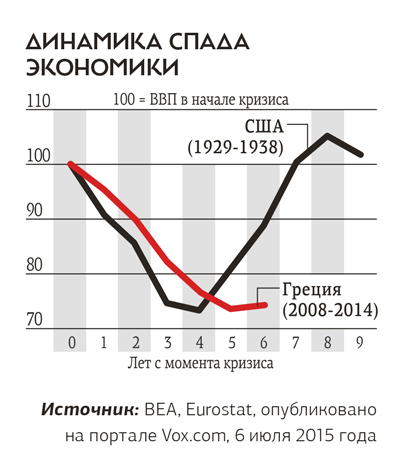
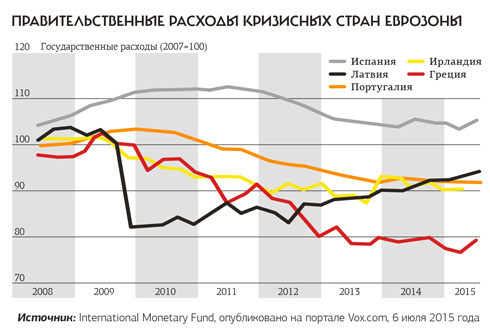
“Temporary” - constant over the rest of the year, the Greece economy will be in free fall. In July alone, the decline to the corresponding period last year will be at least 15% due to the paralysis of the financial system. Tax collection will fall by at least a third due to the desire of citizens and companies to “delay” their euros. By the end of the summer, a serious shortage of imported essential goods can become a reality.
In the EU, such a development of events will cause a sharp rejection of new plans for the settlement of Greek duty. Whatever they are, these plans will assume new loans to the country in exchange for promises to reduce expenses. But the problem is now different: in the chaos situation, no initiatives to reduce pensions or costs of maintaining a state apparatus will ensure the growth of the budget surplus, since tax collection will be sharply reduced. Therefore, Europeans, most likely, will consider that any new proposals of the Greeks are simply unrealized.
In addition, a serious group of countries has developed in Europe (Lithuania, Finland, Slovakia, Holland and partly Germany), in which Greece from the euro zone exit the right option. The head of the European Commission Jean-Claude Junker also stated on July 7 that Brussels had a detailed plan for this case for a long time. Therefore, the most probable: at least. Over the next month, no settlement of the problem named Greece will happen - and this will turn the “temporary” state into constant. As a result, the fall of the Greece economy only in 2015 will be comparable to its reduction over all the previous years of the crisis.
Drahma or Euro? Although Tsipras and its supporters emphasized that the referendum does not concern the issue of Greece in the euro and the European Union, this was a clear crawl. According to the regulations of the Eurogep (
It includes the heads of the financial departments of the Eurozone countries. - NT ) cannot exclude Greece from the euro zone, but Europeans will probably do a lot to make the country take the first step, although the question of the euro is in practice is much more complicated than often it seems commentators.
The most likely seems to the Greece out of the mechanism called the Eurosystem (Eurosystem) and unites the ECB and the Central Bank of the Euro zone. The presence in Eurosystem allows its members to influence monetary policy in the euro zone, participate in monetary issues, count on emergency credit lines of the ECB. The exit from the system in practice will not mean immediate abolition of the euro and replacing it with the old or new drachma. It is different here: Greece will no longer be able to count on the help of the ECB or participate in the development of monetary policy. I would estimate the probability of implementing such a scenario before the end of the year at 70%. At the same time, the euro will remain the Greek currency for a long time: the transition to drachma is technically extremely complex, and is not very popular. Under the new conditions, the Greeks will be forced to introduce currency control and (at least for a while) to restore customs inspection at the borders - the rest will depend on the circumstances. Of the 70% probability diverted by the exit from Eurosystem, I would put 40% on the fact that Greece will introduce a new currency, and 30% - that it will continue to use the euro “by default”, as does, for example, Montenegro, which used the German brand as national currency, and then the euro (and has passed in the republic as part of Yugoslavia to the candidate to members of the members EU).
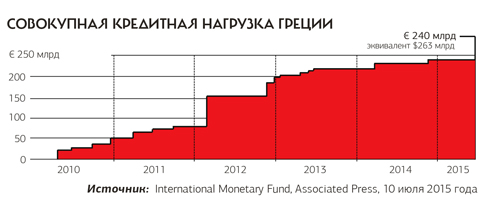
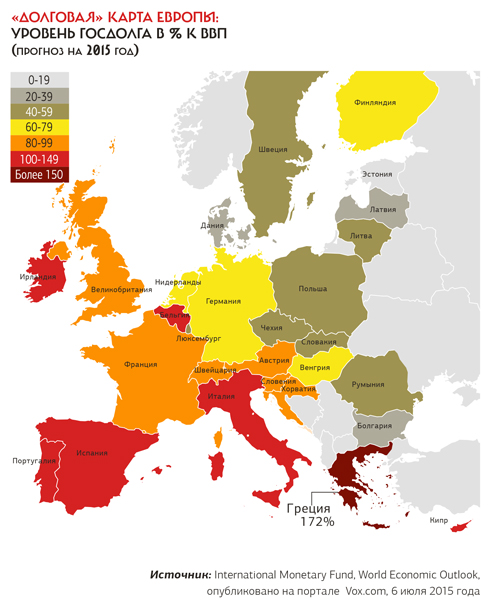
I would determine the probability of maintaining Greece with a full member of the Euro zone in 30%; Such a scenario is bad for Europe, where many will be able to count on the “effect of forgiveness” in this case. In any situation, Greece will not be able to improve its financial situation after six months of the “zigzags of Tsipras”, which means that the euro will be under pressure for many years, which no one needs. The only option for maintaining Greece in the euro zone and the non-blessing of the problems of this zone is at least a 75 percent debiting of Greek debts, which Europeans are not ready for.
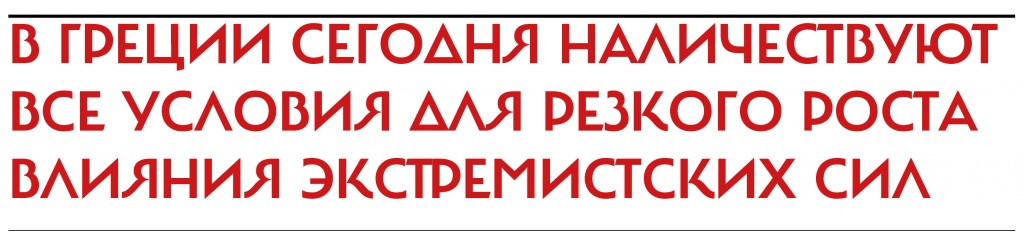
The threat of radicalization is the most uncertain, and the most intriguing, which constitutes the latest events around Greece is political. In the country today there are all conditions for a sharp increase in the influence of extremist forces: for their coming to power, the simultaneous decrease in living standards, economic collapse and pressure of external creditors are quite sufficient.
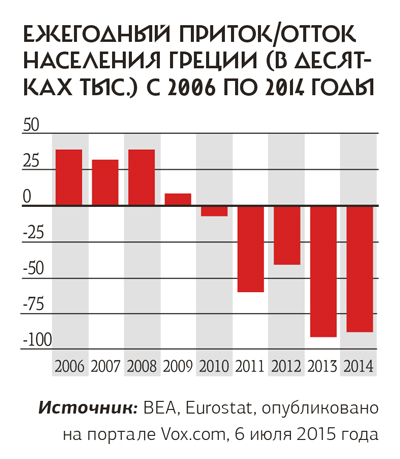
Let us not forget that Greece only 40 years ago got rid of the “black colonels” - a military dictatorship, and still far from old citizens remember the need to obtain permission to travel abroad, a ban on foreign currency deposits and many other “joys” of authoritarianism. As Russian experience shows, the memories of the recent past - even depressing - are far from always acting from populist demagogy. Already in 2013-2014, almost 100,000th annual outflow of the population was recorded in Greece, and in 2015–2016 it may turn out to be 3-4 times more: having euros and the right to leave, wealthy and active citizens will quickly leave the country (I remind you that 400 thousand people left Russia in 2014 with an average indicator of 38 thousand in 2009-20 for Greece). As the Greek society is archaicized, the number of fans of the New Dawn of the National Stock Estimated Party and the most radical elements of the same Tsiprasisov Siriza will grow, and the appearance of them at the helm of the country from which the best people flee is quite realistic.
Of course, such a turn will cause a tough reaction from the EU (we can recall that in 2000, Austria was actually removed from participating in the activities of pan-European institutions due to the entry of representatives of the extreme right-wing party of freedom-and there is soil for more radical forces in Greece), which ultimately can even lead to the exclusion of Greece from the European Union.
Of course, I want to believe that the situation will not become irreversible, and in one form or another, the solution of the current problems of Greece will be found. But no faith in the best should replace the rational analysis of what is happening, and he suggests: populism, which underlies Greek problems, penetrated very deeply into the fabric of local society, and without “surgical intervention”, painful and fraught with complications, it is already impossible to get rid of it today.
From the experience of life without money “throughout Greece, people occupy small amounts from each other or pave jewelry to local usurors,” says the television journalist Eleni Lazaru from Athens. - The level of sales in most retail chains has fallen sharply over the past two weeks - according to some estimates, up to 60%: today even in Athens, not to mention provincial cities, it is difficult to find pasta, rice, legumes, olive oil - the frightened population sweeps everything out. Many grocery companies turned imports in anticipation that prices will soon take off to heaven. ”
Interruptions are already beginning to affect the lives of remote island territories: “We still have enough food, but the infrastructure is already suffering: the hotels have not enough essential items for tourists,” says Nikos Stepanis, mayor of one of the towns on the island of Samos.
Payments on credit and debit cards are often not passed, it is not possible to take relatives abroad: external financial transactions from the end of June are banned. Every day, the authorities introduce some new restrictions. In the same line, the ATM has both the rich and the poor. However, Internet payments are still functioning, but mostly wealthy people use this.
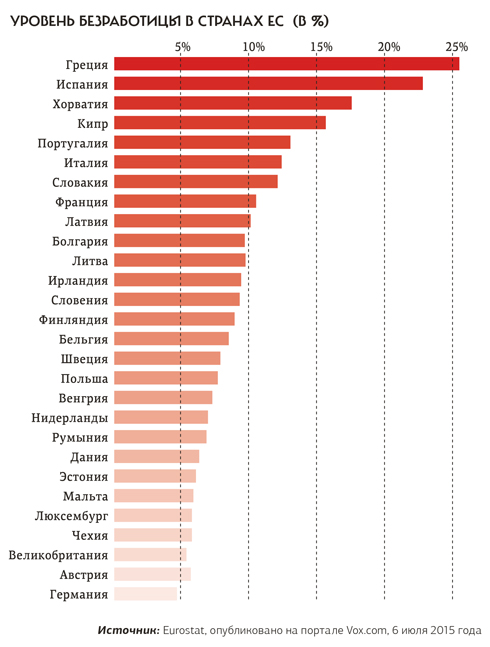
In the country, 1.5 million unemployed, 3 million live behind the poverty line, less than half of the 11 millionth population is working, but you have to forget about regular salary. And so - for three years ...
Entertaining factology
▶ salaries in the Greek public sector are 3 times higher than salaries in private companies. With less than 5 million of the active population in Greece, there are 750 thousand officials or 1 official for every 7 people. Over the past 10 years, 300 new state -owned companies have been created in Greece.
▶ Tax debt in Greece, according to the OECD, is 89.5%: the Greek state has the lowest tax collection in the EU. The unemployment rate exceeds 25%.
▶ Greece is 3 times higher than Finland in the number of teachers per student. At the same time, performance in Finland is the highest in the EU, and Greece ranks first in terms of the number of failed training tests.
▶ The daughter of the deceased government officials who did not have time to marry a lifelong allowance of € 1000 per month. The number of beneficiaries of benefits today is 40 thousand.
▶ Pacemakers in Greek hospitals are purchased at a price of 400 times higher than the same equipment in British hospitals.
▶ A male greens can retire at 55, and a woman at 50, if their profession is associated with “harmful working conditions”. The official list of such professions consists of 600 (!) Points, including hairdressers, radio and TV presenters, waiters, demonstrators in music instruments, etc.
▶ In Athens, the Institute is operating on the problems of preserving Lake Kopais, in which 30 people work. At the same time, the lake itself was artificially drained at the end of the 19th century.
Based on the materials of the foreign press
Photo: Stefanos Rapanis/Reuters