
Translated material
1915 - A hundred years later
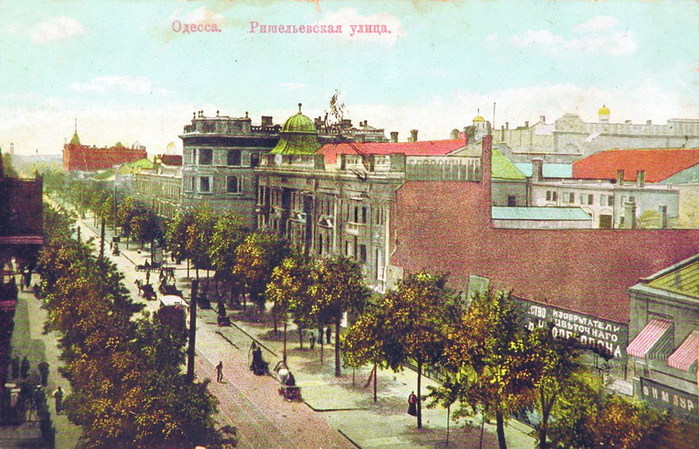
Odessa phenomenon: Babel and virtuoso
Alexander Genis: On the air - a new release of our cultural and historical cycle:
1915 - century later:
Paradoxes and parallels
Faulkner said: "The past is never dead. It has not even passed."
Having taken the famous aphorism into the epigraphs of the cycle, we plunge in the eternally living time of the past, which has reached us in the form of historical events, artistic movements, musical directions, fateful books and an important part of each transmission, which, perhaps, are best able to convey the spirit of time.
Looking into the past, we are not looking for escapism, allowing us to relax in the long -past, but lessons that allow you to better understand the present and look into the future.
The traditional questions that these transfers ask the past sound like this:
What happened?
What happened?
What could be?
(Music)
Alexander Genis: Solomon, I propose this time to go to Odessa. A hundred years ago, very important events related to the cultural life of Russia occurred there. And it is good to return to this time and place today, because Odessa is again on everyone's lips, Odessa today in newspapers, Odessa in the news. Since the governor of Odessa was appointed Mikhail Saakashvili, Odessa has become an experiment: is it possible to overcome the post -Soviet spirit, is it possible to lime corruption, is it possible to make what it was from Odessa - a legend?
When did Odessa become one? This question cannot be answered for sure, because all this is not related to one year. But in 1915, a fateful event took place in Russian culture, in Russian literature, in any case, namely, the birth of the writer Babel occurred. It was the Babel of 1915 Babel began to write, his first stories appeared, the literary career of Babel began at this time. Therefore, I propose to take Babel in order to talk about the phenomenon of Odessa, about Russian culture.
Solomon Volkov: Indeed, Odessa is in many ways the city is completely unusual, which can be compared according to its cultural value, if not 100%, then to a large extent with two centers - with Moscow and St. Petersburg.
This city created its own special subculture. First of all, this is due to the fact that Odessa was a port city where a very active connection was carried out with the West, France, with Italy. The merchants in this city, and indeed rich people made up a special caste, they were well educated, they knew languages, they imitated very actively Europe, arranged, if you like, life competitions with the well -known samples of the Western European bourgeoisie.
Alexander Genis: It is very important here that many of them were Jews.
Solomon Volkov: Not only. There were Greeks, there were immigrants from Italy, from France.
Alexander Genis: This is all true, but it was a city where the Jewish layer was very significant. Why am I so pressed on the Jews, because it seems to me that in Odessa this layer of educated merchants formed “bourgeois” recreated the situation that developed in Germany, where the Jews were very active in the field of culture. Why did this happen? For obvious reasons: since the Jews were on the sidelines of both social and political life, they compensated all this with culture, the culture was concerned about the path up. This was very affected by the development of Germany and in the same way it was in Odessa. Culture meant prestige, culture made it possible to social growth, it was such a social elevator that quickly - for one generation - lifted upstairs.
What you said about foreigners is extremely important, because the phenomenon of Odessa served as a vaccine of the Mediterranean culture to Russia. Imagine: a huge empire, and this small Mediterranean tail combined Russia with antiquity, with Western Europe, with Italian and French culture. It is not for nothing that the young Babel wrote not in Russian, but in French.

Solomon Volkov: You directly took these words from my mouth. Babel knew French very well, French literature in many ways became a model for him. Although the traditional comparison of Babel with Maupassant and Flaubert does not work 100%for me. Yes, at the origins of his novels, the French short manner had a significant impact on Babel, but he went so farther, so it is all more brutal, tougher that his prose became the literature of another century. Let the French literature of the 19th century was a model for him, but in the twentieth century, like Babel, no one wrote before him. And in this greatness and meaning of the woman.
Alexander Genis: I completely agree with you, I do not find anything in common with Maupassan.
Solomon Volkov: Attention to eroticism, of course.
Alexander Genis: He did not come up with erotica, sex was even up to Maupassant. I think that for Babel the most important Maupassant was the sun. He transferred the sun from French literature to the Russian, in his books and in life there was always lack of sun.
It is curious when Babel was in St. Petersburg, and in 1915 he moved from Odessa to Petrograd ...
Solomon Volkov: In general, in the early biography of Babel, there are a lot of ambiguities and confusing moments not least because Babel himself was a great hoax, he deliberately hid any inconvenient moments of his biography. In particular, the fact that it came from a very prosperous family was not necessary to emphasize during the years of Soviet power. Therefore, where, what, how, why did he suddenly end up in St. Petersburg, what he did there.
Alexander Genis: About what he did in Petrograd it is written in the story “Guy de Maupassant”, wonderful, a brilliant story.
Solomon Volkov: This is all invented.
Alexander Genis: Nevertheless, he wrote something documented accurately, what I believe in. Let me read the beginning of the story, first he says what Petrograd is a yellow, dirty city in which there is no sun, unlike Odessa. And then he writes the following:
“I introduced myself to the position of office at the Obukhov factory, a good service that exempted from military service.
I refused to become a clerk.
Already at that time - twenty years old - I said to myself: better a hunger strike, prison, wanderings than sitting behind the office of ten hours a day. There is no special vet in this boot, but I did not violate it and will not violate it. The wisdom of the grandfathers sat in my head: we were born to enjoy labor, a fight, love, we were born for this and for nothing else. ”
This motto of Babel, which he carried through his whole life and whose spirit is full of his extremely bright books.
I will decide to say that one of those important turns in Russian literature, which was already once in our history, is connected with Babel. Namely, in the 19th century, when Pushkin died and it seemed that the fate of Russian literature was forever predicted by his genius, that another Pushkin would come, that the magnificent Pushkin would continue, that his Belcanto would sound infinity.
But the Ivdrug turned all Russian literature sharply to the side because of Gogol. As we recall, we all left the dimensionless “overcoat” of Gogol. And this is true. With Gogol, Russian literature changed and went not along the Pushkin path.
Solomon Volkov: Well then, we all left the "Evenings near Dikanka" rather.
Alexander Genis: I agree! And again this is an introduction to a completely different world.
Solomon Volkov: a bright, sunny world.
Alexander Genis: I always tweak that Ukraine plays the same role in Russian literature as Provence in French. Alfons Dode in Tartaren did the same as Gogol - with Dikanka. The whole exotic kingdom added literature. And Babel reached the same.
Solomon Volkov: Remember Gogol's famous story, like settles, laughing, read it? That is, even for them, if this is also not a story invented by Gogol, which was quite in his character, in any case, even if invented, then it was good. It was a fresh stream that immediately showed the presence of a potential reader, a potential consumer of this new cultural layer.
Alexander Genis: It is interesting that this story was repeated because Babel came to that literature that had already stuck in the rut so deep that it was difficult to get out of it.
Solomon Volkov: household Russian realism.
Alexander Genis: everyday realism, psychological realism. Relatively speaking, the Turgenev style triumphed in all Russian literature. Babel protested against him. Babel and the entire South-Western school, the whole Odessa school, imagine what kind of names were so-Olesha, Ilf and Petrov, Bagritsky and many others. They all helped Russian literature turn aside, they returned the plot to it, returned the joke to it, returned humor to it and ultimately the very sun.
As for Babel, in our 1915 he printed a tiny story “In a Slop”, which is extremely interesting in structure. It seems to me that this text as a hologram contains its late style in cabusl. In this tiny story there is everything that will develop with a mature woman.
The essence of this story is very simple: the hero lives next to the brothel and pays the hostess of this institution five rubles for allowing him to spy on prostitutes. What he is doing, becoming on the stairs and carbing to the window. At some point, the staircase falls, everything is recognized, scandal. But the hero pays again to see how it all ends. This time, a prostitute already knows that she is being spied on. Then a strange story happens. Here is the final of this story:
“After a few minutes, Maroussia knows everything. Everything is known and everything is forgotten. But I think: why did the girl kissed the lanky?
“Madame Kebchik,” I say, “put the stairs for the last time.” I will give you ten rubles.
“You have fallen crazy like your staircase,” the hostess answers and agrees.
And now I stand again at the outlet I look again and see Marusya wrapped up the guest with thin hands, she kisses him with slow kisses and tears flow from her eyes.
“My dear,” she whispers, “my God, my dear,“ and surrenders with the passion of my lover. ” And her face is as if she had one in the world a defender - a lanky.
And the lanky busily blissfully. ”
What amazes in this story? The fact that the ending does not correspond to its beginning at all. A shift is in the text. And in this, of course, Babel goes for Tolstoy, who was able to show such incredible spiritual, mental movements that turn life over. Remember, the “owner and employee”, where the owner saves the employee, but should be the other way around. That is, something is incredible with the hero, but we believe in this, because this strange mental phenomenon Babel shows extremely concisely and at the same time understandable.
How does Babel achieve its effect? It seems to me that this always happens due to adjectives. Babel has a wonderful story that I really like to quote. He talked about how he needed to describe the corpse lying on the table. The dough spent a whole page to show how terribly this corpse looks. And then he crossed the word behind the word, until one adjective was left: a long corpse lay on the table. But here the same thing! You look at what word creates the effect of surprise: it kisses it with slow kisses. This is a crown adjective for the story.
In fact, poets do not like adjectives, Rhine taught Brodsky to avoid them. But I believe that it is the adjectives that can change the whole meaning. These “slow kisses” press the joke of another degree of letter. The effect completes the last word of the story: "The lanky is busy blessed." The whole Babel is felt in this “busily”, it can be seen where he goes.
You say that he has nothing to do with Maupassant. Right. But I would say that he has common with another foreign style - with Kipling and Hemingway. After all, both of them were able to businessize (the favorite word of Babel) to describe the situation, in great detail, very technical, boring. Babel has this businesslike prose in the story “Oil”, for example. But the more businesslike prose, the more piercing that rupture becomes in it when another poetic matter bursts and “slow kisses” appear. This is Babel.
Solomon Volkov: I in turn, in turn, read an excerpt from Babel prose. Notice that we usually read poetry, we read prose in cases where it is the poet’s prose, if I may say so, when it is poetic prose. We read excerpts such from Pasternak's prose, from Mandelstam's prose. I believe that Babel withstands a comparison with these largest poets, because he also has poetic prose, it can be read aloud, like poems.
Alexander Genis: I have one criterion: if prose cannot be retold, then these are poems.
Solomon Volkov: This is what happens to the woman. When I talked about Maupassana, I emphasized that the Babel's manner, Babel's style, Babel technique is completely different than Maupassan, but such a difficult view of love, when something romantic, coming from the depths of centuries, is the traditional and when it is romantic or quasi-romantic contacts and encounters a soberly disgusting look at love, using it again, using it again. The Babel expression, here this spark is carved, here we see how we can call the “Babel effect”.
Alexander Genis: Sometimes he is very frightening. No wonder Babel was tried for pornography, he would have been in prison if not for the revolution. Because all his prose, but especially early prose, overflowed with eros.
Solomon Volkov: I want to read the excerpts from one of those stories now, because of which Babel almost thundered to prison on charges of pornography. In this fragment, different layers, different ways of attitude to love are just facing.
“Stanislav kissed the girl. She laid her head on the pillow and closed her eyes. Both were ignited. A few minutes later, Stanislav kissed her continuously and, in a fit of evil, unpleasant passion, shook a thin and hot body around the room. He tore her a blouse and a bodice. Rimma, with baked lips and with circles under the eyes, substituted her lips with kisses and with a curved, mournful grimace defended virginity. In one of these minutes, someone knocked. Rimma swept around the room, clutching the hanging pieces of a torn blouse to her chest. ”
(Music)
Alexander Genis: Solomon, but now, after all these passions, I propose to go to another topic. After all, Odessa was a great exporter of musical geniuses, right?
Solomon Volkov: We are defeated by this plot through Babel, who has a wonderful story about Odessa as a city in which brilliant violinists were produced, and really produced in literally a factory way.
I know very well about all this, because I spoke, I had such a happiness to communicate with people who were the products of this factory for the production of musical, in this case, violin geniuses. One of them was the great Russian-American violinist Natan Mironovich Milstein, and the other great Soviet violinist David Fedorovich Oistrakh. Both of them immigrants from Odessa, both went through the famous school of Peter Solomonovich Stoylya, probably the most legendary children's teacher, who has ever existed, in any case, for children. As Milstein told me, we talked a lot with him, and for ten years I worked with him on the book of his memoirs, (it was published) he said to me as follows: "Storyalarsky had a musical collective farm, but only successful."
Storyalynsky gathered children, and they played in unison - this is, as it were, a collective farm method of production. It seems that it is impossible to educate the musicians so, but in fact this method has become the basis for the future, for the famous Suzuki method to educate young vinto-virtuosols. The most important thing is that it worked. I probably could not have stood like that and play with someone in unison, I wouldn’t stand it, probably, but the children obeyed the authority of the carpentry, which was in itself a curious figure. Already under the Soviet regime, this school was renamed to the Stolyarsky school. Storyalynsky always said: "Menee School." He was an anecdotal figure of such a good, but demanding dad and raised a whole musical galaxy. Babel wrote a story about this - as if on his own behalf, supposedly he studied, he called this professor not to the carpentry, but Zagursky. This passage:
“All the people of our circle - maclers, shopkeepers, serving in banking offices - taught children to music. Our fathers, not seeing themselves, came up with a lottery. They arranged it on the bones of small people. Odessa was covered by this madness more than other cities. And the truth - for decades, our city supplied the child prodigy to concert pops of the world.
Misha Elman, Tsimbalist, Gabrilovich came out of Odessa, Yasha Haifets began.
When the boy was performed for four or five years, his mother led a tiny, frail creature to Mr. Zagursky. Zagursky contained a factory of child prospects, a factory of Jewish dwarfs in lace collars and varnish shoes. He looked for them in the Moldovan slums, in the fetid courts of the old bazaar. Zagursky gave the first direction, then the children went to Professor Auer in St. Petersburg. A mighty harmony lived in the souls of these freezers with blue swollen heads. They became glorified virtuosos. ”
As you can see, Babel expressed in his prose much better, more concise than us, but he expressed what we were talking about.
Alexander Genis: Solomon, what was special in these Odessa musicians, which is characteristic of the Odessa school?
Solomon Volkov: Probably, such a school could have arisen in any other place, but it was precisely the combination of the Jewish population with ambitions, despite the fact that this path at that moment the music seemed the right way upstairs to the social ladder. And as always, in such cases, it happens under this sun that some outlandish fruits grow, some outlandish plants. So it happens in various fields of culture. So in Russian poetry, for example, happened in the twentieth century, suddenly a whole shoot of brilliant poets arose.
The same story happened in Odessa, since then it has never been repeated anywhere: that suddenly the whole shoot of great musicians arise. Помимо скрипачей, добавлю, есть еще и два самых великих советских пианиста: Эмиль Гилельс и Святослав Рихтер, оба тоже были одесситами. Тут правильно было замечено, что все они потом из Одессы уезжали доучиваться, получать настоящий свой старт в другие города — в Москву, в Петербург, на Запад, как это было в случае с Яшей Хейфецем. В конце концов так произошло и с Натаном Мильштейном. Но Одесса была первой.
Причем, что интересно: с Одессой связано представление, что это город связан с низкой, популярной культурой, условно говоря.
Александр Генис: Как иногда, не без влияния Бабеля считают, приблатненный.
Соломон Волков: Все - с юмором, с шуточками, и все это - “гоп со смыком”. Но музыканты из Одессы выходили как один чрезвычайно глубокие и с таким философским, я бы сказал, и даже аскетическим духом и акцентом. Посмотрите на два самых интеллектуальных пианиста советских — это Рихтер и Гилельс, и оба из Одессы. Рихтер — это вообще философ за фортепиано, и это было признано сразу. С Гилельсом мы только сейчас начинаем понимать, до какой степени это был глубокий и философско ориентированный музыкант. Его воспринимали скорее как виртуоза, особенно в молодости, а на самом деле глубина Гилельса абсолютно сопоставима, а по моему мнению и превосходит во многих случаях рихторовские глубины.
Та же самая история произошла с Мильштейном. Он очень много читал, кстати, действительно интересовался и литературой, и философией, был очень начитанным господином, а в жизни был чрезвычайно жовиальный человек, но музыкальные его вкусы разительно не соответствовали тому, что мы привыкли традиционно связывать с Одессой. Например, один из самых любимых композиторов, в исполнении которого Мильштейн достиг особых глубин — Бах, совсем не тот композитор, который немедленно возникает в сознании при слове Одесса, но тем не менее, это так.
Я хочу показать, как одессит Мильштейн, выросший в этом чудесном солнечном, жизнерадостном, жизнелюбивом городе, интерпретировал самого глубокого, самого философского композитора, который когда-либо существовал. Итак, Бах, ария из оркестровой сюиты номер три, исполняет Натан Миронович Мильштейн, одессит Мильштейн.
(Music)