
Translated material
Bitcoin trust
The head of Rocketbank Viktor Lysenko explains how cryptocurrencies will change our world
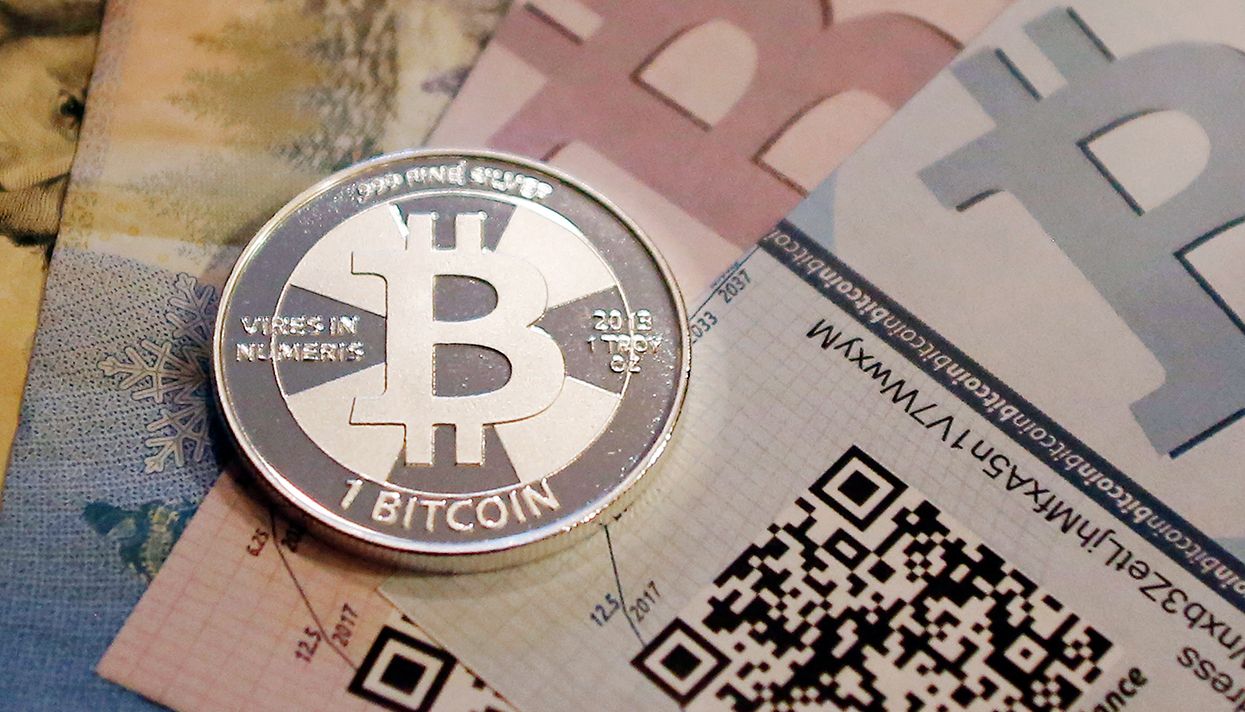
Vladimir Putin first spoke about the prospects of cryptocurrency, which is in a semi -legal position in Russia. “They are not provided with anything, this money, that’s the whole thing, this is the most important problem. They are not really attached to anything and are not provided with anything. But, in general, as a unit of calculation - as they are called there, “coins” - they can be used, they are increasingly spreading. As some kind of equivalent in some segments of the calculation, it is probably possible, ”Putin said on the forum“ Territory of meanings on Klyazma ”. He also added that he was discussing this topic with the head of the Central Bank Elvira Nabiullina. A little later, Putin’s spokesman Dmitry Peskov made an explanation : “It was not specifically about bitcoins. It was about certain forms of conditional calculations. This should not be accepted as specifically to support of bitcoins ”(the Central Bank has repeatedly stated that he does not consider bitcoins real money). Especially for Medusa, Rocketbank CEO Viktor Lysenko explains why cryptocurrency is a technological breakthrough comparable to the creation of the Internet.
There are several important points in the President of Russia about the “Coins”. Firstly, Putin is obviously a little more aware than ordinary citizens: only 20% of Russians heard about bitcoins, while 40% are ready to ban them. Secondly, in our country, it turns out, there are quite influential and progressive forces that understand the potential of these technologies. The head of Sberbank German Gref spoke in defense of cryptocurrencies; A year ago, I raised this topic in an interview with Elvira Nabiullina, and felt not rejection, but interest. And this is significant, since Russia has adopted extremely tough restrictions on cryptocurrencies. It is enough to read this text on the Central Bank’s website, in which citizens and legal entities promise that operations with virtual currencies will be considered as a laundering of income received by criminal means and financing of terrorism. For comparison: in China, for example, the restriction was introduced only for bitcoins, and not for all virtual currencies, and only for financial organizations - the rest can use them at their own peril and risk.
Finally, the most important thing: it seems that everyone understands that the bitcoins themselves should be considered promising, but by the technology standing behind this cryptocurrency and the solutions based on them.
Many technological visioners, for example, Mark Andrissen and Fred Wilson , believe that bitcoins and Blockchain (technology underlying cryptocurrencies) are Next Big Thing , that is, they can change people's lives just as the Internet has done in due time. The most reputable venture investors invest large funds in the development of these technologies. And if a year ago, bitcoins were perceived by many as a marginal toy for geeks, now we can say with confidence: in ten years, most people in developed countries will use decisions based on Blockchain.
And one more news: it seems that 2015 will become a turning point in this regard.
How does this work?
Imagine that the March hare gives Alice a cup of tea, and this must be somehow fixed. That is, to certify the fact that the hare had a cup before, and now Alice has it. In today's real world, a certifying person or organization is usually used to certify such a “transaction”: a notary in the transfer of property, a payment system when paying a card, a central bank when transferring from one bank to another and so on. That is, to fix the transaction next to the hare and Alice, someone honest and authoritative should be nearby, to whom everyone believes; Someone who cannot be bribed, “hack”, destroy.
All over the world, the state or its agents often like to play in such a role. There is a fundamentally different approach: imagine that the transfer of the cup took place in a crowded area, and there are a lot of witnesses who have seen and are ready to confirm the fact of the transaction. If most of the many witnesses certify that the deal took place, then it is. In the first case, both sides must trust the observer; In the second case, it is important that observers honestly record the facts - and the parties can check the transparency of the rules. If there are a lot of observers, then bribe, hack or deceive the majority becomes too expensive, and therefore pointless for the attacker.
To continue, it is necessary to figure out what is the difference between the Blockchain technology (which provides a connection between the hare, Alice and observers on the square) and Bitcoin - the most famous value for the application of Blockchain technology with its specific rules.
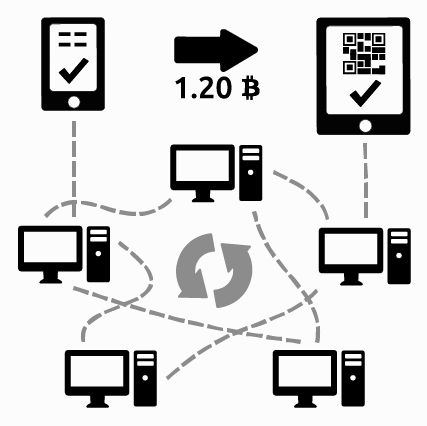
A bitcoin network is a large number of computers interconnected through the Internet (called “miners”), on which special software is installed. On each of them, the list of all transactions made so far is still updated and constantly updated. When the hare wants to send one bitcoin to Alice, he, using a special computer program (electronic wallet), sends a message about such an intention to the entire bitcoin network. The computers included in this network are checked with the transaction list, confirm that the sufficient amount is at the disposal of the hare and has not yet been used, and are also certified that there is an electronic wallet of Alice. As soon as the majority of computers on the Web confirm compliance with these conditions, the transaction is considered a consistent one - and the record about it will spread over time to all of them. Such transactions are approved by blocks, each of which stores a link to the previous block; The blocks form a chain, hence the name of the technology - Blockchain.
A similar approach opens up completely new opportunities for solving problems that had no solution before, or they were solved crookedly. It is good when you make a deal with a friend - or with a person who has common acquaintances with you. And if not? For example, you buy something from an unfamiliar counterparty via the Internet. There are more and more such transactions, this is a clear trend.
At the same time, the creators of bitcoins laid some important features into their system. For example, Bitcoin wallets are not identified. Because of this, cryptocurrency is actively criticized: it is understood that you can pay for all sorts of bad things. But, firstly, this is the peculiarity of the bitcoins, and not all cryptocurrencies; Secondly, over time, this rule may change. The issue of Bitcoin coins is carried out by “mining” (mining) by the network participants, although it can be organized in a different way: for example, a Central Bank of a country can act as an emitter.
What are the advantages of Blockchain?
Information about transactions is distributed between many computers, so the accident or failure in individual nodes of the network does not lead to loss of information, and therefore assets.
Information about all transactions is in the public domain. This increases transparency and radically reduces the possibility of abuse. Frauds are reduced.
In connection with the above, the total cost of transactions is also reduced.
And, most importantly: there is no need in a single certifying center. That is, users will not be burdened with care (voluntary or imposed) to trust someone alone.
Why is 2015 a turning point?
Bitcoin has always been associated with libertarian and anti -government ideas. That is why officials in many countries of the world at first did not even try to figure out the sense of cryptocurrency and met not only bitcoins, but all that was associated with them, introducing restrictions on the use of cryptocurrencies. The states are confused by the anonymity of Bitcoin wallets, as well as the fact that the issue of this currency is not controlled by any state bodies. In fact, these “shortcomings” are easily eliminated: wallets can be authorized (such as bank accounts), and the issue should be carried out centrally.
In 2014, a number of companies (including some large ones - for example, Microsoft) announced the limited receipt of Bitcoin as a means of payment. However, this decision can be considered to be more “flirting” with the residents of Silicon Valley and Geek, since large public companies are rarely ready to play in unregulated and gray zones large -scale.
The advantages of using Blockchain are great for payment systems, and “disadvantages” in terms of regulators are eliminated. So the “reconciliation” of officials with this technology was only a matter of time. In 2015, several events occurred, indicating that this attitude to Blockchain changed. In February, a representative of the Central Bank of England announced that they were seriously considering the possibility of using cryptocurrency technologies to serve their own emissions. Similar news also come from representatives of the US Federal Reserve. These statements are reinforced by the initiatives of very large companies that Blockchain consider to be promising technology. In mid -March, the press appeared that IBM and Intel create units for working on Blockchain technologies - in order to create payment systems for governments and central banks. Citibank is developing its Citicoins . The participation of such significant and conservative players suggests that the ice has moved.
Why is it Next Big Thing?
Blockchain technology is called "Internet for money." If this technology became the base for payments, it would already be grandiose. But its possibilities go far beyond the borders of monetary settlements - it allows you to exchange various assets and make any transactions, including with shares, bonds, ownership of real estate and movable property, insurance policies, and so on. These transactions are already called “smart contracts” - and we are talking not only about transactions, but also about the certification of any events, for example, voting.
The volume of each of the listed markets is grandiose, and the amount of money that can be saved in case of simplification and automation of procedures is amazing. For example, investors will applaud standing if normal accounting of shares in private companies in which they invested: there will always be clarity, how much, when and what shares are issued, who they have, who and when transferred them to anyone. The insurance policy or a certificate of property ownership will not have to be printed on paper and store in a safe. Surely we will see many interesting solutions in these areas in the next few years. The cost of the average procedure for the sale of real estate in the United States is almost three thousand dollars; Most of this amount is spent on certification of titles. Imagine that the cost of this procedure will fall to one dollar. And also imagine that the counting of votes in the elections will not depend on one “certifying center” - and all the procedures will be transparent.
There are a number of projects moving in this direction ( Ethereum , Ripple and many others). Bitcoin is the first and most famous - just one of the players in this gigantic market, where in the coming years we will have strong competition.
* * *
It is funny that this innovation is perhaps one of the most powerful in recent years - ordinary users simply will not notice. It seems that Blockchain will repeat the fate of the TCP/IP exchange protocol underlying the Internet: many familiar services would not work without it, despite the fact that only experts know about its existence.
And finally, the most important thing: Blockchain technology will increase the level of trust between people, which means that it will fundamentally make the world better.
Victor Lysenko
Moscow