
Translated material
Confucian embarrassment

Following Donald Richie, the UFO publishing house has released another book about Asian cinema in the film Text Cinema series - “On Far and Near Asian Films”. Unlike the classical work about Yasujiro Ozu, the book of critic Sergei Anashkin is designed to reflect the current state of Asian cinema - if not an industrial and popular part of it, then at least a festival. This is what the annotation promises: “In recent decades, Asian films regularly receive prizes at leading film festivals - in Cannes, Venice, Berlin ... The book discusses the latest trends in the development of cinema China, Korea, Japan, Thailand, Kazakhstan and other countries ...” True, the author himself is trying to argue with this: Anashkin’s book is a collection of texts, this is a collection of texts, this collection Written over the past fifteen years. Most of them are identical to the materials published by Anashkin in the magazine “The Art of Kino”, whose constant contributor he is (they are available in the archive on the magazine website), only some of them were included in the book in an expanded form. The average age of materials is eight years, and, of course, we are talking about the “latest trends” here.
The randomness of the choice of films and that is another problem of the publication. If the author of the collection does not sign anything on purpose, but collects what has accumulated by itself over a long period of time, then the stones may not develop into the pattern. The first part with the encyclopedic title “Synoy -speaking World” includes, for example, a detailed review of “love mood” Wong Carva, written in 2001, and that’s all in the book about Hong Kong Cinema.
There are two materials about Taiwanese cinematography - a review of all films of the classic Edward Yang and a note about the French musical Tsai Minlyan “Face” of 2009. Continental China is represented by only one text about the not -known film by the festival documentary Van Bin “A man without a name” (the next film, Van Bina “Danger”, for the first time in the history of Chinese cinema telling about the camps of Mao, became a sensation in a kind and was selected to the Venetian competition). The last text of the section is twenty pages about the Malaysian Chinese, director of Ho Yukhan. The “Synoy -speaking world”, as in and other parts of the book, does not have a separate preface, and the author’s coordinate system is not explained in any way. It is not clear why the Malaysian director is worthy of mention, and Singapore or Indonesian Chinese is not. And with all the undeniable importance of Van Bin’s films, it is still interesting why in the game Chinese continental cinema, including festival and independent, there have been nothing other than mentioning the last 15 years. A separate preface to the section would answer questions or at least update old texts. In a review of the film Wong Carva, for example, is very lacking, if not copyright, then editorial notes made in 2015. The remark “Stephen Spielberg engaged to Maggie Chun for the role in the film“ Heisha memoirs ”(the project in the end“ did not go ”)” will be confused by the reader, who saw the film of the marshal of the same name. In addition, it could be noted that the “love mood” eventually became part of the retro-trilogy of Carva, but “Wild Days” were thrown back as an early film, and the completed trilogy “2046” (published in 2004!) Mentioned in the book of 2015 as a kind of “new project”.
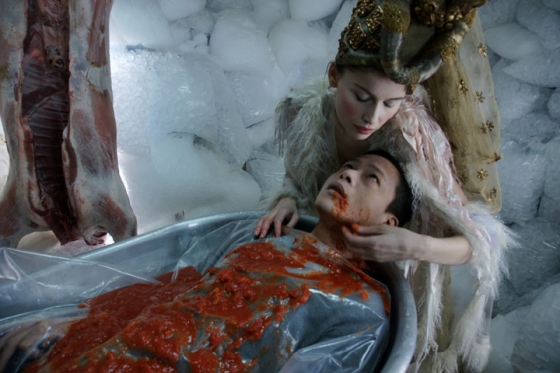 Frame from the film Tsai Minlyana "Face"
Actual notes and a more attentive editing could make a random set of texts more solid or at least remove contradictions. In the Thailand section, there are only two texts - an interview with the director Apichatpon Virasetakun, taken in 2003, and the large material “Apichatpong Virasetakun: Global, National, Individual”, which is assembled from three notes written for different publications in 2003, 2008 and 2011. And, it seems, collecting them in one text, no one tried to save individual pieces from repetitions and inevitable mistakes. In the first part, dated 2008: “The film“ Syndromes and the Century ”is dedicated to his parents (typical of a Thaz Besteen gesture), who still work doctors” - and after seven pages, which speaks of the film “Uncle Bunmi ...”, it turns out that this is not entirely true: “It is curious that Visetakun’s father died of the same kidney disease as his hero.”
The text about Virasetakun and the collection as a whole is an illustration of a long -time European approach to Asian cinema. Perhaps he is associated with the influential book of Noel Burcha “A remote observer: the form and style in Japanese cinema”, published in 1979, or with success at the festivals of the post-socialist Chinese cinema in the late 80s. One way or another, Asian films in Europe are still perceived by many exclusively as “national” ones. The approach to all equally ethnographic-the influence of native medieval ethics, painting, poetry and the traditional theater is more important for critics (even in cases where this influence is not) than manifestations in films of some features of local film industries, pop culture or relevant socio-political movements. The concept of national cinema as an embodiment on a screen of a national character has long lost its meaning, and its use in the description and evaluation of popular or festival films is rather interfered with the analysis of these films.
 © New Literary Review
For example, in the text about Virasetakun, the critic analyzes the embodiment of national Thai ethical and aesthetic categories and the provisions of the Buddhism of the Theravada Buddhism in his films. The first part of the text ends with the assertion that for the European viewer Visetakun is the "plenipotentiary" of the National Thai mentality. At the same time, the author ignores the fact of the director of the director of the director of the family of the family, which has influenced the peculiarities of virasetakun perception of the dominant Thai culture, important from the point of view of the “national approach”. In addition, if the embodiment of Thai mentality is one of the main qualities of the director’s films, then in the framework of a book study, it may be worthwhile to compare it in more detail with the representation of the same mentality in the paintings of other authors. Yes, ghosts living among people, beast -like forest perfumes, Dychotomy “Jungle/Megapolis” help the films of Apichatpon Virasetakun to stand out in the programs of European festivals, but this is absolutely not important in the context of Thai cinema, where these paths are enough without it. There Virasetakun is, first of all, the experimenter who approached the film form and drama with the self -confidence of the contemporary artist and updated the aesthetics of Asian minimalism. By the way, Asian minimalism in itself, as a course that the directors are included without visible general traditional cultural roots - from the ancestor, Taiwanese Haw Syasosyan, to the Korean Hong San, finally erodes the expediency of the “national” approach to the festival Asian cinema.
The use of a “national” approach to one director, but to cinematography of a whole country leads to the fact that the analysis of the cinema is replaced by the purpose and justification of stereotypes. In the book, this can be seen in the example of the Korea section. Almost one hundred pages, nine texts (four, however, about one Kim Ki Doc)-more about South Korean cinema in the book is described more than about any other. It opens the section of a large essay on violence, its nature and representations, written from the standpoint of superficial "Oriental Studies". Confucianism, traditional (that is, medieval) values and their overcoming - according to critic, the main sources of topics, compositional and visual solutions for most Korean authors. There are other inaccuracies in the text itself about violence and in other texts of the Korea section: the films described with errors, incorrect generalizations, attributing individual characteristics inherent in the whole course to which they belong, and so on.
But these mistakes will not interfere with the perception of the films themselves if one of the readers decides to watch them. Another thing is national stereotypes. The approach to the whole cinematography from the point of view of one for all Confucianism does not explain anything about this cinema and, rather, makes it even more alien to the Russian viewer. This is a sketching on the art of an exotic bedspread, automatic addressing of all these incomprehensible Asian films to a narrow circle of exotic lovers. In fact, in South Korea, Confucianism now is the destiny of the ultra-right conservatives, and if it suddenly clearly manifests itself in a film not dedicated to the Confucian Choson dynasty (1392-1897), this is a symptom.
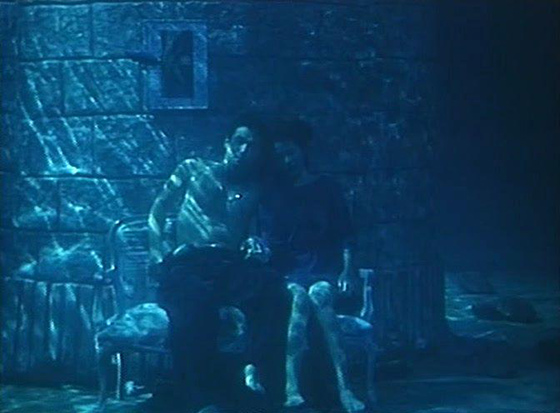 Frame from the movie "Crocodile" Kim Ki Doka
In addition to Confucianism, the author of the book for opening the meanings of modern Korean films uses another ancient Chinese concept - Yin and Yang: “Almost every of the tapes of Kim Ki Doc has a pond. The water, the abyss is the irrational principle: the embodiment of the female essence, the “dark originality”, as the Taoist sages called it. ” Although, perhaps, water is just a link (or borrowing) to Tarkovsky, which is much closer to Kim Ku Doc.
There may be several alternative to the "national" approaches. For example, consider films in their own industrial context. Then collectivism in Korean cinema is not a manifestation of Confucianism, but the opposition to Hollywood individualism as part of the Korean film distribution. Nothing prevents Asian films in the context of the world history of cinema - it is obvious that the director Pak Chkhan Criminal Code and the modern tradition of Korean thrillers develop the ideas of Hitchcock. They also work on the territory of morality and ethics: good people do bad deeds, sympathy for criminals and avengers, manipulation of the viewer’s attitude to characters, etc. It is best to use several approaches at once, including taking into account ethnography and traditions, but for this you need to abandon the position of the “remote observer” and consider films outside the stereotypes and the paradigms that have abstained.
An example of such a direct approach is also in the book, in the last section “Somewhere nearby”. In several articles about the Yakut cinema, the author considers it not in the context of European or Moscow festivals, does not seek antiquity where it is not, but analyzes the Yakut films based on their own nature, the industrial context: how and who does these films in Yakutia watch them. The contrast of these texts with the rest of the book is indicative and confirms that the dominant approach to "national" cinema is necessary for an audit.