
Translated material
Greece in anticipation of the second forgiveness
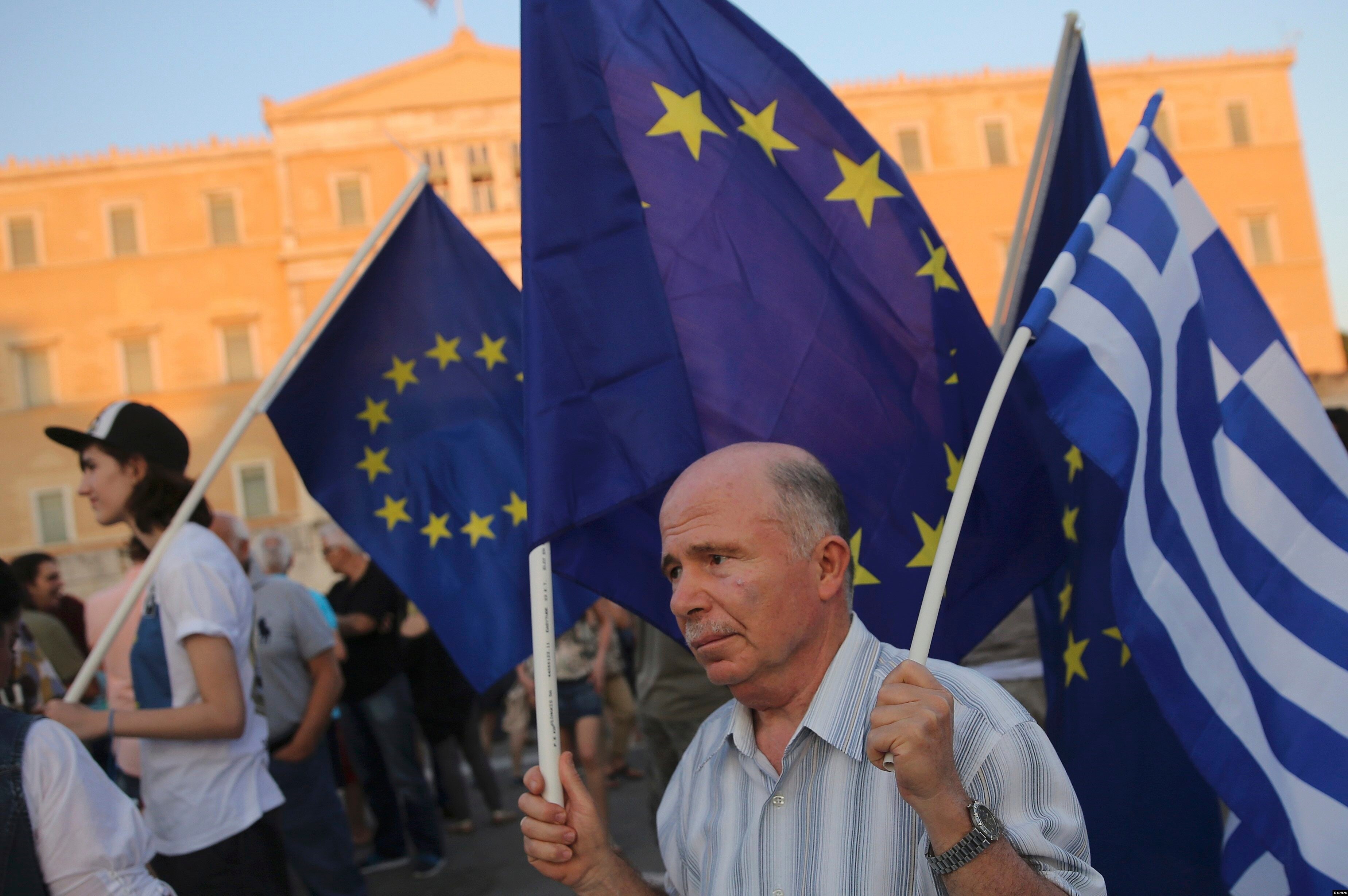
It has already led to a split among its creditors
Having approved on the night of Thursday a package of bills on tough financial reforms, Greece actually passed most of its path to the next, already third in the last five years, the program of anti -crisis assistance. Nearest events are now more or less clarified. Creditors received a formal basis to start negotiations on the financial conditions for the provision of Greece of new loans, although it is difficult to expect their soon completion. On the same basis, the European Central Bank (ECB) will be able to continue the program of emergency lending to Greek banks , which, at least, will allow them to open them after three -week forced “holidays” - on Thursday the ECB announced that it increases the limit of this lending. The finance ministers of the eurozone countries previously agreed on the mechanism for the provision of emergency loans of Greece in the coming days - we are talking about 7 billion euros. These funds are enough for the next payment - July 20 - for debts to the ECB (for 3.5 billion euros), and to pay off the two already expired (June 30 and July 13) payments on the debts of the IMF (in general - about 2 billion euros). Both payments are fundamentally important. Loans determined by the ECB remain the only source of financing of Greek banks. And repayment of overdue payments of the IMF will open Greece to those loans of the fund that have long been agreed, but now suspended due to delay. It is much more difficult to present the outcome of beginning negotiations, especially given the disagreements in the camp of the creditors themselves. This week they appeared especially clearly, and some statements were like, rather, on the ultimatums to each other.
In the center of the confrontation, as expected, the conditions for restructuring by Greece have already accumulated by Greece of public debt. Today it is generally approximately 320 billion euros or 178% of the country's GDP in 2014. Almost 80% of this debt falls on the share of interstate creditors - the European Anti -Crisis Fund, the governments of the countries of the Eurozone, the ECB and the IMF.
In general, for the period since 2010, they provided Greece with 254 billion euros, but only 11% of this amount, according to the special commission of the Greek parliament, went to the current expenses of the state budget. The rest left the country in the form of current payments on debts to a variety of creditors - from interstate organizations to private foreign banks and investors.
Hence the constant appeals of Greece to its main creditors about the need to facilitate the general debt burden of the country, the same restructuring. In November 2012 , negotiations on this subject were promised to her (including expanding the deadlines or reducing interest rates on previously provided loans), but have not yet begun . And with the new Greece government, creditors were completely inexorable: at first - a new agreement on financial assistance, only after that - any talk about restructuring.
A realistic proposal from Greece should meet an equally realistic proposal of creditors - in terms of the country's debt stability.
It is not known which precedents in history could refer to Greek delegations during the negotiations of recent months. But some experts consider it, in particular, the 1953 London Agreement on the external debts of Germany, accumulated by the country for preceding almost three and a half decades, that is, from the moment the Versailles treaty was signed following the results of the First World War. Their total amount-32 billion German brands-was ultimately reduced by creditors by twice, to about 15 billion marks, and the remaining payments were stretched for more than 30 years.
Moreover, they could be made only in those periods when a foreign trade surplus was noted in Germany, and their total volume could not exceed 3% of the country's current income from its export. Such “restructuring” of previous debts was then considered one of the most important factors in the early post -war recovery of Germany. However, there are many experts who believe that the then story with the debts of Germany and the current case with Greece are hardly comparable.
Today, Germany is the main foreign creditor of Greece, which and through different structures account for about 55 billion euros of Greek duty. The shared participation of the EU countries in the European Anti -Crisis Fund is directly determined by the volume of their economies, and the German is the largest on the continent.
German Finance Minister Wolfgang Shoible said on Wednesday in an interview that he still considers the variant of the temporary exit of Greece from the eurozone, which he proposed in the latest negotiations, probably the best decision of the possible ones. “And I don’t know, and no one today knows how to restructure Greek duty without a direct write -off. But everyone knows that such a write -off is incompatible with membership in the eurozone.”
European legislation does not yet provide for the possibility of writing off, at least partial, the debt of one country of Eurozone by another. And in some European capitals, attempts are clearly traced. “A realistic proposal from Greece should meet an equally realistic proposal of creditors regarding the country's debt stability,” Donald Tusk chairman said last Friday. “Only then will the situation, win -win for all participants.”
And literally the day after the preliminary agreement of creditors with Greece with an unexpectedly sharp statement was the International Monetary Fund . In the next review of Greece, the Fund, in particular, noted that if measures agreed by creditors were implemented back in November 2012, no new restructuring of Greek debt would be required to achieve the goals planned then: to reduce the country's debt load to 124% of the GDP by 2020 and “significantly lower” 110% of the GDP - by 2022.
Now, experts of the IMF are believed, by the end of 2018, Greece will require additional assistance for 85 billion euros, that is, 25 billion more than two weeks ago. After that, the country's state debt is approaching the level of 200% of GDP. “The debt load of Greece can again become controlled only at the expense of the new restructuring of the debt, and much larger than in Europe they still preferred to speak,” the authors of the review noted.
No one today knows how to restructure Greek duty without a direct write -off. But everyone knows that such a write -off is incompatible with membership in the eurozone.
Moreover, on the same day, a new warning of the IMF followed: the fund is unlikely to be able to provide Greece with the remaining (from previously agreed on the period until the period until the spring of 2016) loans for 16.4 billion euros, which European lenders are counting on, until a new agreement is concluded on the general restructuring of the debt accumulated by the country.
One of the proposals of the IMF European creditors of Greece is to extend for another 30 years of the “preferential” repayment period. First of all, it is about loans of the European Anti -Crisis Fund (in general - 131 billion euros). According to the agreements of November 2012, Greece will begin to gradually return these loans, only since 2023. The IMF actually proposes to extend the “preferential” period until 2053, the Financial Times notes. According to the current plans, this year the last payment for current debt to the anti -crisis fund has already falls.
However, even such a benefit does not change much for Greece for the coming years, since the country on these loans does not pay. Therefore, the IMF proposals also provide for either the annual transfer of the eurozone to the Greece budget, or - all the same direct and open debt write -off. This is what the IMF proposed to Europe back in 2012.
And if we assume that it is the last option that will be implemented in one form or another in the coming months, this will already be the second write -off of Greek sovereign debt in just three and a few years. Let us recall what exactly 130 billion euros provided to Greece by international creditors under the second financial assistance program, open in the spring of 2012. With this money, the country was able to carry out what is now called the largest restructuring of sovereign debt to private creditors in world history.
Firstly, she had to negotiate with them about the exchange of previously released Greek government bonds for new ones-they are half cheaper and with much more distant maturity. However, the choice was small: agree to less or lose everything. Secondly, the Greece government simply bought a significant part of the Greek government bonds previously sold by him from private creditors-with a very large discount. This ransom, as well as the payment of compensation to those investors who agreed to the exchange of bonds, were made to funds received in the form of new loans from the European Union and the IMF. In other words, the former “private” debts of Greece were re -registered into “state”.
Due to this restructuring, the total state debt of Greece was then reduced by almost 30%, and private lenders eventually lost 55-80% of their previous investments in Greek debts. Today, 8 out of every 10 euros of the debt accumulated by Greece falls on debt to other states or interstate structures. That is, we are talking about the money of foreign taxpayers. And they will be much more difficult to convince them of writing off Greek duty than private investors three years ago. Despite the precedents in recent history.