
Translated material
"Pioneer shows the way to death to the future"
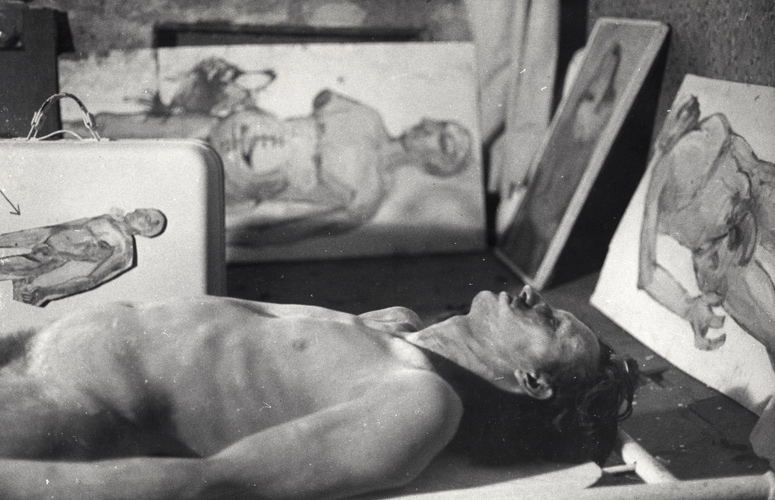
On July 20, Alexander Lyashenko, better known under the pseudonym of Petliura, celebrates his 60th anniversary. The artist was and remains one of the most underestimated and controversial figures of Moscow art. At the same time, despite the pronounced “nationality” and devotion to the subject world of the USSR and Russia, it was better perceived and perceived precisely in the West.
Free academician
Lyashenko turned out to be a white spot in the history of actual art, since art criticism in Moscow, focused on discursive practices, was primarily engaged in Moscow conceptualism and “Moscow radicalism” of the 1990s, including corporalism, but missed the background of the latter, including the shares of Petlyura of the late 1980s.
The controversial nature of Petliur's creativity is due to the fact that it is at the junction of visual and theater arts. His activities in the capital throughout the 1990s were perceived as the design of funny social events, and not as serious, that is, discursive-in the understanding of many critics-art. It is no accident that in 1993 the unknown author of the newspaper Kommersant- Daily called Petliura "one of the most funny and meaningless characters of urban art life." And even in 2014, the magazine "Spark" dismissively wrote about him as a "freak model" . Time did not change the relationship.
Due to the lack of publications, many moments of the biography of Petlyura himself can only be restored from his words and difficult to check from independent sources. The above quotes were taken from several conversations Lyashenko with the author of this text (the German version of the article was released in 2003 in the Austrian journal Camera Austria ).
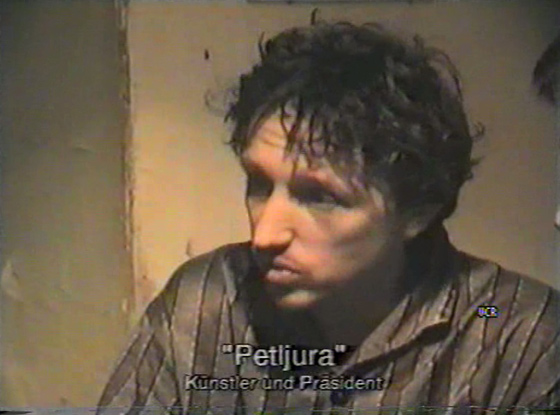 "Petliura is an artist and president." Stop frame from the documentary Die Linke Opposition in Moskau, Germany, 1994
Lyashenko was born in 1955 in the then Voroshilovgrad (today's Lugansk) region of Ukraine, in the region in the east of Ukraine, which, according to him, is blown by the "wind of free peoples." “There, initially people tried to be free, to defend the earth, from this there was a popular movement, which was headed by Makhno,” says the artist, who in his youth himself and rebelled against the Soviet regime. In 1980, after the first year he was expelled from the Kharkov Art Institute-including due to the literary work of Leonid Brezhnev: Lyashenko flatly refused to read the mandatory “small land” and “revival”.
Lyashenko moves to Moscow and enters in 1981 to the Faculty of Interior and Equipment of the Stroganovsky School. Here the problems continue: after the first year it is sent on academic vacation. “I drew some poster that caused the reaction, and they put me not even a deuce, but a unit,” he says. A year later, a certain deputy minister of coal industry from Severodonetsk (Lugansk region), who was glad to help his countryman, was restored. “Non -standard approaches” lead to two more breaks in his studies, which he nevertheless finishes in 1988.
The birth of a collection from the spirit of still life
“Each artist has always increased interest in objects, the artist always loads his world with objects,” says Lyashenko. The beginning of his activity as an artist and as a collector practically coincides. “I used to love to draw still lifes-so that there were a table, cups, bottles and something else to make it clear when you look what happened. For this I collected objects. " The time for collecting turned out to be successful: "The period came when people felt some kind of change in society, and social security increased under socialism-in the 1970-1980s, old objects began to be thrown away."
The exhibition lasted one hour, it was closed, they said that I was a fascist, a bully.
In the 1970s, Lyashenko already had, according to him, the “huge number of icons”, which “alcoholics after the death of their grandmothers were sold for a bottle of port”. After moving to Moscow, he was interested in historical, primarily Soviet, clothes, shoes and objects of everyday life, which he increasingly used for installations. After more than thirty years, Lyashenko had one of the largest meetings of this kind in Russia. According to the artist’s calculations, it consists of 3 thousand pairs of shoes, 1.5 thousand costumes and dresses, 1 thousand units of women's and men's linen, 3 thousand accessories and 2 thousand objects of everyday life.
The nickname Lyashenko, which he received in the mid-1980s, is also associated with historical clothing. “We all met in Novokuznetsk, in the park, there were informal youth, poets, musicians, punks. I dressed in old clothes, a coat, such a dad, a cane, an old umbrella, everything from the market, I looked like an anarchist in a movie, like Petlyura like that. All that was stolen by the bourgeois was put on, ”he says. At first, some called him Makhno, others Petlyura. The last nickname ultimately remained, the Ukrainian origin of the artist, of course, played a role in choosing a nickname.
In an informal environment, Petliura not only made acquaintances (for example, with the artist and fashion designer Garik Assay, a key figure of a party), but also began creative activities: in 1986, together with Maria Kruglova, he He made concerts in the DK Gorbunov.
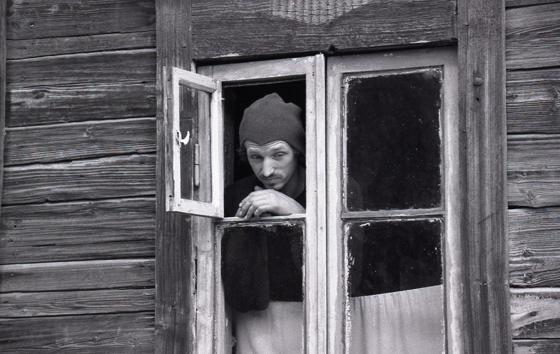 © Herwig Heller Alexander Petlyura at his cottage, Tarusa, 1995
Investigation and a very bad reputation
In December 1988, Petliura participated in the Exhibition-Permans “The Beginning of the End”, or “New Symbolists”, which was organized by artist Oleg Kolesov in the Moscow House of the Artist on the Kuznetsk bridge. “This was my first part in such a central, noisy exhibition. The exhibition lasted one hour, it was closed, they said that I was a fascist, a bully. There were two compositions in two sculptures: one was called “Pioneer shows the way of death to the future”, and the second - “the victory of socialism over capitalism”, there the Soviet soldier with Liver sausage fucked into the anus of the German soldier. Then the girls came, we put them on specially well, came the punks, grabbed the sausage and pretended that it was a member, said: “Uncle, you can suck you, thank you for saving us from the Nazis.” Such an action began, ”Petlyura recalls. The artists carried out objects and lit, the police came.
The reputation of Petliura at this time left much to be desired. In addition to fascism, he was still suspected of necrophilia. “Victims of natural disasters” is the name of the 1989 action, where parts of the bodies of animals were laid out in the room at the former hippodrome and then burned. In the "State Council" action, the artist portrayed a corpse, lay naked on a stretcher, around him there were paintings with corpses that he painted in the morgues. The action is based on the fact that even corpses and parts of the body receive an inventory number from the state and thus nationalize.
I had an idea to linger in this country, to love it for real.
Lyashenko also talks about an action, which, unfortunately, is not documentary evidence. When the GDR collapsed and Mstislav Rostropovich played by the Berlin Wall, Petlyura allegedly ended up in West Berlin. He stole stars from the Mercedes and glued them as a greeting “ Welcom E to Capitalism! "On" Trabants ". On these machines of the socialist auto industry, many GDR citizens first came to the western zone. According to Petlyura, he was detained during this action, but soon released. The German authorities on these historical days were unlikely to deal with the young incomprehensible artist from Moscow.
Collective creativity and failure of perestroika illusions
In the spirit of the general rise in the late restructuring of Petliura, he turned out to be a co -organizer or organizer of several collective projects. In 1988, along with other artists, with the assistance of the actor and the late piercing functionary of Rolan Bykov, he founded the “Free Academy” - after composer Kamil Chalaev and theater director Boris Yukhananov, artist Alexander Lyashenko became its third president. The initial intentions were ambitious: the institution was planned to create the Rock-Laboratory Institute under the leadership of Peter Mamonov, the Institute of performances with Ekaterina Ryzhikova, at the head, the Institute of the Avangard Theater under the direction of Boris Yukhananov, and Herman Vinogradov was to teach avant-garde music. But everything turned out as always: the Academy, which has never really earned, ceased its informal existence in 1993.
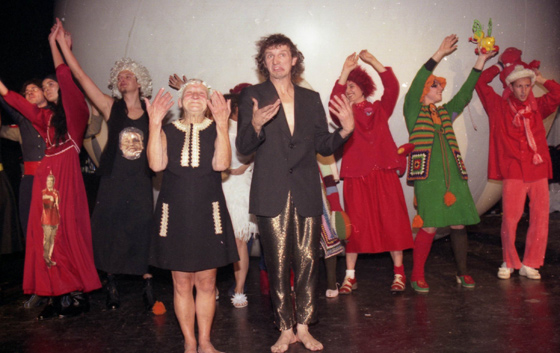 © Elmar Mrs. Brother and Alexander Petlyura during a performance in Austria, Graz, 1996
Perhaps the most large -scale project in the career of Petliura was associated with the plans of the “academic” future. After the first commune on Gashek Street, “Apartments 57”, in 1990 he found a small quarter in the center of Moscow, where he created a new “Community of interests” with like -minded people.
When the artist appeared under the guise of a representative of Mosfilm, who allegedly searches for a set, only an elderly and abandoned marital couple lived in the resettled houses of Petrovsky Boulevard. Vladimir Abramovich Dubner soon died, his widow, Bronislav Anatolyevna, the care of artists prolonged life for several years. Or even more: for a Pensioner, Bronislava, born in 1924, acquaintance with Petlyura was a real social elevator - she turned into a character in Mrs., became an artist, an actress and a well -known model not only in the Moscow underground. In 1998, she won the London competition of the British artist Andrew Logan and became Alternate Miss World , until her death in 2004, she traveled a lot and performed all over Europe.
After the official opening of the “territory” on Petrovsky Boulevard on September 28, 1990, a small quarter - 6 hectares of land, 2 thousand square meters of living space - in the center of the capital became the habitat of artists, many of which not only worked here, but also lived. The artists of German Vinogradov, Rostislav Egorov, Arkady Nasonov, Kirill Rubtsov and Aristarchus Chernyshev, performanist Ekaterina Ryzhikova from the North group, fashion designer Olga Soldatova, DJs Alexander Osadchiy and Kompas-Brubel and many others were associated with the commune. They did not have a general aesthetic approach, but at least twice a year, during the birth of Mrs. Brother and Territory, they arranged collective holidays. We are talking about theatrical and artistic performances, in the center of which Mrs. armor was invariably. These events, which have become part of the Bohemian-Soviet life of Moscow, created the image of a bright secular character.
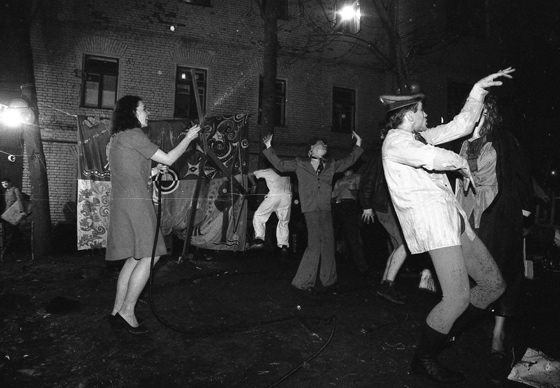 © Archive of Petlyura's performance on the "Territory", early 1990s, Moscow
“I had an idea to linger in this country, to love it for truly, to create an association to which others will be equal. Show that you can collect a large company and move on in this country, demand from the state, to seek the rights to open some non-profit centers, ”says Petliura about his then mission. Under the onset of excavators who demolished part of the buildings in this reserve of contemporary art, the "territory" ceased to exist in 1995.
Petliura with Mrs. armor moved to an apartment with a large basement in the house at the intersection of Petrovka and Petrovsky Boulevard - new Russians settled in other apartments of this house, part of the territory opposite the Russian Orthodox Church, fences appeared everywhere. The artists were no longer there.
Together with the “territory”, not only the perestroika illusions of Petliuras about the creation of an art institution were left: the collective with which he worked and worked for several years has gradually disappeared. He, like many Moscow artists at this time, faced economic problems. Renting the basement, where most of his collection is still stored, turned out to be extremely expensive. Nevertheless, his artistic activity did not stop. Petliura was engaged in the production of copyright show performans with elements of Trash in Moscow clubs. His rapprochement began, where he not only works as a costume artist, but also acts as an actor. In 1997, he, along with Renata Litvinova, played the British director Kate de Puri in a short -range “ Orpheus Walking ” , in 2002 he starred in the “penny” by Ivan Dykhovovichny (the co -author of the script - Vladimir Sorokin).
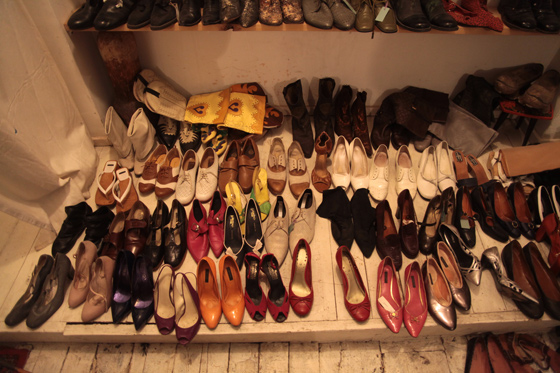 © Herwig Heller part of the Petlyura collection in his basement, Moscow, 2012
Opus Magnum in 12 "situations"
Petlyura implemented one of his most important projects in 2000-2001 in the Moscow Club "House". It was called "25 years later. The empire in things ”consisted of 12 parts, 12 performances with dozens of participants, in which the artist, with the help of his wealthy meeting, tried to reconstruct the aesthetic and daily history of Russia and the USSR as possible in the 20th century:“ I wanted to show the artist’s subjective view of history and accurately find the state of the situation by real objects. And I am one hundred percent sure that no one in the country will do it better than me. There is no empire, no one can collect these 25 years. ”
12 “Situations” covered Russian and Soviet life in a wide range: in the episode “Salute of Victory”, the joy of the end of the war - both domestic and Afghan - was emphasized by bright colors in clothes; The episode “Thank you for the help” talked about the decline of domestic production and the influence of Western imports in the new capitalist Russia; The Last Tango was devoted to emigration. The most difficult work, says the artist, was the choice of accurate clothes from the last decades. “I buy forty shirts associated with the Olympics and space, on which, for example, rockets, and then from them I use in the performance only the most accurate two or three, which even people of that generation perceive as rare. Show that it is to find part of the range of emotions, either very bad or very good for a person to laugh or be proud that he lived at that time in the Soviet Union. ”
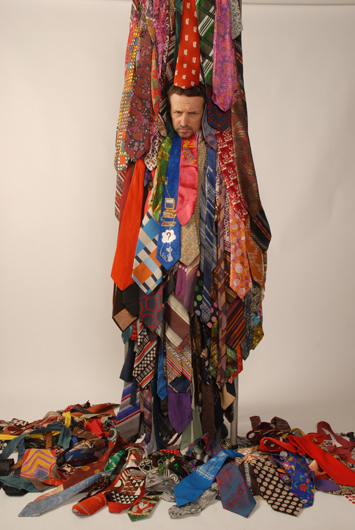 © Alexander Lakhnovsky Alexander Petliura and part of his collection, Moscow, 2012
The abroad helped him
Despite the fact that the artist’s work is closely connected precisely with Russian traditions and can be understood in the context of the notorious “nationality”, Petlyura is more often perceived as a serious artist in the West.
Already in 1991, the Austrian curator Peter Pakesh called him to the Shtyrian Autumn festival in Graz, after which he regularly appeared in this Austrian cities. Numerous invitations abroad followed, Petlyura participated in the prestigious German theater festival Theater der Welt in 2002, played at the Cartier Foundation in Paris, gave lectures at Watermill Center near New York-with Robert Wilson, his big fan, participated in numerous exhibitions and festivals throughout Europe.
“In Russia, foreign friends did a lot for me. Russian lazy, do not believe in anything! " - says the artist. Since then, the situation has nevertheless slightly changed for the better. Important Moscow art sites, such as GTSIA, Garage, a Gallery on Solyanka or Museum of Decorative and Applied Arts, began to invite him, although Petlyura’s personal exhibitions and major performances at home is still less than abroad. But the main thing is that a certain number of young people interested in his art, in his experience and obviously wanting to learn from him were formed around the artist in Moscow. Sometimes they, along with Petlyura, arrange events in the basement of an artist, which he proudly calls "DK Petlyura." Perhaps we are observing him a kind of revival of his “free academy” of the early 1990s-and again in its informal hypostasis.
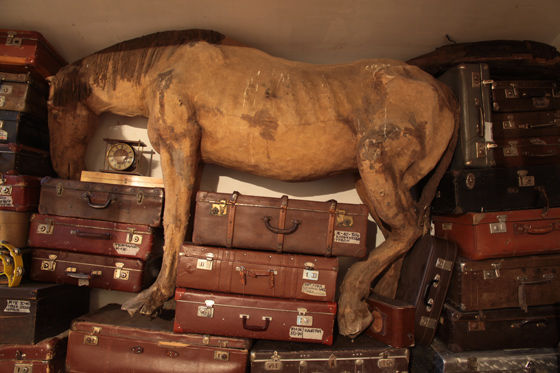 © Herwig Heller part of the Petlyura collection in his basement, Moscow, 2012