
Translated material
The price for an orphan
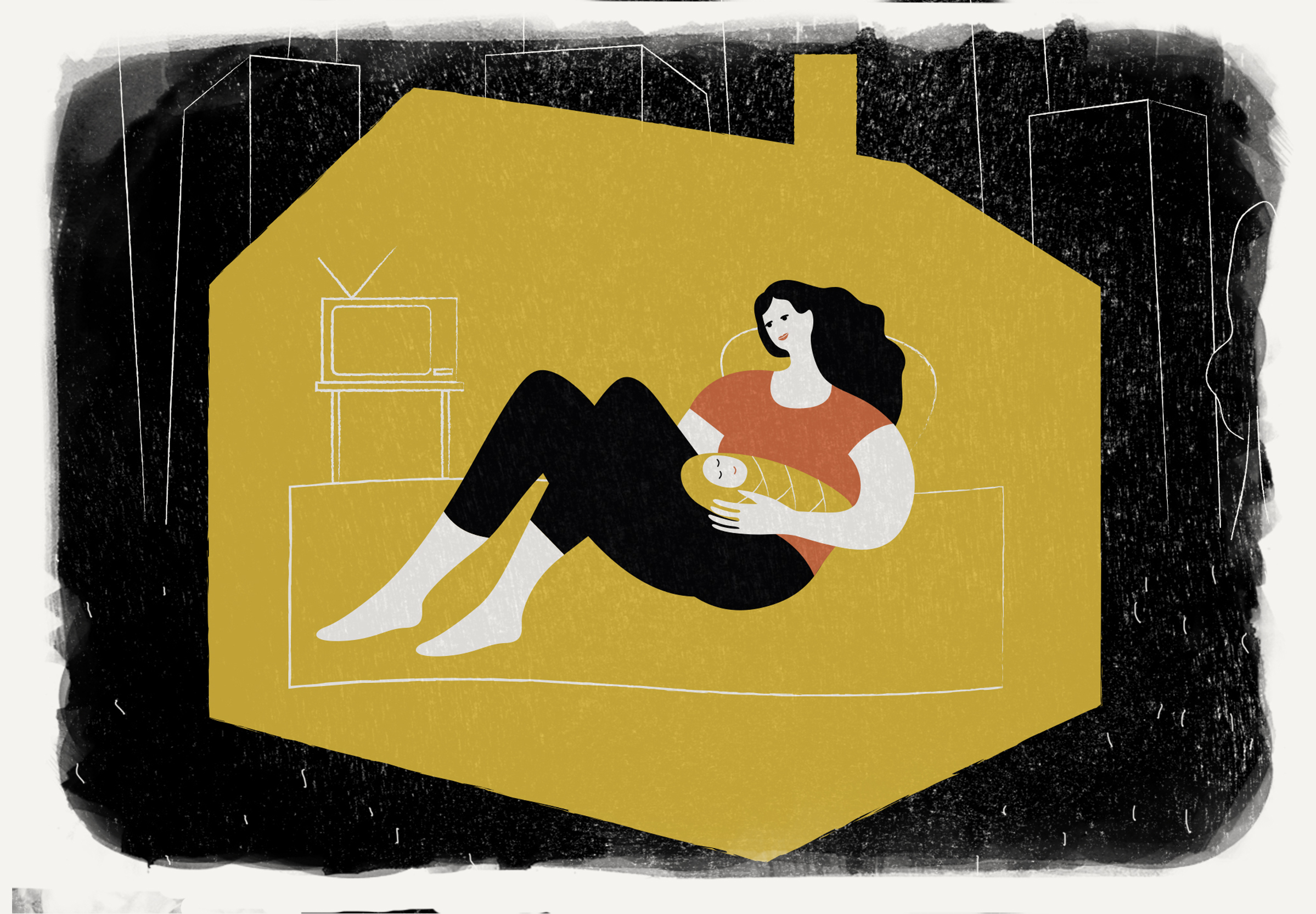
Several months of psychological, legal and medical care to young mothers - this is the way to reduce the number of refuseniks.
We help the prevention of refusals from newborn children collected 897,565 R required 625,000 rThe collection of funds is over
The train near Moscow, swaying with a creak, is taking me to the city of Pushkino. I am going to a “ warm house ” - a shelter for women who were with newborn children in their arms and without a roof over their heads. I almost arrived when the sounds of the guitar are suddenly heard in the train and a hoarse male voice begins to sing the American ballad “The House of the Ring Sun” - “The House of the Rising Sun”. Under the words “Oh Mother Tell Yoor Children, Not Do What I've Done” (“Oh, mother, punish children like me”) I go out at Klyazma station.
A girl with big blue eyes meets me - one of those who now live in a "warm house". I think that she had just graduated from the university, and miss: Tatyana (name changed) this year will turn 30 years old. On the way to the shelter, she tells me her story - from the category "this cannot happen to me." Tanya is a native Muscovite, she has a higher education. There is a child from the first husband who lives with her mother. With the second civil husband Tanya was together for three years. They created a common business-an online store for the sale of shoes. They seemed to live well, well, they quarreled sometimes, but with whom it does not happen? When Tanya became pregnant, her husband wanted to leave the child. It will only strengthen the family, then Tanya thought. this cannot happen to me Twist this quote
But at the beginning of this year, she found that their employees had nothing to pay - the score of their company was completely reset. They did not store money at home. I called my husband, who was away. “I’ll come on Tuesday, and we will decide everything,” he answered, but neither on Tuesday, nor on Wednesday, he never appeared, and the phone suddenly ended up outside the access zone. A little later it turned out: the company is bankrupt, the husband withdrew all the money from the account and disappeared. Even friends did not know where he was - before leaving he took them from them ... Tanya was then in the sixth month.
She tried to find a job, but no one took her at such a long time. Then they evicted from a rented apartment - there is nothing to pay. Friends and colleagues did not help: they said that the crisis is already difficult for them. At that time, Tanya was a lot of nervous, and somewhere she lost her passport-there was more one problem. The gimp with the restoration of documents took place against a background of strong toxicosis. The child was born a month ahead of schedule. I called my mother, but she refused: "I have raised you two, and now let's do it myself somehow." I didn’t even come to the hospital.
And imagine Tatyana: with a newborn child in her arms, without a family, housing, money, passports ... What to do? The woman began to hysteria. In this state, she was seen by the head physician of the hospital, and invited an employee of the "warm house". They brought Tanya there after discharge. What has changed over the past three months? A psychologist worked with a young mother who helped to get out of depression and realization that you were abandoned by the closest people. The lawyer helped restore documents, and she was also waiting for her in the same place where she worked before meeting with her husband. He says that he soon plans to leave the “warm house”: rent an apartment, find a nanny to the child and start all over again. Only while without men - Tanya is not ready to believe them again. And it’s a pity that without a mother - she still does not burn with the desire to communicate. With a newborn child in his arms, without a family, housing, money, passports ... What to do? Twist this quote
Muscovite in the "warm house" is still a rarity. Most of the inhabitants are from the Russian regions or republics of the CIS. Each has its own drama, but one finale - they had nowhere to go from the hospital. There was nowhere to pick up the baby. And so they were ready to write a refusal ...
The shelter has agreements with four maternity hospitals and hospitals in Moscow and the Moscow region. When doctors see that a woman is ready to leave a child, they call a shelter, and a psychologist comes to a woman to understand the reasons. In half the cases, it turns out that a woman would not be glad to give a child, but simply does not see another way out for herself. And in this case, the psychologist tells her that there is a way out is a “warm house”.
In the office for the shelter staff, I see photos of the children who lived here. The photographer is sometimes invited here so that the mothers have pictures of their children, because most of the inhabitants of the camera do not even have a camera in a cell phone. Now all these children are at home, with mothers. In his house and with his mother.
I am considering photos and listening to the story of employees. The project "Warm House" is four and a half years. Founded by the Foundation " Volunteers to help orphans . The fund helped children, who were refused in the hospital, but at some point it became clear that there would be fewer such children if their mothers were offered at least some help. If their mothers would be elementary where to go after the hospital. The refuseniks would be less if their mothers would be elementary where to go after the hospital. Twist this quote
For these four and a half years, 42 women and 46 children lived in the shelter. The youngest was 22 years old. The oldest is 36 years old. Six women can live here at the same time. On average, they remain in the "warm house" for six months. True, someone lived for only a week-it took so much to contact relatives and buy tickets to their homeland. Someone is more than a year. During this time, women not only provide psychological and legal support, but can even teach a new profession, for example, the ability to make manicure and pedicures.
Where do they go later? Most often home: the shelter’s employees help restore contact with relatives, and even if they initially believed that the birth of a child out of marriage is a shame, then, seeing a photo of the baby, they say: “Come on, come already.” A more rare option is working with accommodation. Such work with you and I may seem unattractive: for example, one girl went to care for a lying grandmother in a deaf Tatar village. But she is satisfied: there is a roof over her head and the child is nearby. Some lawyers help someone to buy housing for maternity capital-even if this housing is a room in a hostel near Vladimir. It happens that the inhabitants of the shelter become friends and decide to rent housing together and work on a shift schedule so as not to spend money on the nanny. One way or another, these women find a way out of their desperate position - a way out for a better life for themselves and their children. Thanks to the employees of the shelter, they do not make mistakes, the cost of which would be broken fates - their and their children.
There is a shelter due to private donations. And here I would like to ask you about participation. The Help Foundation raised funds for partial wages within eight months of the following employees of the “Teplny House” - the head of the project, two psychologists and a lawyer. The amount is small - only 625 thousand rubles. And while I was preparing this material, it was possible to assemble it. “Need help” closed this fee, but asks you to help the shelter, which is constantly in search of money. Only for renting a house where the shelter is located, 70 thousand rubles are paid monthly. The psychologist who goes to the hospital in order to convince the woman not to refuse the child, receives 16 thousand rubles a month. Money is needed for food and medication. The Panthenol spray, one of the most common medical tools for children, costs an average of 250 rubles. Any amount that you can sacrifice will work to ensure that one orphan in our world would be less. And the “Help” fund guarantees that for each of your ruble - within the framework of the estimate and beyond it - the “warm house” will provide a report.
In 2013, in Russia, about six thousand women left children in maternity hospitals. We can do so that there are fewer failures.