
Translated material
Quiz on the blood
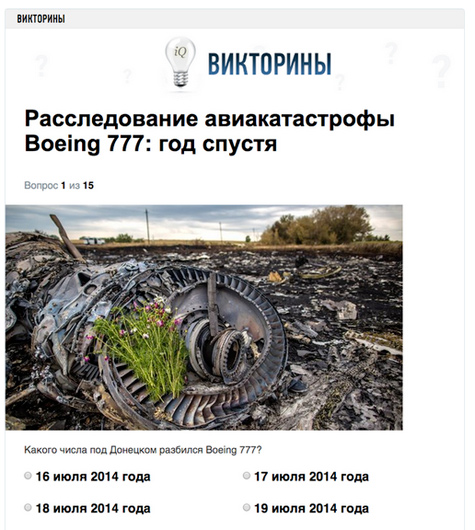
RIA Novosti made a quiz, offering readers 15 questions about the passenger Boeing, shot down over Donbass. If the reader answered the question correctly, for example, indicated the exact number of victims, the algorithm congratulated on the correct answer.
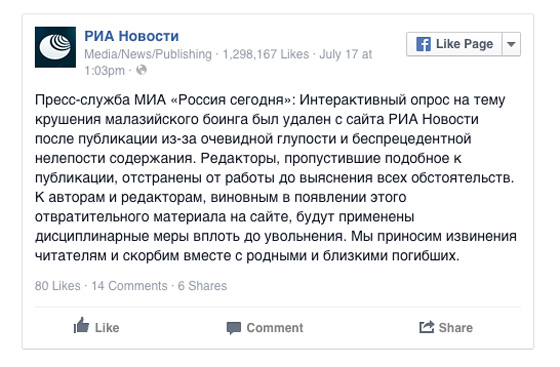
The quiz caused indignation on the network and was removed from the site. RIA apologized and promised to punish the perpetrators up to dismissal .
The media earn on tragedies, this is known. Now they also play. Interactive polls allow you to involve the audience using its minimum, “muscular”, activity. Having clicking on some button, people express support, condemnation or demonstrate their own competence. Even such a minimal author’s activity of readers provides a higher level of involvement than just reading. These baits are more effective, interesting than content. Therefore, media (and not only) increasingly use such "services of lazy authorship."
The desire at all costs to get the audience is now being realized in the search for new forms of involvement. This is hypnosis for hypnosis. The form uses the content only for the actual binding: the plane is not important, the quiz is important. The Medium itself creates the Message , and the content is secondary, as Makluen pointed out. Anyone will fit. Similar stories are increasingly taking place. In a trap of format, when the technique blocks ethics, not only RIA Novosti came across.
 © RIA "News"
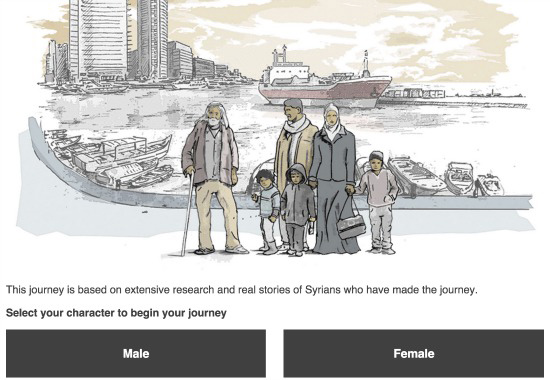
The Air Force (also the State News Agency) in April 2015 issued the project “Syrian Journey: Choose Your Own Escape Route” . This, in fact, is an interactive game that offers the reader to be a Syrian refugee and choose the path of evacuation from Syria on behalf of a man or woman. For each selection of the user, Victorin draws the promotion of the route on the map and reports what dangers and deprivation can expect a refugee at this point of the route, including the separation of families, capture hostages, deportation or death. Reporting, in fact, the information unfolds in a playful way: a new portion of content depends on the choice of the reader. This is another variety of the “service of lazy authorship”, when the reader is involved at the level of “mouse” activity, which means that it interacts with the content and the media brand more actively than if he simply passively perceived the information.
The Air Force quiz caused criticism from experts and colleagues who accused the agency of “turning human suffering into fun” (“... Transformm The Human Suffering of Literally Millions Into a Children ' s Game ") . Nevertheless, the Air Force defended its project, insisting that it increases the audience’s awareness of the distress of Syrian refugees. “The project is based on real stories of refugees gathered by journalists, and shows the audience the choice that thousands of Syrian families are faced with,” the Air Force reports in response to criticism. And then he adds: "The project received a million views." And this is perhaps the main thing.
 © BBC
© BBCSimilar problems of the ethical properties appear in the other prime -fashioned direction of media innovation - in “Immersive” ( Immersive Journalism ) . For example, the 5-minute film “The Party” shows a student party through the eyes of a young man and the eyes of a girl. Although this is not quite a film - we are talking about “watching” the situation of virtual reality through the Oculus Rift device. The theme of the work is sexual violence in the campus. The viewer gets the opportunity to “perceive” the situation from the inside of the character. Despite the fact that the topic is extremely acute, a piquancy element is present in the presentation. However, the element of piquancy would be present in the traditional presentation of this topic .

A similar project with an immersion of the viewer in the situation was presented in 2014 at the Davos forum. Project Syria used virtual reality technologies to allow the audience to be “attended” on Syrian street during a missile strike, and then end up in a refugee camp. The reconstruction uses real shootings, as well as high -quality graphics of a computer game. And although the author of the Nonny de La Pena project emphasizes the presence of ethical restrictions, the very room of such a topic in the reality of the computer game looks ... unusual .
The use of Newsgame - game forms, as well as virtual reality, is indicated in the first place among the 9th editorial trends of 2015 . It should still be noted that the game itself, or the “service of lazy authorship”, does not doomes the creators to violate ethical norms. The game-port, like a quiz, can be quite harmless and even-it happens-cognitive. But still, the shift of creative efforts from content to the form, apparently, inevitably entails some moral risks.
There was always some tension between the need to attract an audience and a social mission. This voltage often vomits fuses, especially at the transitional stage, when new and unusual public formats appear. The attraction easily obscures all other functions of journalism. The tools are not neutral: certain formats or genres are “charged” with their purpose. A quiz is an intellectual, but still entertainment. The game is fun, even if it is good for immersion in a specific story. The editorial offices, looking at new trends, should take it into account.