
Translated material
Golden sleep grip
Maria Galina’s novel “Autochton” is read differently by different people. It is possible that of these numerous readings, no one coincides with the fact that Maria Galina herself has already said and will probably say about her novel.
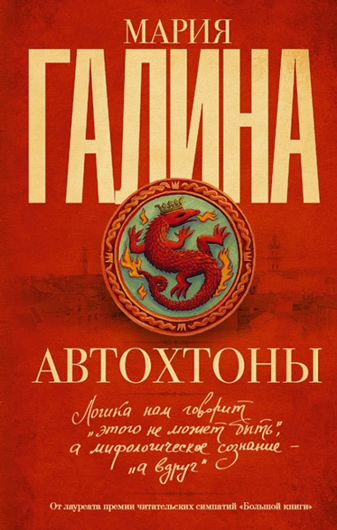 © AST
© ASTFor such multilayer stories, this situation is completely natural. This novel is not written at all so that everyone is equally understood. It sounds somewhat clumsy, but the “autochthons” do not need to be equally understood - we must feel equally. Well, more or less the same. Ideally, about the same relationship, between the two main characters, should be established between the reader and the novel.
The first main character, gaining the name only at the very end, and even by accident, comes from unnamed area to a certain, also nameless city. He comes for a reason, he has some kind of secret goal, about which we have no idea. Somehow, this goal is connected with the opera “The Death of Petronius”, set in this city in 1922 to anyone unknown to the group “Diamond Vityaz” and withstood exactly one performance.
Here in this place the first trap has already been prepared for the reader, one of those that Dickens wrote, “hold and attract”. They tell us that the “diamond knight” is like a fragment of a “tubercle jack”: we need to translate the phrase “booze jack” into English, you will get “Knight of Diamonds” , and then transfer back to Russian, for example, with the help of Google - here is the “diamond knight”. Everything would be fine, but only the “tambourine jack” in English will be “Knave of Diamonds” , and any “word by word” method of translating, except the “diamond scoundrel”, will not be given to you.
But this is only the beginning. The first main character (like any tourist who comes to this city) is immediately immersed in the world of legends and illusions. Ancient, almost Roman yet, catacombs under the city, one of the main tourist attractions. City pharmacy with its blood-peak history. Quite living contemporaries of the same opera production, quite young. Werewolves, at night attackers of people. Salamander, who are fed with milk in specially left saucers at night. Reasonable newtons that are self -proclaimed in urban sewage. Mysteriously empty graves in the city cemetery. The unearthly beauty of the sylphs, the creation of air and the children of the world.
And much more.
In that unnamed area from which the first main character came, there is nothing like this. That is, once, perhaps, it was, but this is already over. What Roman catacombs? Old wine cellars in which gullible tourists lure. And the story with a bloody pharmacist was already told several times in one Austrian town and in other places. How did you say - Salamander? “There is such a thing called a lighter. Such, you know ... Click a wheel ... ". Reasonable Triton generally turns out to be a bald local resident, someone's uncle. As for Sylph, this is the patient of the psychiatric hospital, who was taken to her, the barmith from Krinitsa and lives with him as with her husband.
It would seem that the appearance of a rationally thinking individual should radically reduce the number of false entities, but this does not happen. It turns out exactly the opposite. The resuscitation of the old and all the forgotten story about the “death of Petronius” unexpected for the Aborigines (or autochthons) leads to a long -not seen surge of myth -making. Well, the fact that the release of souvenir dishes begins with sketches of the artist of the performance, and the mayor of the city is preparing for the presentation of a suddenly open episode from the world history of the theater is still familiar. But the secret society of the “music lovers” also appears, who believe that the orgy spontaneously arising at the view was provoked by the unknown “music of spheres”, and hunting for the gap of the gone without a trace by a trace. Together with them, “contactors” act. These have their own theory: the composer was an alien from space and the owner of a crystal ball, and our main character was also an alien and went down to the ground to take possession of this ball. I must say that the “contactors” make an unsafe impression, so the main character has to admit that he is really an alien, but he refuses his rights to a crystal ball and urgently must leave back.
It’s not so easy to say goodbye to a golden dream.
But in parallel with the passive myth -frying, carried out by the main character, something strange happens. The character is more and more amenable to the charm of the illusory world surrounding him, and practically without resisting. He is like a magnet to himself the second main character.
It is clear why the word "city" is written everywhere in the text with a lowercase letter - the Bulgakov associations can only interfere. But right, of course, is the “city”, making a reservation that there is nothing to do with the Bulgakov city, except perhaps there and there and here banking street.
The city has a difficult past. Like many other border settlements in the west of Ukraine. The Huns and Tatar-Mongols passed through the city, Taras Bulba walked there with his Kozatskoy Volnitsa, then there were Swedes, Germans, the first horseback, the reconciliation under the rule of the Commonwealth, advice, again the Germans and again advice, for a long time. After each next raid, the city more and more closed in itself, dug up, surrounded by legends, multiplied the illusions and parallel versions of its own history, enclosing from wars and political theories. He gradually turned into such a special city of Kitezh, about which no one really knows whether he really is, why he and what is happening there. The city has lost its historical identity, which could be written in the textbook that it was so, and this is how it was different, and replaced it with a cloud of many alternative interpretations. “Why is no one telling the truth? I always tell the truth. What truth do you need? " This method of protection.
And the city stopped time, it just stopped flowing, and the past, edited and propagated in various versions, merged with the present and future. "As always, you?" - asks the shoe in Krinitsa for the client for the first time there, and this is not by chance, because if he went today, he was also yesterday and tomorrow. Cars and strollers, sliding with white horses with plumas, are driving through the streets, giants walk on stilts, and the girls twisted with hops give out free beer passers -by. "Magic box the size of a city."
And the first main character begins to dream of strange dreams. In these dreams, he does not fly, as in childhood-he runs somewhere, he himself does not know where. The reality and sleep begin to be confused, and in the window, on the contrary, above the glass with a blazing raspberry light sign, where silent men eat dumplings, he sees every evening how the same girl in a small black dress corrects and does not correct the hairstyle, and that was yesterday, today will be tomorrow. But this is a very strong temptation: "Find the hidden door and slip through it - and there, outside the door, to see the light, and a bugol landscape with the mountains and the sea, and an angel with an olive branch." Something like the last refuge arranged by Woland for the master.
Of course, this is an illusion, another phantom generated by the city, but - as it was with Berange - "the honor of a madman who will bring to humanity the sleep of gold."
However, the first main character refuses the illusion. He leaves, and here we first learn something about the unnamed area from which he arrived in the city. There are "terrible iron sounds, and people with fester heads, and darkness, and dirt, and shame, and sometimes blood."
The train takes him to this unnamed, but painfully familiar area. “And he slept on the upper shelf, clutching a dead phone in his hand, and his legs twitched in a dream.” He still dreams that he is running somewhere. It’s not so easy to say goodbye to a golden dream.
So, if anyone is unbearable among people with pesh heads, re -read the "autochthones". Helps.
Maria Galina. Autochton. - M.: AST, 2015. 352 p.