
Translated material
Fear of emptiness
There is a tradition in the Ukrainian cinema community - to wait for one of the two main festivals of the country (“Youth” and Odessa) in the hope of new revelations in a short competition. Waiting this is certainly accompanied by mandatory skepticism, and its result is already the usual disappointment from time to time. The national contest "Youth" has become one of the weakest in recent years. The current Odessa film festival showed that, despite the quantitative rise of Ukrainian cinema (almost 200 applications are now submitted for participation in national competitions of both festivals), in relation to “quality (that is, the ability to work with a movie language, telling stories, etc.), everything is still. For three years, only two good young directors appeared in Ukraine, one promising and another group of small local stars that fade literally before our eyes.
The most important and productive year for young Ukrainian cinema was not at all revolutionary 2014, but the previous one, 2013. Then, at the “youth”, Marina Stepanskaya (“Vacations”), Katerina Gornostai (“Between us”) and Philip Sotnichenko (“Hugs”) debuted. Then, the cinema unification such like “assholes” and “Ukrainian evil” also functioned (albeit in the last breath): their representatives (Batitsky, Kenda, etc.) were considered headliners of festivals; The latter, however, once. The main hope of the new cinema was appointed Marina Vroda, who in 2011 received a short “gold” in Cannes. The two most original films - the work of Stepanskoy and Ermine - went completely unnoticed and did not receive any prizes. But now, two years later, their new paintings - “Men's Work” and “at a distance” - became the owners of the main awards of the Odessa festival and really were a cut above all other participants in the short competition.
The most important year for young Ukrainian cinema was not at all revolutionary 2014.
The victory of Stepanskoy seems especially symbolic. In 2013, her “holidays” were very close in spirit “between us” Ekhnostai: both gathered their cinema with improvised means, personally engaged in all, from directing to sound, both told very intimate stories about themselves and their wife (Ermine) or about a young couple (Stepanskaya). “Between us”, at the same time, quite soon turned into an object of a small cult, causing a whole series of imitations (from the “crystal” of Oksana Kazmina to the “Gleb Road” Anastasia Babenko). “Vacations”, despite all the originality, became, rather, by a hidden trophy, the audience of which immediately divided into two categories: those who enthusiastically accepted it, and those who categorically opposed.
Over the past two years, Stepanskaya managed to finish a documentary about the 90-year-old movie budget, who for more than 40 years shot a 16-mm film on the life of his native village. She worked on the set of the new film by Yuri Rechinsky “ Ugly ” , luring from there the Austrian operator Sebastian Taler. She also wrote a script for a full meter and simultaneously shot the short film “Male Work”.
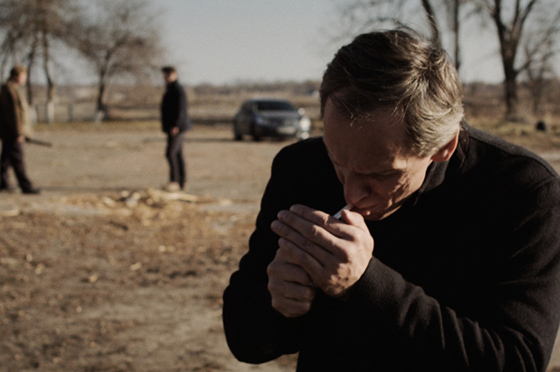 Frame from the movie "Male Work"
The film lasts only 15 minutes and can be mistaken for prologue to a full meter. Its plot easily fit into several lines: two men go to convince the farmer to sell their land. On the way, they meet their boss, requiring them from them. Then - the farmer actually and soon - the mysterious boy. At first, this resembles the “nostalgia” of Tarkovsky (especially the scene in which the hero is fascinated in front of the huge wall of the cathedral), after approaching the quiet Russian art laminstream. In the frame, fatigue gradually accumulates that does not leave all the heroes - fatigue from this very “male” work, from constant struggle, from life. Soon, however, a completely conventional story about the disproportion of a small person and majestic, understood in the romantic tradition of nature, turns into a real hockey. Classic hockey consists of three lines, the key place in it is given to the image of nature, often this naturalistic image turns out to be a metaphor for human life. All the same in the film Stepanskoy; In one of the first scenes, the heroes admire the dilapidated church, which is obviously perceived by them as part of the natural, not anthropogenic, landscape - a little later both surrender before its passive power. Other important conditions of Hokka are minimalism and focus at the present moment, on "here and now." Stepanskaya follows this rule. In her small film, there is practically nothing superfluous (including the climax), the audience is allowed not only to contemplate, but also to think up the story themselves. If the “Vacations” were, first of all, a small anarchist film shot on the knee, then “Male Work” is already a film of a mature director who can work so much: work with a frame and actors, withstand style, tell a story, get away from banality, speaking about simple things, and at the same time also play freely with the viewer.
Not just a game reconstruction of a certain real everyday situation, but also a fixation on the video of the process of representation itself.
At some point in the film, one of the protagonists tells how the hero of the book he read retold a poem about how a married woman fell in love with another and, returning from a date home, found a green inflatable ball on the bed. This simple poetic story looks completely inappropriate in the world of harsh men, who themselves are not able to comprehend and understand it. She literally destroys all our expectations from the film, shifts accents, worries. So the realistic plot before our eyes turns into history with hidden content - hidden not only in the film itself, but also in man, nature, peace in general. And the open finale is the same green ball endowed with personal meaning for each viewer.
Unlike “male work”, “at a distance” of Katerina Ekhnostai continues the DIY -Kino line. Night, bed, two close people and an extremely personal story about inevitable problems in relationships. That's all the components of this small chamber film. At the same time, the entire filmography of the Ermine is an artistic representation of her own personal life, and “at a distance” can be considered as a game continuation of her documentaries “between us” and “everywhere Maidan”. In “Between us,” for example, she told the story of her departure to Moscow to study at the school of Marina Razbuzhkina and the love triangle, which was the last on the eve of these events. In the film “Everywhere the Maidan” - gathered together scraps of personal memories of the winter of 2014. In the Dodal - recalls a small episode from life in a parental house, where, together with her husband, they were forced to huddle in a small room. This is a very intimate cinema of the crisis that is inevitable in any relationship. Its starting point is a conversation about sex, to which the ermine approaches with openness and tact unprecedented in Ukrainian cinema, which is why the viewer “at a distance” is in the role of a voyeurist who peeps behind a couple in bed, plunges into a thin atmosphere of awkwardness, fragility, vulnerability.
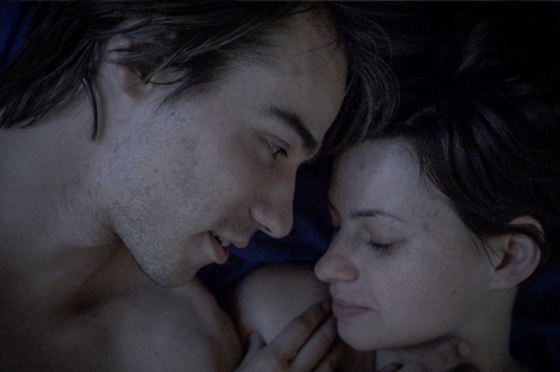 Frame from the movie "House"
This is if not an important directorial step forward, then at least the neat intelligence of the documentary in the territory of the feature cinema. "At a distance" was shot in almost one 11-minute frame. And this is the first bold decision of the ermine, which looks completely natural here. The second is a special regime of the existence of reality in the film: this is not just a game reconstruction of a certain real everyday situation, but also a fixation on the video of the process of representation itself, the dock about how a real couple, friends of the ermine itself, play her with her husband. Improvisation, the presence of someone else's vision, someone else's interpretation give the director the opportunity to look at what is happening from the side - and this experience of the real event changes all the initial ideas of the “confessional film picture”, turns the director from the subject of the statement into the first viewer of the film.
* * *
Each critic makes dozens of mistakes in his life. Two years ago, at the Youth Film Festival, they showed the short film by Philip Sotnichenko's hugs, and I was among those who completely ignored this work. But, having watched the next film Sotnichenko, “Son” at the Odessa Film Festival, I am ready to admit in it the potential of a strong criminal cinema in the style of Dominic Count. Sotnichenko knows how to tell stories, albeit sometimes a little confused, he is interested in the genre. Both of his films are small dramas of good guys who are on one side or another of the law. In the "embrace" it was a question of the confrontation between the policeman and the criminal. Their collision itself was taken to the background, and most of the time was occupied by a leisurely story about the drama of each of the heroes. In style, this even resembled a new Romanian wave. In the “Son”, criminal themes also serve as a skillful addition to the family drama, to the conflict of generations (in the film two stories of fathers and sons - the protagonist and his father and son are intertwined).
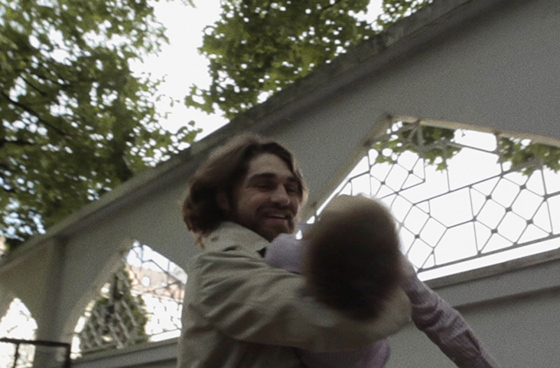 Frame from the movie "Son"
Sotnichenko is one of the leaders and initiators of the next Ukrainian cinema unit - “Suk” (“Modern Ukrainian Cinema”). Formally, this is a more open and free continuation of the case of “assholes” or “Ukrainian evil”; If the first two associations were inspired by producers, then the “SUK” is an example of self-organization of directors who are still familiar from studying at the Karpenko-Karoy Institute. Their goal is to show their short, cinema on large screens, combining small films into a large program. Their traditional rolling collections are the thematic collections of their films and the work of invited young directors (for example, “at a distance” of Ermine). Unlike nonexistent, more “assholes”, “bitches” do not make any clear requirements for the style of work, which is why each of their program sometimes resembles a selection of amoric cinema, where in rare cases you can find something interesting. Although it is more important here is another thing - the “bitch” managed to again bring the Ukrainian short cinema to the large screen.
From the films "Bitch" in Odessa there was still a new short film of Nikon Romanchenko "Carousel". And this is already a smooth transition to everything bad, which is so rich in the Ukrainian short meter. Two years ago, at the Kyiv “Youth”, Romanchenko made his debut with the small film “Salvation”, an original story about a teenager riot against parents, reminiscent of either Xavier Dolan, or British “angry”. Last year, his dock “The faces of the Maidan” defeated in Kyiv (Romanchenko gathered all the most cruel scenes that he managed to shoot during the revolution, diluting them with static video portraits of people; paradoxically, this winner of “Youth” was perceived by the audience as one of the most situation and bad films about the Maidan). “Carousel” is just an unsuccessful work resembling a bad video clip. Romanchenko tries to tell the story through images, and not through the text, but confuses spectacity with effectiveness. Each frame of the “carousel” turns out to be super -energy, excessively aesthetized, which interferes with the actual combination of personnel into the narrative. Confusing, disguised as an artistic technique, seems to be an attempt to hide the inability to tell your story. And this is the main disease of young Ukrainian directors.
However, the main drama of Ukrainian cinema seems to be the story of Marina Vroda. In 2011, Vroda won the Cannes Film Festival with a short-term Cross, but at home, due to overstated expectations, this small, similar to diligent terminal work, no one appreciated the film. Later there will be an unsuccessful Penguin documentary, filmed by one of the Ukrainian funds. And the new short film "Snails", which even the patient Odessa public managed to boast.
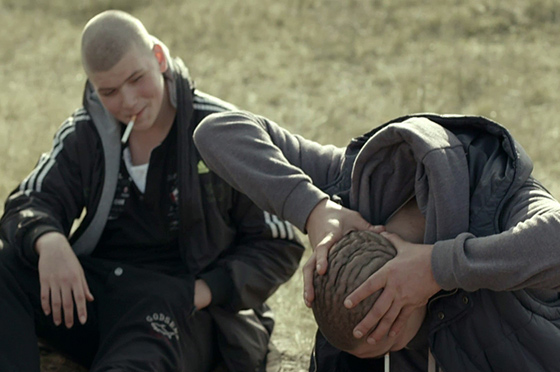 Frame from the movie "Snails"
“Snails” is a kind of requiem of conditionally street style “assholes” (it is interesting that the nroist has never been involved in this movement): marginals with beer and obscenities rest in nature. It all starts with the scene in which they communicate (let's call it so) several teenagers. Among them there is an older guy who came from Kyiv. His only professional actor plays in the film - and this alone distinguishes him from the team. Then the verbal clarification of the relationship, which will be immediately interrupted by the director at a glance, will follow.
Vroda literally uses types, but does not know what to do with them. Trying to let them say, but immediately intervenes in their conversation. The hero’s hero that interests her immediately falls out of history and seems to be the most unnatural character of the film. Perhaps this was the whole plan of “Snails” - to make a documentary about the actor depicting the marginal before the company marginalists depicting film actors. A good idea, but, alas, the reality here is again not subject to the director. As a result, having not achieved anything from the heroes (or actors?), The nroista interrupts the action obligatory for art kino with a long passage, leveting any emotion.
The “insomnia” first and only time talks about the war in the East and an attempt to evade the call.
However, then the director is awaiting failure: the tragedy of violets, despite distracting techniques, is quite read in her films. The protagonists of each of them are outsiders. As the author, the child is constantly trying to distance himself from them, although, as we know from the history of cinema, constancy in choosing a topic can say much more of any of his statements about the director himself. Each time, denoting the motive of the “other”, Vroda does not know what to do next with it. And this already resembles some kind of phobia, fear of opening up, the fear of saying finally something really important and personal. Perhaps that is why each of her new film looks more fake.
The descending trajectory of Marina Vroda is repeated by another star of the new Ukrainian cinema - Alexander Ratiy. With a nastom, there are a lot of them. They are both graduates of the Karpenko-Kary Institute. Like Vroda, Ratya also had its own moment of fame (victory at the Youth Film Festival in 2013) and two frankly failed subsequent work. Moreover, the last of them turned out to be so bad that it could only be seen in Odessa in the video - festival Vigwam, where films from another world were collected. At the same time, Ratiy is also a mentor of young directors: he taught them to make a movie and oversaw a course in a film school at one of the regional festivals. And this is also a very painful topic - the problem of training and mentors, guidelines and authoritative names. Here is just a small example: the country's main kinovus is the Kyiv National University named after I.K. Karpenko-Karoy-over the past 15 years (!!!) gave us only two truly interesting directors, and one of them (Stepanskaya) took place exclusively due to subsequent self-education. What, in the end, is every Ukrainian film festival, if not a demonstration of the failure of this university?
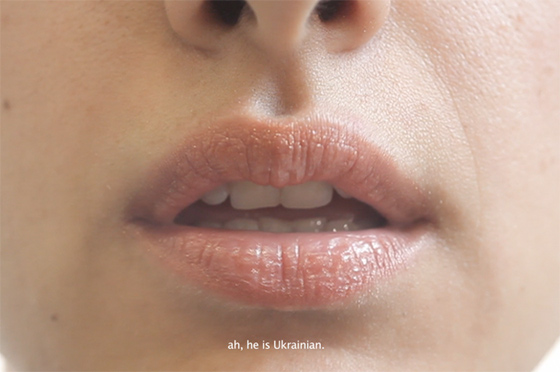 Frame from the movie "Insomnia"
 However, a much more painful problem is that today it is generally difficult to say what in 2015 a movie in Ukraine is being shot in 2015. General mood, trend? She is not. The theme of the Maidan has already gone the past, and its competent understanding, it seems, will remain an impossible task for our new cinema. As well as a comprehension of what is happening here and now, it does not matter, through the present or the past. The only attempt to say something about the war in the East was made in the "insomnia" of the 24-year-old Maxim Madonov-who, apparently, was removed outside Ukraine. The first and only time at the festival it was said about an attempt to evade the call-and this short, slightly naive monologue of a young man who cannot fall asleep somewhere in beautiful and distant Europe, seems to be the most fresh voice in a long list of almost fifty new Ukrainian short films. All others, as before, are trying to compete with reality, but lose it. They do not want to think, look, ask questions. Every second of them, choosing a topic, immediately goes ahead. At the same time, he is afraid of difficulties and simplicity, afraid to speak on his own behalf, is afraid to be ridiculous or naive, sincere or incomprehensible, afraid to observe and try to understand what he saw, is afraid of the experiment. Maybe fear - this is really a new trend in Ukrainian cinema?
Odessa - Kyiv, July 16-19