
Translated material
Expand your telescopes
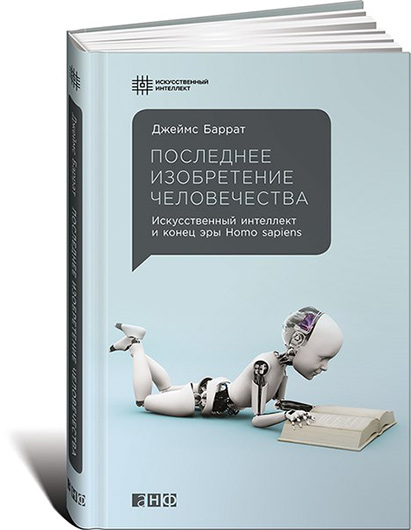
The book “The Last Invention of Humanity” is published in the Russian translation at the Alpina Non-Fixing publishing house. The author, American documentary director James Barrat, analyzes the most hackneyed plot of science fiction-about the riot of artificial intelligence-from the point of view of academic science. Since 2000, he interviewed the main theorists (and practitioners) of this issue-from the futurologist Ray Kurzweil and science fiction writer Arthur Clark (when Barrat became interested in this topic, the classic was still alive) to the Mathematics of Vernon Winja and Exchange Robots.
One of the unexpected conclusions of the book is that artificial intelligence is the main obstacle to the discovery of life in space. This week, entrepreneur Yuri Milner said that he would donate $ 100 million for a 10-year project dedicated to the search for extraterrestrial life, in which the Astrophysics of Frank Drake agreed to participate (he proposed the famous formula for assessing the number of inhabited worlds in the 1960s) and Stephen Hawking. However, according to Barrata, the extraterrestrial mind requires completely different conditions for itself than the alien life that is expected to find - and the search will not end in any good.
I personally see a kind of black humor in that the first contact of a different galactic life with the Earth may look like a cheerful greeting on the radio, and then the devastating deadly landing of nanofabrics. In 1974, the University of Cornell, launching the updated radio telescope Aresibo, transferred the so -called Epistle of Aresibo to the space. This message, developed by the founder of SETI Francis Drake, astronomer Karl Sagan and other enthusiasts, contained information about human DNA, the population of the Earth and our coordinates. The radio broadcast was aimed at the M13 star cluster, located at a distance of 25,000 light years. Radio waves travel at the speed of light, so that the message of Aresibo will reach the destination no earlier than 25,000 years later. Maybe it will not get to the place at all - after all, the M13 will change its position regarding the land compared to 1974. Of course, the Aresibo team knew this, but still took the opportunity to post itself and its project.
 © Alpina Publishing House
Nevertheless, other star systems can be more effective targets for messages from radio telescopes. And the mind that these messages will discover may not be biological at all.
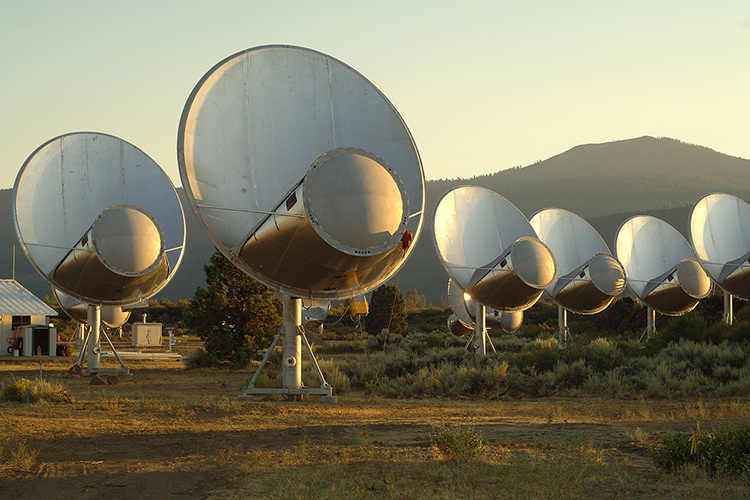
Such an assessment of the situation gives SETI -the organization to search for an extraterrestrial mind with the headquarters in the Mountain-Vew (California), just a few quarters from the Google headquarters. This organization, which has existed for half a century, is trying to catch the signals of the extraterrestrial mind from a distance of up to 150 trillion km. To receive alien transmissions 450 km north of San Francisco, 42 giant plates of the radio telescope were built. Seti listens to signals - but he sends nothing, and for half a century the employees of this organization could not hear anything from other planets. But one annoying circumstance, which suggests the possible spread of an artificial superinTelelex, managed to establish for sure: our galaxy is weakly populated, and no one knows why.
The main astronomer Seti, Dr. Seth Shostak, put forward a bold assumption of what exactly we can meet in space, unless, of course, we meet at least something. It will be an artificial, not a biological mind.
He told me: “What we are looking for there is an evolving object. Our technological achievements teach us that nothing remains stable for a long time. Radio waves that we are trying to catch are the result of the activity of biological entities. But the temporary window, meanwhile, is the moment when civilization gets the opportunity to declare itself on the radio, and the moment when it begins to build the surrounding cars, thinking cars, is only a few centuries. No more. It turns out that each civilization itself invents its successors. ”
Our galaxy is weak, and no one knows why.
In other words, for any reasonable form of life, there is a relatively short period of time between two technical milestones - the appearance of radio and the appearance of advanced artificial intelligence (AI). And it is worth creating powerful AI - and it quickly takes control of the planet or merges with the inventors of the radio. After that, the radio becomes unnecessary.
Most of the Seti radio telescope is aimed at the "zones of life" of the stars closest to the ground. The planet in the "zone of life" is located close enough to the star so that the water on its surface can remain in a liquid state - it does not boil or freeze. In general, the conditions on such a planet should very accurately fit into a rather narrow framework, so sometimes the “zone of life” is also called the “Zlatovlaski zone” - by the name of the capricious heroine of the famous fairy tale.
Shostak claims that Seti should be directed at least part of its receivers to the sections of the galaxy, the conditions in which are represented by attractive for the artificial, rather than biological mind, in the peculiar “Zlatovlaski zones” for AI. These are areas rich in energy - young stars, neutron stars and black holes.
I think we could watch a small part of the time that are perhaps not too attractive from the point of view of the biological mind, but where reasonable machines can live. The cars have different needs. They have no obvious restrictions on the duration of existence, so they, obviously, can easily take a dominant position in space. And since their evolution is much faster than biological, it may turn out that the first reasonable machines that appeared on stage will ultimately subjugate all the rational creatures of the galaxy. This is the case when "the winner receives everything."
Supernocial machines need a super -cooler environment.
Shostak connects modern cloud services organized by Google , Amazon and Rackspace , with high -energy super -cooler media, which will require supernatural machines. One of the examples of such frozen media is globes (dark gas -pale nebulae with a temperature of about -263 ° C, one of the coldest objects in the universe). Like today's computing clouds of Google , the hot thinking cars of the future will probably need cooling; Otherwise, they can simply melt.
Shostak’s proposals about where to look for AI tell us that the idea of the mind, which leaves the earth in search of resources, is able to light a less lively imagination than that of Stephen Omokhundro and children from Miri (the Institute for Study of Machine Intelligence in California. - Ed. ). However, Shostak, unlike them, does not think that the superno will be dangerous.
“If in the next five years we will build a machine with the intellectual capabilities of one person, then its successor will already be wise than all humanity combined. Through one or two generations, they will simply cease to pay attention to us. Just as you do not pay attention to ants in your yard. You do not destroy them, but do not tame them, they practically do not affect your daily life, but they are there. ”
The problem is that, for example, I destroy the ants in my backyard, especially when they lay paths to my kitchen. But there is a difference: an artificial superinTelelex (ISI) will fly to the galaxy or send probes there, because the resources on Earth he needed has already ended or he calculated that they would end in the near future - and expensive spaces are justified. And if so, then why will we still be alive by that time, if there is probably a lot of the same resources on our existence? And do not forget: we ourselves, too, are from the substance for which ISI can find his application.
In short, that the Happy End on Shostak becomes possible, the super-meaning that is discussed must want to leave us alive. It’s not enough not to pay attention to us. But so far there is no generally accepted ethical system, nor a clear way to put such a desire in advanced AI.