
Translated material
The Russian Orthodox Church asks to transfer her to the Isaac's Cathedral
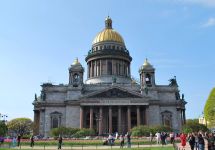
The St. Petersburg diocese turned to the city authorities with a request to transfer to it to the Isaac's Cathedral. This was reported by Interfax with reference to the press service of the diocese.
"The appeal was sent to return to the free use of the Russian Orthodox Church in the person of the St. Petersburg diocese of the building of the Isaacievsky Cathedral on the basis of the current legislation," the press service said. The request was sent about a week and a half ago, but the answer to it has not yet been received. The diocese emphasized that the cathedral in the event of its transfer to the church will remain available for tourists and citizens.
"The dioceses consider the problem of the return of church property and, above all, temples that were built and intended for liturgical purposes, very urgent," the press service noted.
In addition, in the St. Petersburg diocese, they also insist on the transfer of the Annunciation Tomb of the Alexander Nevsky Lavra to the Church. “Unfortunately, many media outlets continue to replicate the wrong statements that the Annunciation Church was exclusively on a tomb. We insist that the Annunciation Church was built as a temple in which burials could be made. The church was closed to one of the last, in the 1930s, worships were regularly performed there,” the press service said.
Later, a source familiar with the situation, told the agency that the diocese was preparing an appeal to transfer to the ownership of the Russian Orthodox Church also to the Temple of the Savior on the Blood, built at the murder of Emperor Alexander II. The corresponding letter to the city authorities has already been written. However, the press service of the diocese refused to comment on this information.
Savior on blood along with Sampsonievsky, Smolny and Isaac's cathedrals is part of the State Museum of the St. Isaac's Cathedral.
The spokesman for the governor of St. Petersburg Andrei Kibitov said that the issue raised by the diocese requires careful and comprehensive consideration. He confirmed that the appeal of the Russian Orthodox Church was received. No decision has yet been made.
The chairman of the City Committee on Culture, Konstantin Sukhenko, said that they had not previously planned to be transferred to the Church of the St. Isaac's Cathedral and saved the blood on the blood. “As far as I know, there was an agreement that the Isaac's Cathedral and saved on the blood are not transmitted, but, apparently, either the leaders of the diocese or relations have changed. Apparently, the agreements that acted until recently will be reviewed,” Suchenko emphasized. “They didn’t want to be transferred before, because these cathedrals were not in the full sense of the word of the Church: they were in the property of the courtyard and the property of the courtyard and the property of the courtyard and the property of the courtyard and the property of the courtyard and had a special status. "
Isaac's Cathedral is the largest Orthodox church in St. Petersburg. It was built in 1818-1858 according to the project of the architect Auguste Montferrand, the construction was supervised by Emperor Nicholas I. Consulated in the name of St. Isaac Dalmatian, revered by Peter I Saint, since the emperor was born on his memory - May 30 according to the Julian calendar.
The cathedral has the status of a museum. The church community registered in June 1991 has the opportunity to perform a worship on special days with the permission of the directorate.
In April 2013, the director of the GMP "Isaac's Cathedral" Nikolai Burov said that the authorities of St. Petersburg intend to transfer the Smolny Cathedral in the near future. At the same time, Burov noted, the authorities have not yet been allocated a new premises for exhibitions and concerts.
The city authorities and the Russian Orthodox Church concluded an agreement on the transfer of the Smol Cathedral on March 1, 2013. The basis for the signing of the document was the Federal Law adopted in 2010 "On the transfer of religious property to religious property, which is in state or municipal property."
Currently, the Smolny Cathedral continues to remain as part of GMP, concerts are taking place there.