
Translated material
Memory. Nikolai Kuznetsov
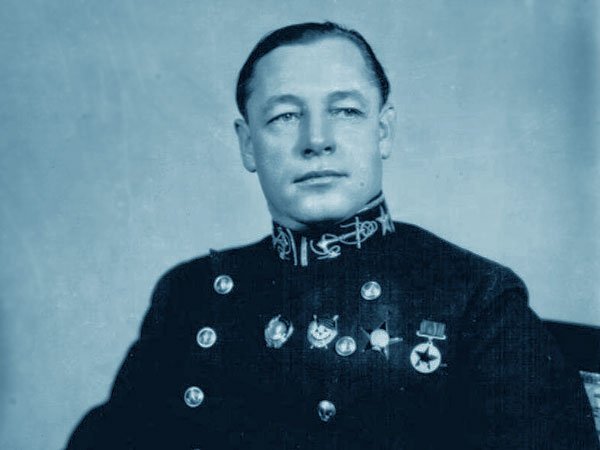
July 24, 1904 was born Nikolai Kuznetsov, the legendary Soviet admiral of the fleet
Personal business
Nikolai Gerasimovich Kuznetsov (1904–1974) was born in the village. Medvedki (now in the Kotlas district of the Arkhangelsk region) in a peasant family. From the age of 13 he worked as a mess in the Arkhangelsk port. In 1919, he joined the North Vodinsky Military River Flotilla. In 1921-1922 he was a drill of the Arkhangelsk naval crew. Since 1922 he served in Petrograd. In 1923 he entered the Naval School. Frunze, who graduated in 1926 with honors. The service of the service was chosen by the Black Sea Fleet. He served on the cruiser Chervona Ukraine - the first of the cruisers built in the USSR. He was the commander of the battery, the company commander, the senior watchman.
In 1929 he became a listener of the Naval Academy, which he graduated in 1932 with honors. After the end of the year was the senior assistant to the commander of the cruiser Red Caucasus. In November 1933, he returned to Chervona Ukraine cruiser as a commander. For several years he brought to perfection the system of combat readiness of a single ship.
In August 1936, Nikolai Kuznetsov was sent to the Civil War to Spain, as the chief naval adviser of the republican government. He participated in the preparation and conduct of combat operations of the Republican Fleet, ensured the reception of transports from the USSR. For the service in Spain, he was awarded the orders of Lenin and the Red Banner.
Upon returning from August 1937, he first became deputy commander, and from January 1938 to March 1939 - the commander of the Pacific Fleet.
In the spring of 1939, Kuznetsov was transferred to Moscow to the post of Deputy People's Commissar of the Navy of the USSR, he was awarded an extraordinary military rank of the flagship of the 2nd rank fleet.
On April 29, 1939, 34 -year -old Kuznetsov was appointed People's Commissioner of the USSR Navy: he became the youngest People's Commissar of the Soviet Union and the first sailor in this position (previous people's commissars - Commissioner Smirnov and Chekist Frinovsky were active organizers of repression in the Navy and themselves became their victims).
In the position of People's Commissar of the Navy, Kuznetsov did a lot to strengthen the fleet -begun before the war. He conducted a number of major exercises, personally visited many ships, became the initiator of the opening of new marine schools and marine special schools (later Nakhimov schools).
With his active participation, the disciplinary and ship charters of the Navy were adopted. After the introduction of general and Admiral’s titles in the USSR in June 1940, he was awarded the title of admiral.
By the beginning of the Great Patriotic War, Kuznetsov managed to do a lot to strengthen combat power and increase the combat readiness of the Navy forces and means. On the night of June 22, 1041, he ordered them to bring them into full combat readiness, which allowed to avoid losses of ships and naval aviation.
During the war, Kuznetsov was a member of the Headquarters of the Supreme High Command, coordinated the military operations of the fleets and ground forces, and constantly went to ships and fronts.
On May 31, 1944, Kuznetsov was awarded the military rank of admiral of the fleet. On May 25, 1945, this title was equal to the rank of Marshal of the Soviet Union and marked marshal -type shoulder straps.
In 1945, Kuznetsov participated as part of the Soviet delegation in the work of the Crimean and Potsdam conferences of the leaders of three union powers. In September 1945, he was awarded the title Hero of the Soviet Union.
In February 1946, the People's Commissariat of the Navy of the USSR was abolished, and the Navy was included in the United People's Commissariat of the Armed Forces of the USSR. Kuznetsov was appointed Commander -in -Chief of the Navy - Deputy People's Commissar (then Minister) of the Armed Forces. However, already in January 1947, as a result of disagreements with Stalin regarding the program for the further development of the Navy, he was removed from the post of commander-in-chief and appointed head of the department of naval educational institutions.
On January 12, 1948, Kuznetsov, along with a group of admirals (L. M. Galler, V. A. Alafuzov and G. A. Stepanov), was devoted to the military collegium of the Supreme Court of the USSR. They were accused of the fact that in 1942-1944, without the permission of the USSR government, the UK and the United States transferred secret drawings and descriptions of high -altitude parachute torpedoes, distance grenades, several ship artillery systems, firing control schemes, as well as a large number of secret marine cards. The collegium found Kuznetsov guilty of charges against him, but, given his great merits in the past, decided not to apply criminal punishment to him. However, he was lowered in a military rank to Rear Admiral. The rest of the accused were convicted of various terms of imprisonment.
Since June 1948, Kuznetsov held the post of deputy commander in chief of the Far East for Naval Forces, and since February 1950, the commander of the 5th Navy in the Pacific Ocean.
In January 1951, Kuznetsov was awarded the “next” military rank-Vice Admiral.
On July 20, 1951, Kuznetsov again headed the fleet as the USSR naval and was in this position until March 15, 1953. However, the criminal record was removed from him, and the title of the fleet admiral was returned only after the death of Stalin, May 11, 1953.
In 1953, Kuznetsov was appointed Commander -in -Chief of the Navy and at the same time the First Deputy Minister of Defense of the USSR - at that time this post was held by Nikolai Bulganin , whose daughter Kuznetsov was married. In March 1955, his title was renamed the Admiral of the Fleet of the Soviet Union and he was awarded the Marshal star. During this period, Kuznetsov paid great attention to the technological re -equipment of the fleet, including the development of aircraft carriers.
After Bulganin, Georgy Zhukov, the post of Minister of Defense of the USSR, was leaving, with whom Kuznetsov has not been completed from the time of the war. In December 1955, Kuznetsov, under the pretext of guilty of explosion at the Novorossiysk battleship, was removed from his post (although at that time he was on a vacation on illness-he had a heart attack), and on February 17, 1956 he was reduced again to the Vice Admiral and resigned with a humiliating formulation “without the right to work in the fleet”.
After the resignation of Kuznetsov took up the pen, began to learn English, read a lot of foreign military literature. He himself learned to print on a typewriter and, tapping two or three pages, but be sure to daily, if health allowed, he wrote the books “On the eve”, “On the distant meridian”, “Combat Alarm”, “Course to Victory” and “Cool turns: from the notes of the admiral”.
Over the past 18 years, he lived in the farm Moscow Region with his wife. Nikolai Kuznetsov died on December 6, 1974 in Moscow. He was buried in the Novodevichy cemetery.
What is famous
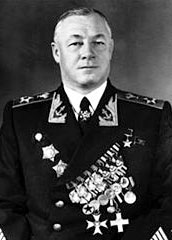 Nikolai Kuznetsov
Nikolai Kuznetsov is the most famous Russian admiral of the 20th century, whose name was covered with legends during his lifetime.
The “forever disgraced” Kuznetsov was reduced several times with the rank, but then they restored again for his merits in front of the fleet.
As a result, he twice became a rear admiral, three times - Vice Admiral and three times received the highest military rank in the Navy - the admiral of the fleet of the Soviet Union (the third time already posthumously).
Despite the fact that in the official history of the war his role was often obscured due to disgrace, it was thanks to Kuznetsov that the Great Patriotic War of the Soviet Naval Fleet met fully armed. Being in time brought into combat readiness No. 1, in the early days of the war the fleet did not lose did not lose a single ship, not a single sailor, not a single coastal battery.
Now the name of Kuznetsov is named the largest ship of the Russian fleet - the heavy aircraft -caring cruiser "Admiral of the Fleet of the Soviet Union of Kuznetsov", he erected monuments in Arkhangelsk and Vladivostok, named naval schools, squares and streets in many cities of Russia were named after him.
By order of the Minister of Defense of the Russian Federation of January 27, 2003, the departmental medal "Admiral Kuznetsov" was established.
Kuznetsov is also the author of several books - the “official” book “Course to Victory” and memoirs about the war, about repressions, about Stalin, which were published only posthumously; In them, he sharply criticizes party interference in the affairs of the army and claims that "the law must rule the law." Unlike many other "Marshal" memories, they were written by Kuznetsov personally.
What you need to know about
After Zhukov’s resignation in 1957 from the post of Minister of Defense, the group of veterans of the Navy repeatedly petitioned the government that Kuznetsov was restored and arranged in the group of general inspectors of the Ministry of Defense, which would give him, in addition to symbolic, and material advantages. However, all these initiatives came up to counteract the successor of Kuznetsov as the Commander -in -Chief of the Commander -in -Chief of the Navy S. G. Gorshkov.
Kuznetsov could not even be restored posthumously with the rank while Gorshkov was alive. Only after his death, Nikolai Kuznetsov in July 1988 was posthumously restored with the rank of admiral of the Navy of the Soviet Union.
Prior to that, for 14 years, by the will of his relatives, no military rank was listed in the Admiral’s grave.
Direct speech
“Kuznetsov is a legendary figure not only for the fleet, but for the whole country. Without Nikolai Gerasimovich, Russia may never have become a marine power, and a book of memory that died in the Second World War would be replenished with several thousand names, ” Anna Abramova, editor of the Academy of Russian Symbolism of Mars.
“I did not have to change the profession in search of a matter that would have been more to my liking. My whole life is connected with the Soviet Navy. I made a choice once, in very young years, and never spared about it ... ” - Nikolai Kuznetsov.
“I, as a communist, should tell the truth in the eye, no matter how unpleasant it is, if this is beneficial. I understood: either I have to go with the flow, knowing that sooner or later they would take me off, or actively fight for business, but in this case there is a danger that you will be removed, only with already difficult consequences for you. Experienced leaders preferred the first way. As an example, you can cite Admiral Yumashev. I prefer the second way, ” - Nikolai Kuznetsov.
5 facts about Nikolai Kuznetsov
- In order to join the North Vodvinsky Military River Flotilla, 15-year-old Nikolai Kuznetsov attributed to himself two years. The erroneous year of his birth - 1902 - is still found in some reference books.
- During the war in Spain, Kuznetsov took the pseudonym Don Nicholas Lanto - in honor of the greatest naval victory of Spain.
- On the initiative of Nikolai Kuznetsov, who then held the post of People's Commissar of the Navy, on July 24, 1939, the Navy Day was introduced.
- By order of Kuznetsov in 1941, the first diving special unit of Ron (special forces company) was created in the country.
- Kuznetsov one of the first military leaders and naval farmers in the USSR was introduced by the concept of “balanced fleet”.
Materials about Nikolai Kuznetsov
Site dedicated to Nikolai Kuznetsov
Kuznetsov Nikolay Gerasimovich . The project of the RVIO and VGTRK "100 great commanders".
Article about Nikolai Kuznetsov on Wikipedia