
Translated material
Andrey Clepach about the main
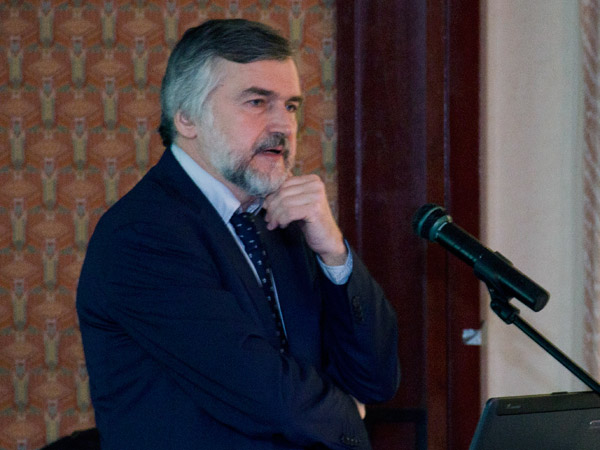
We publish a report from the next meeting of the Russian-Kazakh discussion club "Conversation about the economy and not only."
A bright and interesting undertaking - the discussion club "Conversations about the economy and not only" - has been holding its meetings in Kazakhstan for almost a year, in Almaty, with the support of the National Bank of the Republic of Kazakhstan and the Faculty of Economics of Moscow State University named after Lomonosov.
The quality of the discussion is surprisingly high - leading Russian scientists share their thoughts with colleagues from Kazakhstan, decryptions of these meetings appear in the press of Russia and Kazakhstan, and are quite understandable and useful not only to professionals, but also by a wide thinking public. The understanding of what is happening in our countries and in the world is growing, what to expect and what to prepare for.
At the next meeting of the club in the conference hall of the Rahat Palace hotel, the head of the Department of Macroeconomic Policy and Strategic Management of the Economic Department of Moscow State University Andrei Klepach, and the moderator, according to the prevailing tradition, was acted by Kairat Kelimbetov, the head of the National Bank of Kazakhstan.
Cleepach is interesting to the Kazakh side in particular in the fact that he worked for a long time in the Ministry of Economic Development of the Russian Federation, also oversaw the issues of the OPC economy, including space (Baikonura), this is a native, so all this is impressive.
He performed in the genre of understanding our time and today's challenges. The speech of Andrei Klepach was transmitted here abbess with the inclusion of quotes, non -sting. The conversation is about the most important in today's economy, about the fact that it is not clear not only to amateurs - and the pros is conceived here. Everything is very, very difficult. The usual approaches no longer lead to the truth. What's happening? What will happen next? What to do? Here's about this.
So, the price of oil is falling.
What can be seen from the dynamics of non-exporting countries? (And this is Russia, Kazakhstan and Belarus, which earned well on the oil refining of Russian raw materials and was actually an oil exporter.)
Before the crisis of 2009, in the 2000s, they developed faster than the world economy (!). And now the pace has fallen, and the development that we had in the 2000s was impossible. Stagnation began. For a long time.
What next? The transitional period, and in it - a few crooks.
Here are two crisis periods: 2008-2009 and 2014-2015. Russia is experiencing much harder than any of its partners - a reduction in GDP by 8 %, and neighbors have just a slowdown in growth. In dynamics, Russia was similar to, oddly enough, Ukraine, which became dependent on metals instead of oil. The only one who is very similar in dynamics to Russia is our fraternal Ukraine. Because, if in Russia the main component of the economy is mainly oil and gas, and it is they who create uncertainty in terms of export and shock fluctuations in oil prices, then metals act in Ukraine in the same role. In this regard, it was a big decline in 2009, so now we are observing it.
The current crisis on the Ukrainian economy was influenced by military operations, and sanctions to Russia that cut access to capital markets. And there is shock, and here. The negative effect of the Russian economy goes to Belarus and Kazakhstan, not so much through trade, but through - we will call the fall of the ruble an honest word - the devaluation of the Russian currency. Both in Belarus and Kazakhstan there was also devaluation, but it is several times less Russian.
And another Russian feature. Positive balance in current operations ranged in 4-6%in redwork, and in 2013 it amounted to 1.7%, and the trend-a drop of up to 1%. And this is not the result of a reduction in oil prices. The reason was different - quickly grew imports. This began to put pressure on the ruble, and he went down. Further shock factors: a drop in oil prices and sanctions, and a collapse began. However, due to the sharp compression of imports, even with the reduced export, for 2015, we expect a balance for current operations about 5%, or even higher-it grew both in 1999 and in 2009.
In Kazakhstan, the situation is different - periodically there is a fluctuation, the balance on current operations: either plus or minus.
In Belarus, the balance of the balance is steadily negative, it is covered with an influx of capital, and in fact, by loans, subsidies or investments from Russia.
In Ukraine, it is also stable negative. Partly correction occurs due to the devaluation of currencies. There is an influx of capital - this is the assistance of international organizations. Plus, the translations of Ukrainian migrant workers from abroad, which, however, were sharply reduced by a third or more.
But in Kazakhstan - "Carrying through the heartbeat." This usually leads to currency devaluation. In order to avoid it, a stable influx of capital is needed - this to Kazakhstan, unlike Russia, manages to achieve.
From Russia there is an outflow, according to the indicators of 2014-15, it is 7-8% of GDP, huge means. Therefore, despite the positive balance, we lose the currency reserve. Over the years of the new crisis, we lost more than at the end of 2008 - early 2009. Before that, we slightly did not have up to 600 billion, now we have 340, and then we can have about 300 billion. That is, we lost half of the foreign exchange reserves.
The problems and shocks of everyone are approximately general, and the reaction of each economy is completely different. Because countries differ both in economic policy and institutional policy. In Kazakhstan, economic institutions are still quite close, and with Belarus they differ by 20 or 30 years. The country lives in another time, and sometimes this allows you to amortize and soften shocks.
Many people think that the economies of Russia and Kazakhstan are strictly dependent on fluctuations in oil prices. But this ligament is not so tough. Here we can talk about “eco -meteric schizophrenia”, ecosometrics have such an expression. This is when there are very good statistical indicators, but they are meaningless. For example, everyone knows that the stork does not bring children in the beak, but they are still born as a result of people's meetings. But if you apply graphs of bird flights to the dynamics of the birth rate, and it is approximately the same in all countries, one peak in the spring, the other in the fall, it turns out that the birth rate depends on the flights of storks. True, normal people do not see causal relationships here.
The influence of oil prices on the economy, of course, is huge, but it is more interesting to find out another: how much the dynamics of oil prices diverges - with the real dynamics of GDP.
Let’s look at Russia of the 2000s.
The speakers differ quite strongly! This is somewhat unexpected, right? There are a bunch of sophisticated calculations, they show: 40 to 50% of GDP growth depends on oil. But here - attention - not only the price of oil is important, but also the volume of exports! The shock from the fall in the price was both in the crisis of 2008-09, and he, of course, gave a powerful blow to GDP. And there is an interesting thing, many did not notice it: oil has fallen in price everywhere, but in Kazakhstan there was no fall in GDP. Only a sharp braking!
Further, the price of oil went off above $ 100. Russia got out of the crisis in 2011. But still after the stagnation began! How so? Oil is expensive, but GDP does not save. What is the matter?
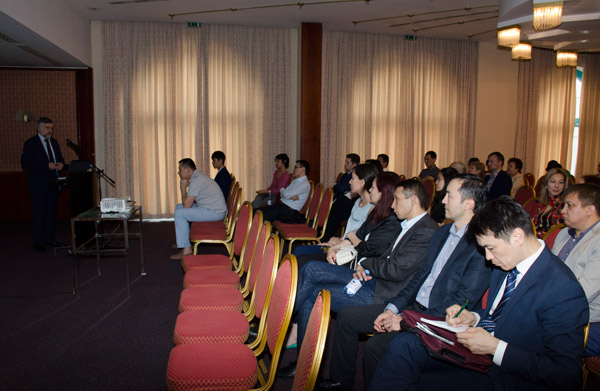 Andrey Clepach in the discussion club "Conversations about the economy and not only"
How to explain? For example, the fact that we have a bad investment climate. A very popular explanation. In my opinion, the wrong. Under the Soviet regime, they have not yet been talked about a bad investment climate, but in the current economy we are talking about a bad investment climate every year. The fall in GDP, stagnation - the climate is bad. GDP growth 7-8% is a bad climate. Gazprom’s investment falls by 30% or Rosneft is also a bad investment climate. The flight of capital is again the climate is to blame.
By the way, let's look at this. Through whom the money is withdrawn, who withdraws it? This is a very narrow circle of well -known players, key players in the Russian economy - on the one hand. And on the other hand, the population bought currencies last year, no less, more than 30 billion bills. This is a minimum assessment and only official statistics.
This is money from salaries, where else. But still they say that they are low. Where are low! On the contrary, in the distribution of money - skew in favor of salaries, and profit, therefore, decreased. Well, where then to wait for investment? These "Russian slides" are very paradoxical. So 2009, in a large crisis, the share of the salary fund in the GDP (this is according to the system of national accounts, including shadow and other) sharply jumped, and did not fall, as usually happens in such periods. As happened in the 1998 crisis: there was a redistribution, a decrease in salary in favor of profit.
Now a skew is from where: in 2013 a package of social reforms has been launched in the country, these are the presidential decrees to modernize healthcare, education and science. An increase in salaries to teachers, doctors, as well as monetary allowance of military personnel was very powerful, and it inevitably led to the fact that the profit fell.
During this crisis, at the end of 2015, as we expect, there will be a significant adjustment of this ratio: salaries will fall in favor of profit. And then a fork arises again - it will be necessary to increase either the salary or profit.
Alexey Kudrin and part of the representatives of the Ministry of Finance believe that in order to reach the development trajectory, it is necessary to significantly limit salaries growth, abandon indexing mechanisms in the budget sector. (Now in Russia, the real salary is about $ 500 more. And before the crisis, it was above $ 1000. It will not return to the previous level quickly.) This position: to squeeze salaries, leave business profit-and this will extend the economy. But there are several risks or a fork.
- A significant part of the profit in the economy, as you know, is not invested. And it goes into the outflow of capital, which accelerates. Despite the fact that the investment climate in formal indicators ("Doing Business") is improving. Apparently, the next year, the indicators are worsened due to sanctions, but the outflow of capital will most likely decrease. Therefore, there is no literal direct connection here.
- If we want us to have high -quality education and healthcare, people need to pay more or less worthy wages. Before the aforementioned reform, the doctor’s salary in Russia was about 65% of the salary in the economy. Teacher's salary is more than 50 percent. Now this gap has been significantly reduced. In a number of regions, it is generally aligned, but this created a lot of problems: the load on the budgets, first of all, regional, the imbalance of GDP ... But if we want to eliminate the imbalance, then the question arises: what to do with teachers and doctors? There are, according to various estimates, from 150 to 200 thousand. Drop them? Or will they leave somewhere? They left Moldova and partially from Ukraine, and now the windows are sprouted, they drive a taxi in Germany, Italy or Portugal. And who will teach and treat us? It is necessary to pay with dignity, but how if the economy stagnates? Unrealistic. So you need to achieve growth and this is not only an economic, but also a social factor.
- The next fork. Devalvation gives a good effect - but in a couple of years it eats, with the monetary foreign exchange policy that the Central Bank pursues. And it would be necessary to save the devaluation supply. Why? Because, again, the ratio of wages is not only a matter of the purchasing power of the population within the country (how much bread, milk we will buy or how to pay for the same medical services), but also in dollar terms, and this is still a matter of a foreign exchange rate. Now, after the devaluation, we again have become competitive compared to the countries of Eastern Europe. Prior to this, our salary was about dollar terms about the same as in Poland, Hungary or slightly lower than in Hungary, although by parity of purchasing power, the consumer basket is better here. Moreover, it is comparable with what dollar salary in Shanghai and Beijing, although China as a whole is still winning. However, this is an important point.
We again had a window of possibilities. It, of course, is a double-edged, because some sectors won, some lost. In general, our industry reacts positively to devaluation, so if we expect this year to fall by 3.8-4 percent of the GDP (according to the government, less than three), our industry retains a total decline a little more percent-1.3%. Industry is better worried about all this than the economy as a whole.
These are already specific forks, but they pose more general questions: how adequate the policy of inflation and floating course targeting is adequate. Since 2015, we have moved to complete inflation targeting. Our ruble has strengthened. But there are two points: this is not only the price of oil, which has now jumped, and everyone is happy. In fact, the Central Bank spent foreign exchange reserves. If he did not do this, then there would be no strengthening of the ruble exchange rate, especially on such a scale.
In fact, if you do not argue about the numbers, this creates a fork: either we have adopted the official position of inflation targeting (the course can be almost any, in accordance with the dynamics of export income of the capital movement, but the Central Bank will be slightly smooth out), or you can choose another model of monetary policy. We cannot have only one target in such a complex and unbalanced economy as Russian. This means that we should have several targets. And a certain target at a foreign exchange rate, even if we do not publicly declare it, should be.
Somewhere you need to seriously spend reserves, but somewhere on the contrary it is better to create devaluation reserves, because still the devaluation will occur. It is better to be prepared for it and have strength reserves than to allow sharp large amplitudes of oscillations of more than 20 percent in one day.
Our problems are also our possible future advantages and winnings, so I am convinced that the Russian economy has just a serious unrealized potential, and therefore there is a window for reconfigure, including budget and monetary policy. But - combined with structural reforms. It is necessary to significantly accelerate the pace and improve the quality of economic growth, then the Russian economy will again not become a negative factor, but a growth engine, including for the economy of the countries of the Eurasian Economic Union.