
Translated material
Soon in space
Over the past twelve months, three important events have occurred in space research. The Rosetta spacecraft flew to the Churumov-Gerasimenko comet, the Dawn apparatus, continuing its wanderings in the asteroid belt, approached Ceres, and finally recently New Horizons got closer to Pluto and Haron. What new events will we have to become in the coming years?
The more distant plans for the study of the cosmos are discussed, the more often the word "if" sounds in them. As a rule, this is “if” refers to the financing of projects, there are other circumstances that can interfere with their implementation. Remembering these “if”, we list some interesting projects, the implementation of which we hope to wait.
Drilling on Mars
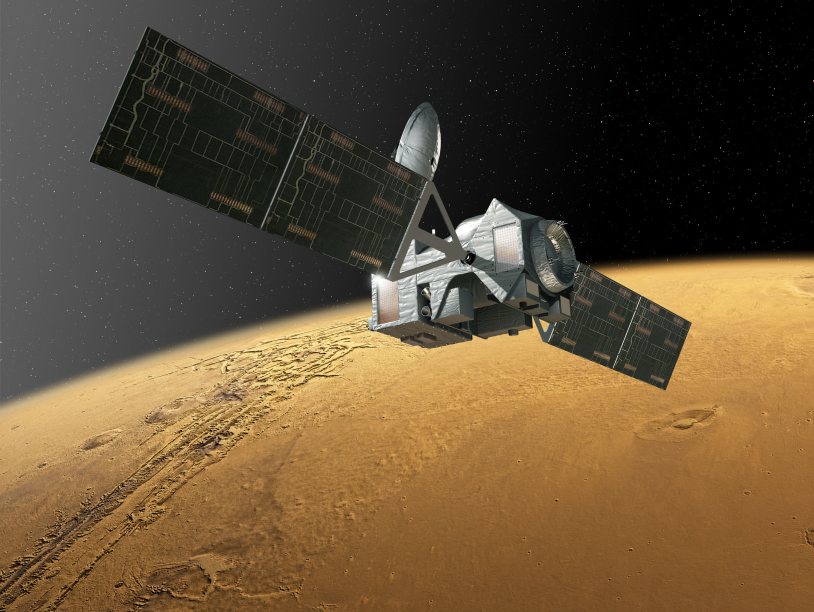
For 2016, the start of the TRACE GAS Orbiter spacecraft is planned for Mars, which will enter the orbit around the planet, replacing the Mars Reconnaissance Orbiter working there. The main function of this spacecraft will be the search for impurities in the atmosphere of Mars, especially methane and water vapor. A possible source of methane can be the activity of living organisms, so Trace Gas Orbiter will try to determine areas on the planet where methane is highlighted especially actively. The orbital apparatus will also send to the surface of the planet a stationary landing module "Schiaparelli", which will take up meteorological and geophysical studies there.
The next phase of the program will begin in 2018. Exomars Rover will go to Mars. It is planned that a six -wheeled rover will work on Mars for at least six months. Among its tools will be a two -meter boat for the study of the bowels of Mars. The places of his work will tell Trace Gas Orbiter, determining the increased concentration of methane. The Exomars program is carried out by the European Space Agency together with Roscosmos.
Closer to the sun
In October 2018, the launch of the Solar Orbiter spacecraft of the European Space Agency is planned. He will have to become a satellite of the sun, settled at a distance of 0.284 of the astronomical unit from a star (in Perigelia), that is, it will be closer to the sun than Mercury.
The SOLAR Orbiter side addressed to the Sun will be warmed up to 600 ° C. Nevertheless, in such conditions, he will have to work for seven, and possibly ten years.
The interchange of antiquity Hubbla
The Hubble space telescope has been working in space from 1990 and will be at least at least 2030 as a minute. But the scientists decided to launch a second telescope into orbit, which will work with it, and subsequently replace it. This telescope will be named after James Webb, who headed NASA in 1961 - 1968. The telescope James Webb is planning to launch in 2018. It will be equipped with a mirror with a diameter of 6.5 meters (at the Hubble telescope, the diameter of the mirror is 2.4 meters). It is planned to install devices for observations in the middle and near infrared range (Hubble is mainly designed to work in the visible range).
This telescope will be located at one of the points of Lagrange Earth system - the Sun, 1.5 million kilometers from the Earth in the opposite side. Among its unique capabilities will be the ability not only to find exoplanets and their satellites, but even to detect spectral lines of exoplanets, which no telescope can now. Thanks to this, astronomers will be able to determine the composition of the atmospheres of these planets. Observations in the infrared spectrum will allow the telescope to see the formation of young galaxies that arose a short time after a large explosion.
Orion flies to the moon
Since mid -2000, NASA has been developing a new ORION spacecraft. It should fly both automatically and with astronauts on board. So far, there was only one trial unmanned launch of this ship on December 5, 2014. Perhaps in the coming years we would have witnessed piloted flights on it, but the US Constellation piloted cosmonautics program was rolled up due to a lack of funds. However, NASA calculates at the end of 2018 to arrange a second unmanned flight of the Orion ship, the program of which will include the flying of the moon.
In the future, NASA experts expect to use Orion to deliver goods and crews to the International Space Station, as well as for expeditions to the moon, auroid belt and Mars. Estimatedly manned flight is scheduled for 2021, and the Martian mission may take place no earlier than the 2030s.
The capture of the asteroid
This ambitious plan was invented by NASA. The Asteroid Redirect Mission (ARM) program provides for the flight of a spacecraft to the asteroid belt, the capture of a four -meter piece of asteroid and moving it into orbit near the moon. Subject to funds, the start of ARM is scheduled for December 2020. The developers of the project say that it can be a good rehearsal for eliminating an asteroid danger.
Initially, the authors of the project proposed two options for capturing an asteroid material. One provided for a kind of heener bag in size of 15 meters, which would be able to capture a small asteroid up to eight meters with a diameter and weighing up to 500 tons. In the second option, the device will be equipped with special robotic captures that will raise a stone up to four meters in size from the surface of the asteroid. In March of this year, it was announced that the creators of ARM chose the second of these options.
To the satellites of Jupiter
In 2022, the European Space Agency plans to launch the automatic ship Juice (Jupiter ICY MOON Explorer). If everything goes smoothly, by 2030 he will reach the environs of Jupiter. There, Juice will make several turns around Europe and Callisto, while also studying other satellites of the planet and Jupiter himself. Then, in the fall of 2032, he will begin the clocks of Ganyveda, gradually reducing the height up to 200 kilometers.
Juice will have to check the hypothesis of the existence in Europe, Kallisto and Ganyaede of the Oceans, in which, like the famous Uzra Lake East in Antarctica, life can be preserved theoretically. A separate object of the study will be the magnetic field of Ganyaeda and its interaction with the magnetic field of Jupiter. Ganyaed is the only satellite in the solar system that has its own magnetic field.