
Translated material
Disorder of words
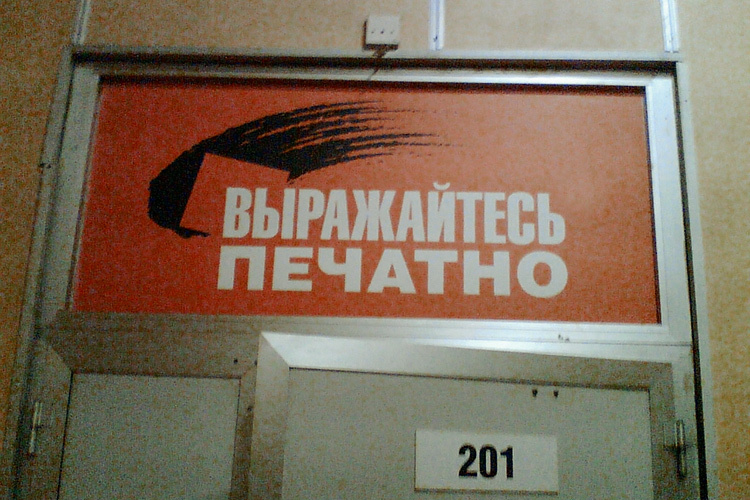
On July 24, Roskomnadzor issued a written warning of the editorial office and the founder of Colta.ru due to the publication of the article by Philip Dzyadko “Hugolev Room” dedicated to the work of the poet Julia Gugolev. The text contains Gugolev’s poems containing obscene vocabulary - it was they who became the reason for the intervention of Roskomnadzor, who explained his decision by the fact that “the use of the mat in the media materials violates Article 4 of the Federal Law“ On Mass Media ””. Colta.ru recalls who and why in Russia declared war on the swearing word.
Cases when the mat became a formal (and even more informal) reason for the fight against the authorities objectionable power are single even in Soviet practice. The most textbook story occurred in 1989. Then the Riga newspaper "Atmoda" (Atmoda) , which published the famous poem by Timur Kibirov, was subjected to persecution. Rubinstein. " In addition to unambiguous “liberties” to the newspaper Pravda, the work contained abnormal vocabulary.
The publication in Atmod was not the first - shortly before that, Kibirov’s poem appeared in the emigrant magazine Syntax, published in Paris. In the late 80s, the Soviet government had already flirted with Russian emigration, so Kibirov did not follow a repressive reaction to the text of Kibirov, while Atmod was a printed body of the Popular Front of Latvia, that is, a political opponent, for which any means were suitable. The Riga Prosecutor's Office filed a lawsuit in the court, accusing the editorial office of petty hooliganism. However, an independent literary examination, where famous literary critics, philologists and critics were invited as experts, established the "artistic nature of the use of non -normative vocabulary." Not finding the corpus delicti, the court was forced to terminate the case (“The question was such that it seemed a parody,” Mikhail Gasparov wrote in his book “Records and Extritations”). Meanwhile, it was this scandal that brought Kibirov wide fame. “Those who had not previously realized my existence immediately became my readers,” says the author of “Messages”. “And two of the writers involved in the examination, Evgeny Toddes and Mikhail Gasparov, subsequently wrote rather flattering articles about me.” The addressee of the Kibirovsky “Message” - the poet Lev Rubinstein recalls that story as one of the jokes of late Soviet times: “Everyone understood that this was one of the last exhalations of the scoop, so no one was afraid - they only laughed. Today I want to laugh less and less. The warning made by colta.ru is a continuation of a powerful trend that is strengthened every day. The current struggle for the morality and purity of the language has become one of the ways to combat the liberal media that is objectionable. ”
A full -scale war with the obscenities in Russian media began in 2013, when President Putin signed the Federal Law “On Amending Article 4 of the Law of the Russian Federation“ On Mass Media ”and Article 13.21 of the Code of Administrative Offenses”. So, against the abuse of freedom of the media, a ban on “materials containing obscene abuse” was introduced, and the new article in the code established administrative responsibility for those who create and distribute the media containing it. A year later, amendments entered into force to the Federal Law “On the State Language”, prohibiting the use of a mat on television, in films, literature and the media. The innovation caused sharp criticism from the media community, writers, theater figures and filmmakers. The latter at the beginning of the year even wrote a letter to Prime Minister Dmitry Medvedev with a request to amend the law and allow the use of obscene abuse in the cinema (however, to no avail). “It’s bad or good, but the mat has long become commonplace,” says Timur Kibirov, “young girls in the Ostankino smoking room are talking in my youth, only in my youth they spoke for drivers and demobilization in the absence of officers. Against this background, a demonstrative struggle with obscenities looks like an amazing hypocrisy, especially if it is integrated into an artistic text. The artist has different tasks, including conveying live speech. It is impossible to do this without a mat. And in order to protect children from him, quite age -related labeling of content. ” Julius Gugolev also agrees with him, who is sure that an attempt to shock the audience with the help of a mat is a “rotten undertaking”: this is unlikely to be suitable for attracting attention, but for artistic purposes, obscene vocabulary is necessary.
The demonstrative struggle with the obscenities looks like an amazing hypocrisy, especially if it is integrated into an artistic text.
The media yuers are sure: the ban on the use of obscene vocabulary is an artificial measure that does not bring any real benefit, but creates additional risks for some publications, in particular, those where modern poetry is published. The practice of the last year shows that this is an additional hook for the media, especially the network, because any comment containing an unacceptable statement and is not remote in time can bring a warning from Roskomnadzor on time. Obtaining two such warnings during the year threatens the media by deprivation of the registration certificate. “Due to the total ban on citation of obscene words, many poetic texts risk being not published at all,” says Galina Arapova, director of the media protection center, “because if by rhyme and meaning it is possible to understand which word is replaced by points, Roskomnadzor still considers this the spread of the mat. Most attempts to appeal the decision of Roskomnadzor in such cases in court were unsuccessful. The exception is only those episodes when it is not clear which word is hidden behind the points, and the texts containing hyperlinks on the prohibited content, as in the case of Rosbalt.
The most interesting law enforcement practice of adopted amendments. In 2014, Roskomnadzor recorded 51 cases of obsceneity in the media, in the first months of 2015-15 (data on the end of May). Formally, Roskomnadzor is not obliged to endure a warning - this is just his right. Having discovered the prohibited word, the department can make a warning, and then the media to which it is addressed will be on the hook, or not to bear the warning, but to bring to administrative responsibility, that is, a fine (from 2 thousand rubles). Each time, the choice remains for officials, and it is often impossible to understand what it is dictated by. According to Arapova, the prerogative of warning, especially when it comes to network publications, is always with the Federal Roskomnadzor. Regional units, as a rule, only monitor the network media outlets, limiting themselves to administrative responsibility. However, according to the information available to the practitioners, there is no special intra -decoration procedure or instructions on this score. So, in 2013, the Voronezh newspaper "Economics and the Life of the Black Earth Region" published a review of the released almanac of modern poetry and prose of the Voronezh authors "Residents of the Cretaceous Mountains". It is noteworthy that the publication of the collection funded the Department of Education, Science and Youth Policy of the Voronezh region. The author of the review cited in the text excerpts from the two poems of the Almanac - in both cases, obscene words were reproduced only partially. Formally, this is an occasion for a warning, however, the newspaper editors escaped with a fine.
The war with obscene abuse in poetic works also captures social networks, and not only modern authors are banned. In early July, the Facebook administration for seven days blocked the journalist Maxim Kononenko’s account for the publication of the quatrains from the poem by Alexander Pushkin “My Domestic” (1830), where, in relation to the Ukrainian nation, an unacceptable, from the point of view of the site administration, ethnophilism. The lock was explained by the fact that Kononenko’s post “did not meet the Facebook community.” It is curious that officials themselves are increasingly becoming victims of political correctness. So, shortly before Kononenko, the same ethnophilism used the deputy head of Roskomnadzor Maxim Ksenzov on his Facebook page. After blocking the post, an official, dissatisfied with the policy of the site administration, deleted his account.
Despite the fact that the Russian media are increasingly held accountable for the publication of obscene vocabulary (only in the last two months Roskomnadzor has issued the relevant warnings to the MAXIM magazine, Novaya Gazeta, Colta.ru), cases when poetic texts are prohibited, and are still unit. The story with the publication of the article “Gugolev’s Room” is the most resonant after the scandal around “Atmoda”. However, it is unlikely to compare these episodes, Lev Rubinstein is sure: the country's development vectors in 1989 are now directly opposite.