
Translated material
Lessons "Fukushima". Fukushima Lessons

Once in the alienation zone and into the territory of the Pukushima-1 nuclear station, you will immediately feel like the hero of the “picnic on the sidelines” of the Strugatsky brothers. As in the novel, you will be allowed to move inside a closed zone only together with specially trained people after briefing and with constant control of the radiation level.

Each of us - 12 journalists from Australia, Germany, India, Spain, China, Nepal, Russia, France, Finland and Switzerland, as well as Japanese colleagues - passed the radioactive pollution checking before and after visiting the nuclear power plant, each had its own individual dosimeter in the station. "Oh, what a healthy, pink!" - I exclaimed when we were given gadgets. However, the color did not mean anything, the “boys” and “girls” went the same.
On a trip to the station, we were allowed to take with us only pens, notebooks and simple voice recorders. The international group of journalists invited to this tour of the Japanese Association of Journalists writing about science and technology ( JASTJ ) allowed to have only one photographer and one video operator for the whole team. Colleagues from India and Switzerland (Pallava Bagla and Werner Hadorn) had to go through a special briefing and shoot with cameras packaged in special plastic.

After a meeting with the General Director of Fukushima Dayti NPP, Akiro (Akira ONO), who talked about work to eliminate the accident, which is conducted daily, we allocated two lockers, where we divided to underwear, and then put on special “pajamas”, two pairs of socks, masks and helmets, two pairs of peppers, moreover The “lower level” gloves were wrapped with tape to clothes.

If suddenly the lightning on a protective suit refused to work, then the hole was covered with tape in layers. Then we once again passed the audit for the presence of extraneous gadgets, and when leaving the building we put on special shoes.
It cannot but surprise how the workers at Fukushima manage to work in such clothes. In a special mask and clothes, it’s hard not only to move, but also to breathe, but in warm weather you feel in such a vestments as in a sauna.
For employees of the station, a special house for 2000 places was built where you can relax, put yourself in order and eat. After returning from a short round to the first and second power units, having been in their skin, I looked at these Japanese as heroes.
Accident
As you know, in total at Fukushima-1-the twenty-fifth most capacity of nuclear power plants in the world-there were six nuclear power units. The fifth and sixth in April 2011 were in a state of “cold stop”, repair work was carried out there. Fuel rods were taken out of the fourth reactor before the accident, but three other power units - 1, 2 and 3 - were in work. On April 11, 2011, after the strongest earthquake (magnitude 9), after 50 minutes, tsunami of 15-meter height followed, it overcame the protective wall from the ocean with a height of 10 m.
On April 12, 2011, due to a complete disconnection of the supply of electricity to all the systems of the station and the subsequent overheating of the non-drilled reactors, there was an explosion of hydrogen on the first power unit that destroyed the roof of the building. On April 14, the hydrogen explosion occurred at the third power unit, the roof was also demolished, 11 employees were injured. The explosion also damaged the building of the fourth power unit located next to the 3rd. On April 15, an explosion occurred at the second power unit. After the accident at the Chernobyl nuclear power plant (1986), this is the second most serious consequences of a nuclear incident in the history of mankind.
The leadership of the station, the prefecture of Fukushima and the Japan government had to take urgent measures to evacuate the population from nearby areas and the elimination of the accident in conditions where there was no clear information about the situation with power units. It should also be taken into account that at the same time it was necessary to take urgent measures to eliminate the consequences of the earthquake and tsunami, due to which about 16 thousand people died.
The subsequent analysis showed that the nuclear power plant, like the whole TEPCO company (Tokyo Electric Power Company), was simply not ready to resist the whole set of natural cataclysms of this level. Now they say that the nuclear power plant should not be built so close to the sea, and if you build, then with a higher wall from the waves, as at the Onagawa nuclear power plant. This Japanese nuclear power plant was closer to the epicenter of the earthquake, but the height of the protective wall from the ocean was 14 m, which saved the station from severe damage. Moreover, it is noted that the leadership of TEPCO did not listen to the warnings of scientists who called to prepare for powerful earthquakes and tsunami back in 2009 [1] .

The Prime Minister of Japan admitted that the country's leadership and the country's leadership, who believed in the technological infallibility of the nuclear power plant and became hostage to this “security myth”. "What did the accident teach you?" - We asked Akio Komori (Akio Komori), the head of the Tepco nuclear department, who had taken part in the station to save the station from the very first minutes. “It is necessary to prepare for various natural disasters, not only tsunami, but also earthquakes and tornado. It is necessary to evaluate the most possible risks and be ready for them. It is necessary to create a multi -level protection, ” he answered.
However, my question is whether TEPCO is going to remove from the use of a single-circuit, old type reactors (BWR-4 and BWR-3, Boiling Water Reactors) and go to a safer reactors, remained unanswered. Japanese experts seemed to “not notice” him. It is clear that this is a difficult and expensive solution. In fairness, it must be said that in Russia (the share of atomic energy in which is 17% of all generated electricity), several reactors of the “Chernobyl” type of RBMC are still valid, which showed their unreliability in the event of an error of operators. Of course, they were improved, but ... At the same time, the head of the Rosatom Sergey Kiriyenko, who performed on the air of Echo of Moscow, noted that after an accident in Japan, nuclear stations corresponding to the "post -Fucusim requirements" began to be in demand. If, before the accident of 2011, part of Rosatom’s clients thought about how to save on security, now everyone is striving to purchase reactors of a new type of “generation 3+” [2] .
Kiriyenko also explained that the accident on Fukushima became possible due to the fact that the system of protection rods that contains Bor and when entering it into the reactor is extinguished, was located from the bottom under the reactors. And in order for the rods to enter the active zone, they should be lifted by electric motors. But automation systems and emergency diesel generators did not work, as they were in the basements and were flooded with water from the tsunami. In Russian “post-Fucusim type”, protection rods are suspended on electromagnets above the reactors. If the electricity is disconnected, then the rods under their own weight will drop into the reactor and stop its operation.
To date, the employees of the Fukushimi NPP have managed to remove all fuel elements (1535 pieces) from the fourth power unit. The remaining three emergency reactors are supported in the Cold Stop, constantly cooled by water. At the moment, the roof has been removed and work is underway to clean the third power unit from nuclear fuel (565 elements) and various fragments. According to estimates, work on the third power unit will go within two years. It is complicated by the fact that part of the remote manipulator for working with fuel has fallen into the pool where the fuel rods are stored, and now the liquidators of the accident think about how to extract it. After the power unit is freed from nuclear fuel, the roof is again hooked on it. The roof collected in another place will be brought on the ship by sea and collected from large parts already at the nuclear power plant. Work is underway to deactivate the territory around power units. Here and there we saw plots with a depth of 20-30 cm with soil.
Engineers and experts are still thinking what to do with the second power unit. Due to the high level of radiation, the stay there is life-threatening. Will robots be able to do this work? Another headache of liquidators is groundwater pollution by radionuclides. Employees of the station are trying to create an ice shield around blocks of nuclear power plants. The water that manages to collect is stored in tanks - special tanks located in the station. "What will you do with this water?" - the journalists asked Akio Komori. “The Japanese government is concerned about this problem. The decision on this issue will be made from April to September 2016, ”he answered. One of the ways out is to store water on special tankers for more than 100 years, the other way is to pour this water into the ocean away from the shore.
You cannot leave
To the station itself, we rode half an hour along a deserted twenty -kilometer zone. Around-abandoned and in some places at home, shops and offices, overgrown fields, gardens and gardens. All the territory contaminated with radionuclides around the nuclear power plant is divided into three conditional types. Most of all, 24 thousand Japanese were not lucky, whose areas are attributed to the first type. After the accident, people had to leave about 9100 houses forever, they are unlikely to be able to return to where they were born, lived, studied, worked.
In several better conditions, there are 24 thousand Japanese, in whose 8400 houses “it is not allowed to live constantly” - these are areas of the second type. After the decontamination, about 32 thousand Japanese (10,900 households, according to TEPCO on October 1, 2014) may soon be allowed to return to the areas of decontamination.
As the representative of Terso noted, for all these areas affected by an accident, the general rule applies: “You can’t stay there at night”. However, those who lived earlier in areas of the third type are allowed to temporarily return to their home, in these areas soon the order of evacuation will be canceled. Residents are also allowed to temporarily return to areas of the second type, but it is emphasized that it is not necessary to do this without much need. It is not recommended to come to areas of the first type, but in some cases exceptions are made on temporary entry.

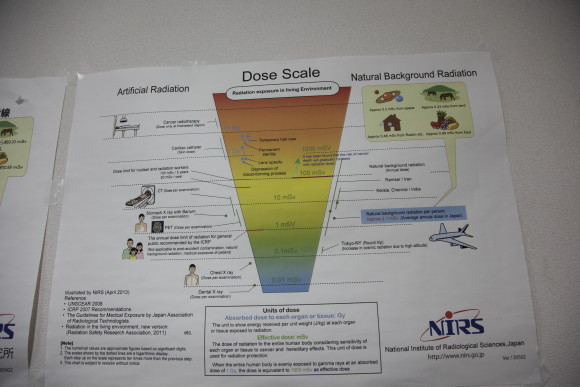
After visiting the station, our individual dosimeters showed absolutely not dangerous for the health of 0.03 millisiverts, which is equivalent to three x -ray pictures from a dentist.
In addition, we were in masks, goggles, special clothes and surrounded by specialists who constantly monitored our safety. At the entrance to the bus, special shoe covers were put on us to our feet. You raise your leg, once - and the shoe covered, you put your leg on the bandwing, you raise another leg and once - another shoe covered. At the entrance to the most polluted blocks 1 and 2, other shoe covers were put on us, and then, at the entrance to the bus, these were removed and changed to new ones.

Experts argue that if you live in polluted territories, it is very difficult to control the entry of radionuclides into the body. This is especially dangerous for children. So, Strontius-90, being a chemical analogue of calcium, entering the young body, is built into the growing bone system and has a destructive effect on the bone marrow. An invisible danger can lurk anywhere, while not all dangerous radionuclides are easily detected by dosimeters.
However, the government of Japan has already called the date of the return of part of the inhabitants. It is expected that on September 5, 2015, 7401 people will return to the village of Narah Prefecture Fukushima for the first time after the 2011 accident [3] . These are the first evacuated, who were allowed to return to permanent residence to their homes of seven municipalities of Fukushima, whose population was completely evacuated after the accident.
However, the problem is that not all residents of Naraja will want to return to their 2704 houses due to fears before radiation and the lack of infrastructure. “There are no shops. There are no doctors. I don’t know what to do, ” said one woman in an interview with local news. It is noted that the decontamination work in Narah ended in March and the level of pollution by radionuclides fell by 60% - up to 0.3 microsiverts per hour. Now the government is trying to restore the infrastructure of the city cleared of radionuclides.
During a trip to Japan, Dr. Sae Ochi, who said that sometimes evacuation from the accident zone was more life-threatening than staying in the zone. There were even cases when older people after evacuation were left completely alone and died of hunger. The psychological state of many evacuated leaves much to be desired.
The accident at Fukushima-1, like the Chernobyl accident, posed a lot of problems for humanity, and only a small share of them to date was resolved. Currently, the duration of deactivation is estimated at 30–40 years, but, given the large periods of half -life of a number of dangerous radionuclides, this is a headache for Japan, and the whole world, for several centuries.
The government of the country and the TEPCO administration seek to return citizens' trust in atomic energy, especially on the eve of the Olympic Games in Tokyo 2020, but this is not easy. Many Japanese, despite the increased electricity accounts, advocate a complete rejection of nuclear power plants. The former deputy speaking to journalists. Mayor of the city of Mikharo, located 45 km west of the Fukushima-1 nuclear power plant, SHIGERU FUKAYA, and the physicist of Takeshi Koike told how neither the government, the prefecture, nor Tepco were informed, nor the local authorities, nor the population about the radiation level and the population about the radiation level and the population about the radiation level and the population the size of the affected areas. “Even physicists were not talked about what is happening,” said Tokhoku, Dr. Cuike, Associate Professor.
In the city of Mikaro, it was possible to get objective information thanks to the pensioner, the former teacher of physics Sakum, who four years after the Chernobyl accident bought a dosimeter for himself and for ten years methodically conducted observations and recorded data. Three hours after the explosion on the first power unit, he and his wife and his wife sharply intensified their work and two and a half months once per minute manually recorded dosimeter data. Thanks to this married couple, the Micharo authorities had objective information about what was happening, and on April 15, 2011 they independently, without the perfection of the prefecture, decided to distribute to all residents younger than 40 years old 14 thousand tablets with iodide.
Since March 27, 2011, a group of vulture physicists from Tokhoku University began to carry out a regular collection of samples of the upper soil and their measurement on the IOD-131, Cesius-134 and -137 in a two-hundred-kilometer zone around the emergency nuclear power plant [4] . This gave the start of the movement (The Miharu Misho Project), designed to create a system of public independent monitoring in the situation at nuclear power plants, in kindergartens, schools and local agricultural products.
At the same time, the visit of foreign journalists to Fukushima-1 cannot but testify to the increased openness of the TEPCO and the Japanese government, which recognized errors in the early days of the accident and the failure to take the necessary preventive measures to ensure proper security and failures in the community during the NPP accident. They are now striving to create a new system of interaction with a society that will never forget the shocks experienced. And apparently, this also needs its own “roadmap”.
2. Http://echo.msk.ru/programs/beseda/1570002-echo/
3. Http://fukushimaupdate.com/thousands-off- believes-tourn-home-following-fukushima-nuclear-disaster/
4. Http://iopsciens.iop.org/0952-4746/34/3/675/pdf/0952-4746_34_675.pdf
5. Articles of colleagues on a trip. Articles of my colleaguses, Who took Part in Postfukushima Tour: