
Translated material
Scotland Yard: Litvinenko poisoned Lugovoi and Kovtun
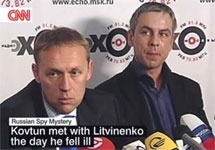
The ex-officer of the FSB Alexander Litvinenko was poisoned by Andrei Lugovoi and Dmitry Kovtun. According to RIA Novosti, representatives of Scotland Yard stated this, speaking with the final word during the open hearings in the high court of London.
"We believe that Litvinenko was poisoned by Polonium -210 on October 16, 2006 and November 1, 2006. Lugovoi and Kovtun poisoned him," said the legal adviser to the police Richard Khoruell. At the same time, he left the court a decision on whether the Russian state has an attitude to this.
He also stated that Litvinenko’s infection could cause Polonia’s poisoning “hundreds, if not thousands of London residents”.
Horuell recalled that investigators found traces of radioactive pollution in both hotel rooms where Kovtun and Lugovoi stayed, while "the meadow number was very contaminated." “Both of them or one of them are responsible for this pollution of polonium,” Horwell said. "Litvinenko, of course, has never been there," said the legal adviser.
On January 24, the British newspaper The Telegraph reported with reference to these correspondence between the main suspects that the Russian authorities are directly related to the murder of Litvinenko . A source close to the investigation confirmed that the US National Security Agency transmitted the evidence collected to special services. At the same time, the interlocutor of the publication emphasized that although these documents will not be able to accept the court for consideration, the British authorities are convinced that Litvinenko was killed by order of the Russian state.
On January 23, The Telegraph betrayed the publicity of another document related to the name Litvinenko. At the disposal of the editorial office was an audio recording made by Litvinenko a year before his death. In it, he talks about Putin’s connections with one of the most wanted criminals, Ukrainian criminal authority Semen Mogilevich, who was suspected of supplying al-Qidea weapons.
Alexander Litvinenko, who left for the UK in 2000 and received a British passport in October 2006, died on November 23, 2006 in a hospital in the University College of London. After his death, the specialists of the British health protection agency said that they discovered a significant amount of radioactive element of the Polonium-210 in the deceased body.
In October 2011, the Corror Court of the London district of St. Pancraz resumed an inquiry on the fact of the death of Litvinenko . Earlier, the Royal Prosecutorial Service of Great Britain said that he had enough evidence to charge the murder of Litvinenko to the former officer of the Russian special services, and by that time the State Duma deputy from the LDPR faction Andrei Lugovoi.
For several years, Russia refuses to extradite a meadow at the request of the British court. In March 2013, Lugovoi himself refused to participate in the London inquiry, saying that he did not see the opportunity to achieve justice in the UK.