
Translated material
Scientists have found the planet "only" in 21 light year from us.
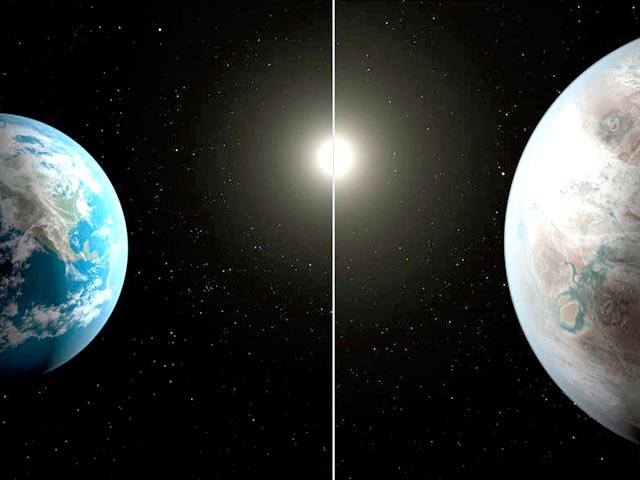
Scientists have found the closest land -like exoplanet to us - it is at a modest distance of 21 light year by cosmic standards, spinning around the star in the constellation Cassiopei along with two more "super -earths", AFP reports.
The planet HD 219134B is circulating around the Gliz 892 star in the constellation Cassiopeia. The star can be seen from the ground with even the naked eye, although it is less bright and hot than the sun. The planet is too close to the star so that life can exist on it. However, it is interesting in that it is the closest to the planet of the earthly type. Only the GJ674B exoplanet in 14.8 light years is closer to us, but its type is unknown to scientists. According to TASS, most exoplanets are removed from us for hundreds of light years, and the most similar to the Earth, the famous planet is located at a distance of 1,400 light years.
The HD 219134B planet is transit, which means that it is located in such a way that we can observe with the help of telescopes, as it passes in orbit against the background of its star. This allowed scientists to clarify its size, and in the future it will find out if the planet has an atmosphere and, if any, explore its composition.
The opening was made using the controlled NASA of the Spitzer telescope. “Transit exoplanets are worth its weight in gold, because we can describe their various parameters. This planet will be one of the most actively examined in the coming decades,” said Michael Werner from the reactive traffic laboratory in Pasadena, whose words are given in the NASA press release.
Initially, the HD 219134B was discovered using the Harps-North spectrograph on the Italian 3.6-meter Galileo telescope installed on the Canary Islands. By mass, the planet is about 4.5 times more than the Earth and turns around its star in three days. Observations made using the Spitzer telescope showed that the HD 219134B size is 1.6 times larger than the Earth. A comparison of mass and size made it possible to calculate the density of its substance - 6 grams per cubic centimeter - which confirms its belonging to land -like planets. In addition, astronomers found three "neighbors" in HD 219134B: a planet weighing 2.7 times more than the Earth, a gas planet weighing nine earthly and another planet weighing 62 times more land.