
Translated material
Reptile of discord
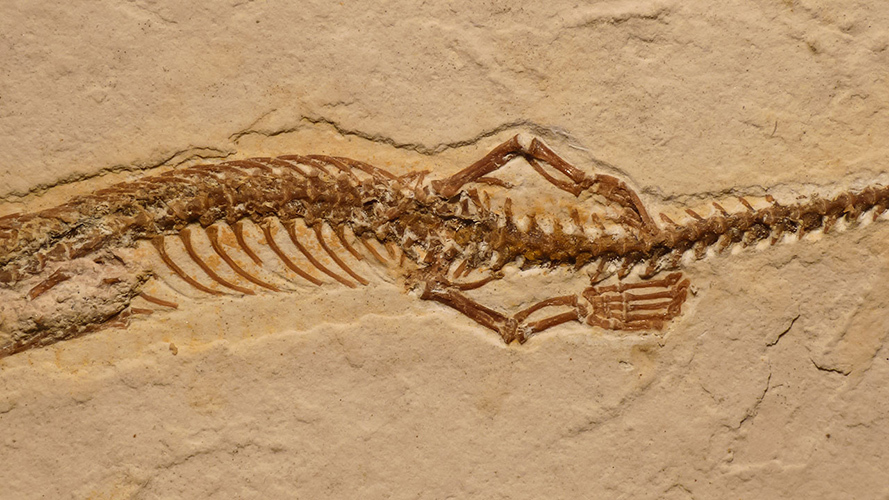
At the end of July, a four -legged snake occupied the scientific news around the world: the fossil Tetrapodophis amplectus from Brazil with the age of about 120 million years , accidentally discovered at the Museum in Germany, was the first in the history of the paleontology of a snake with four limbs . The creature described in the article in the journal Science by the British David Martill and his colleagues is an expressive illustration to the story that evolution not only gives different creatures new complex organs (fish that went to land - instead of fins, girafi - a long neck), but also selects existing ones. The common ancestor of the snakes had all four legs, and evolution eliminated them as unnecessary. It was believed that the snakes came either from land reptiles that had drew underground passages, or from the sea, and the Tetrapodophis amplectus skeleton resolved obscurity in favor of the first version.
This is half the news that you can write about this. The second half, with a smaller font, looks something like this: a scientist from the UK, ignoring all the rules of decency in his own discipline, examined fossils, most likely stolen from Brazil, and does not particularly worry about this-because they have wild monkeys in this country after Richard Famenman’s departure and there is no one to worry.
Almost no one has written the second half of the news in Russia yet: perhaps it gives too much the problems of the first world , attempts to shame the developed countries for the fact that they are developed, and, most importantly, scientific political correctness, which in our country is considered such an annoying cost of being in a Western society (if not a grimace of it). Meanwhile, just how in Russia it would have to be read very carefully.
As an exhibit, this ancient snake was one of thousands, probably, such unknown pieces in the reserves of museums of natural history: the genus and the species are unknown, the museum’s fund got from a private person. Neither dates, nor surnames, nor give or take - an unidentified museum object. In the article from Science, the authors write so: the object was in a private collection for several decades, was one of many elements in it, seemed insignificant - therefore, “there is no information about its acquisition or pro -provenance” (the circumstances of the transformation of the usual object into a museum exhibit).
The common ancestor of all the snakes had four legs, and evolution eliminated them as unnecessary.
Nevertheless, the scientists themselves are sure that the snake got into the museum from Brazil, - Martill, the Brazilian newspaper O Estado de S. Paulo, said that as an expert on this geological formation, he immediately and accurately recognized the place of origin of the find. And this is the first problem: since 1942, it is forbidden to export fossils from Brazil.
“There is no information about Provenans” in a museum business today actually sounds quite like euphemism for “stolen”, and this is how this was understood in Brazil, where the loud history was perceived primarily as a violation of their legislation. The chances of charging to someone concrete or at least understand when the find left the country, striving to zero.
The Western scientific media, which wrote about the find, shaking their heads: how did Science even take up the article in which the object of research and its legal status force decent paleontologists to get up? But the indignation of journalists, with rare exceptions, was still somewhat formal, and this formality successfully reflected in Forbes heading: “The same (potentially illegal) fantastic snake with four legs and ethics of fossil collecting.” The status of the find for almost everyone except the Brazilians is a note in brackets, a posting one sentence. Well, yes, oh, spoonfuls, apparently, is, ay-yai-yay, and the drawing is beautiful.
David Martill himself rather aggressively waves away from any questions about the legality of the fossil in Germany: he does not care how she got there, and “these Brazilian scientists can think what they want” (the Brazilian newspaper is said). If you try and pushing aside this tone of a typical conscientious acquirer, a scientist can be understood: in the end, first of all, this is the reputation problem of the museum in which the snake is stored - such a free treatment of the industry colleagues usually look obliquely.
Martilla is only interested in the scientific side of the issue, and, like many scientists, he consistently criticizes the legislation that limits the work of paleontologists. Fossor belong to everything, because when all these interesting animals and plants died, there were no countries and state borders. Down with paleontological xenophobia, and then, it turns out, “Brazilian fossils for the Brazilians”, Moscow for Muscovites.
Paleontology in this sense really differs from, say, archeology: a snake skeleton is still not a weapon with which someone’s ancestors defended their land, and not mummies that once former living people (and these very ancestors). Political geography, which we apply over physical, ancient animals and plants did not concern; In addition, fossils, as a rule, do not have religious significance. Nationalism, driven by efforts to repatriate values and preserve them in the homeland, in the case of mummies and artifacts humanly even understanding. This is a material history of the people, strings into the past, visual evidence of historicality and limbs of man - right along Heidegger.
“There is no information about Provenans” in a museum business today sounds like euphemism for “stolen”.
And even when this nationalism, in general, directly threatens the very existence of values-as, for example, in the case of the mummies of Chinchorro in Chile, which recently suddenly began to rot from growing humidity due to climate change-no one seriously thinks to blame the mistress to the guilt. Chilean experts attracted the problem of colleagues from other countries, and for 120 mummies (which, by the way, about two thousand years older than the Egyptian), new storage facilities are successfully built in the same small museum in the city of Arika.
Then, as a paleontologist and part-time, a scientific journalist, willingly explained to me, the scientists themselves, in general, really no matter where the thing is from which they made an article for Science or Nature -only science matters. Their business is not to violate the legislation, which in this case was not: Martill from the point of view of the law has nothing to present. And let museum relations find out specially trained people.
Most conflicts about who should belong to the museum exhibit today either smoldering for years without any solution (Rosettic stone or, for example, Elgin marble in the British Museum), or are resolved elegantly and bloodlessly. The parties often find themselves in a path situation: the museum does not want to part with an exhibit, in which a lot of labor is invested, but it does not rush to aggravate relations with the country, which, in turn, would probably like to take its own, but without cooperation the museum will not be able to do this (not to steal, in fact).
We add to this the fragility of the absolute majority of valuable objects, and an inevitable solution is the agreement on constant storage, Permanent Loan : the artifact goes into the property of the historical homeland and immediately, without any movements, is transferred to constant exhibiting to the museum where it is already stored. This is usually supplemented by agreements on the partnership of two museums and joint research programs: this is how the conflict turns into friendship.
The raider approach to the museum business, too, happens, it is found, although infrequently. Probably the largest (in several senses) such a case occurred in May 1992 in Hill City, South Dakota. Two years before, local scientists found a local resident named Maurice Williams Skelet Tyrannosaurus on the ranch of a local resident, paid five thousand dollars for the right to take him out of there, spent a thousand hours for excavations and took him to the local Paleontological Institute. By 1992, there were already going to build a museum around the largest and most complete skeleton of the tyrannosaurus in the world, when 50 people from the FBI and the National Guard suddenly arrived at the institute, plunged the bones into the boxes and took it to the warehouse, where they lay the next three years while everyone was suing everyone.
The point was that the local resident, a representative of the indigenous peoples of America, once for the sake of tax benefits, seemed to transfer the rights to land to the federal authorities - and, according to the Actness of the Antiquities of 1906, nothing arbitrarily could be taken from the federal land. As a result, after the proceedings, the dinosaur went to Maurice Williams, who immediately decided to sell him using Sotheby's : more than seven million, the whole world was collected for the Field Museum in Chicago, where the tyrannosaurus, known around the world as Sue, now lives.
Nevertheless, the majority prefer to live by the Testaments of the cat Leopold, including in science. It is obvious to everyone that although there were no Australopithecus Lucy and Ethiopia on the date of the snake or, say, Australopithecus, at the time of their discovery and discovery for science, these countries very much existed. And there are real and future scientists in them, for the scientific quarry and moral spirit whose participation in a large discovery, and even their native, is very important. And these countries are neglecting the fact of their existence, from where all these laws on the prohibition of export are in the end.
Therefore, the usual practice for paleontologists was an invitation to the scientific group of local researchers: if anything, it can smooth out the fact that the fossil itself, so to speak, has gained a new house. And this is not considered a handout or a comforting prize-on the contrary, the international cooperation of scientists only strengthens the scientific and cultural ties of the countries. The article is more important than the block of stone, remember?
When such a question-“Did you call Brazilian scientists or scientific organizations”-the newspaper San Paulu set Martill, who only in co-authors, they received an answer that deserves a literal translation: “But what would it change? Do you want me to take the team of a black, disabled and woman, or maybe also homosexual just for balance in all respects? ”
Then he still argues that if you invite Brazilians to cooperate “only because they are from Brazil”, then everyone will think that any Brazilian got into the co-authors of the article precisely because of his nationality, and not according to his merits. According to Martill, when he investigated fossil and wrote an article, he did not know a single Brazilian herpetologist, but now he knows that there is one comrade by the name of such and such (and calls it inaccurately).
By 1992, in South Dakot, they were about to build a museum around the largest and most complete skeleton of the tyrannosaurus in the world, when 50 people from the FBI and the National Guard suddenly arrived at the institute, loaded the bones into the boxes and took it to the warehouse.
But one first tirade, in principle, was enough for the newspaper, stunned from such a turn, translated from Portuguese into English - in an attempt to draw attention to, to put it mildly, the marginal position expressed by the scientist.
In English there is such an expression- to add insult to injury : it is something like a cross of “pour salt on the wound” and “extinguish a fire with gasoline”. This is exactly what the British paleontologist did: in the event that not everyone in Brazil, a free attitude towards their legislation, decided to insult the country's scientific community for fidelity.
It is not very clear whether Martill considered that in the question of cooperation with Brazilian scientists, it really was meant “honorable” participation for the species, and not normal research - or even the second opportunity did not occur to him. Perhaps he was tired of the people who nod in response to his statements about the scientific significance of the find and still get boring with their ethics, and he could not restrain himself (although these are a weak justification: questions and answers by e -mail usually give a happy opportunity to avoid bloopers in a burning room).
The words about the Brazilians for the ethnic balance look especially beautiful about the discussions about the same law of 1942: they say, you destroy fossils there when mining, calmly give them slowly to collapse in the ground, but if someone try to pick them up in the name of science, you immediately to prison is a disorder. In other news: barbarians do not value their treasures and cannot cope with an important scientific task without the help of civilized people. He called the nineteenth century, wants his stereotypes back.
That is, it is more or less clear that when the British scientist speaks of “science for all”, he most likely actually refers to a very specific subset of “all”. Such distilled scientific colonialism in the era of the Internet and “Mass graves” (this is the name of the very long enumerations of the authors in a scientific article from some major project, where there can be tens and even hundreds of them), you still need to look for.
And yet: why should we in Russia excite this digging in the high matters of scientific ethics and the clarification of relations between the science of the first and second world? Well, for example, this is why: whatever we imagine - whatever scientific rating of countries to take, all the time the CPSU turns out. If we soberly try on a similar situation on ourselves, we must not look towards Great Britain and Germany.
In the dry residue there is a loud scientific discovery, which until recently put the unknown fossil to anyone next to Sue, Lucy and other “the most sung”, and an unexpected case on scientific ethics, which actually would like to avoid. Why, in general, this case should be interesting to anyone except the Brazilians, who, presumably, are preparing for a serious conversation with the provincial German museum?
The answer can be, for example, such. In 2010, the parties to the Convention on the biological diversity of the UN adopted the so -called Nagois Protocol of “regulation of access to genetic resources and joint use on a fair and equal basis of benefits from their use”. This complex, even for the prepared reader, the document determines the mechanism of participation of developing countries, the main suppliers of biological raw materials, and the profit from its use.
That is, soon the colleagues of David Martill at the University of Portsmut, suppose, will find a large potential in the treatment of Alzheimer's illness in the treatment of, for example, the Brazilian flower unknown. They can’t say in any way that when the flower was evolved, you were not standing here and we found it in general, while you mined minerals there and gave the flower just to sit in the ground.
The Nagoic Protocol criticizes a lot, including for introducing completely new rules of the game in the study and development of the living world, which supposedly will restrain progress. But, on the other hand, the agreement is simply officially, on paper it confirms that in the science of the new millennium we prefer to negotiate where there used to be a kind of wild West with the right of strong and scientific results justifying any means.
For those who think so, of course, it is unpleasant to see that the science of the past of all living things in the course of business has not yet got rid of all the bad habits of that, another time.