
Translated material
"They will again be scattered by anathemas"
Kyiv priest Georgy Kovalenko explains why Ukrainian churches want to unite without the participation of the Russian Orthodox Church

In the fall of 2015, the Ukrainian Orthodox Church of the Kyiv Patriarchate convenes the Unification Council. The main intrigue: will two independent Ukrainian churches go to the patronage of the Patriarch of Constantinople, and how the Ukrainian Orthodox Church of the Moscow Patriarchate will behave, which has two times more parishes in Ukraine than that of Kyiv. The special correspondent of Medusa Ilya Zhegulev spoke with the former head of the Synodal Information Department of the UOC of the Moscow Patriarchate Georgy Kovalenko (he ceased to be an official speaker, but still heads the educational department of the UOC MP and heads the Otheny.Cr site)-about why the Orthodox Ukraine want to unite without the participation of the RPC, and Will they be able to do it.
Ukrainian Orthodox in Ukraine have been divided since the beginning of the 1990s. Most parishes in the country (about 12 thousand) belong to the Ukrainian Orthodox Church of the Moscow Patriarchate (UOC MP). This is a relatively autonomous part of the Russian Orthodox Church, which formally obeys Moscow. In addition, the Ukrainian Orthodox Church of the Kyiv Patriarchate (UOC -KP), which was organized by Metropolitan Filaret, who had been quarreling with the Russian Orthodox Church, operates in the country. Moscow did not accept the UOC -KP and anathematized Filaret, the organization is considered not corresponding to church canons; Nevertheless, the church has five thousand parishes. Finally, there is also a small Ukrainian autocephalous (independent) Orthodox Church (UAPC), which is also not considered canonical.
In 2015, autocephalous and Kyiv churches decided to unite. Among the priests of the UOC of the Moscow Patriarchate, there are also supporters of the association who expect Ukrainians to take Patriarchate in Constantinople under their patronage. Officially, the Constantinople Church will not take part in the cathedral.
- The last time you were in Moscow in early 2014 - on the round table of the Synodal Information Department ( the performance of Kovalenko was called “The Voice of the Church in the conditions of a political crisis and a force confrontation in Ukraine” - approx. Medusa ). How did your colleagues from Moscow react to this performance?
- I had a strange feeling that we are people from different planets and speak in different languages. I saw a clear interest in what I said, among Muscovites - and the absolute misunderstanding of what I say, among representatives of other regions of Russia. And I felt that I was simply uninteresting with them.
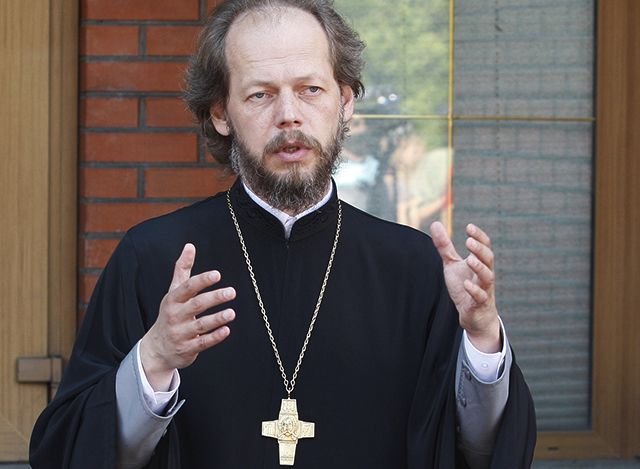
- It was when you talked about the priests who went to the Maidan, opposed corruption and appealed to the main commandment?
-Yes. You see, then I still felt such a thing: real life - we have here in Kyiv; Events [on the Maidan then] still took place. And there I fell into some other story in which I do not feel, I do not feel.
- In Moscow a swamp?
- No, there are problems. I understand perfectly that Russia has its own problems, but I am inclined to the fact that I am not an adviser to other people. I do not know all the circumstances, somewhere I do not understand the mentality, somewhere some things that are obvious, [so] I cannot teach. Unfortunately, they are trying to teach me all the time.
- And who is trying to teach you?
- I mean - they tell us how we should live here in Ukraine.
- And they told in the Synodal Department?
- No, not in church terms. In the days of the blessed Metropolitan Vladimir ( led the UOC of the Moscow Patriarchate in 1992-2014 - approx. Medusa ) they did not tell us anything, we lived quite autonomously. As now, I don't know. As for the fusion of the state and the church, the Ukrainian Orthodox Church condemned the so -called political Orthodoxy.
- The UOC of the Moscow Patriarchate?
- Yes, in 2007 it was. Some movements, Orthodox-political organizations were convicted ... Therefore, it was easier for us when the “Russian Orthodox Army” arose-we even have documents that allow us to talk about it as political law.
- Do you mean the “Russian Orthodox Army” in the Donbass, which at one time captured, and then released the adviser to the Secretary of the SNB of Ukraine Nikolai Yakubovich?
- Yes. They have nothing to do with Orthodoxy in general, this organization is not religious by definition, like the same “Islamic state” ( the organization is recognized in Russia extremist and is prohibited - approx. “Medusa” ).
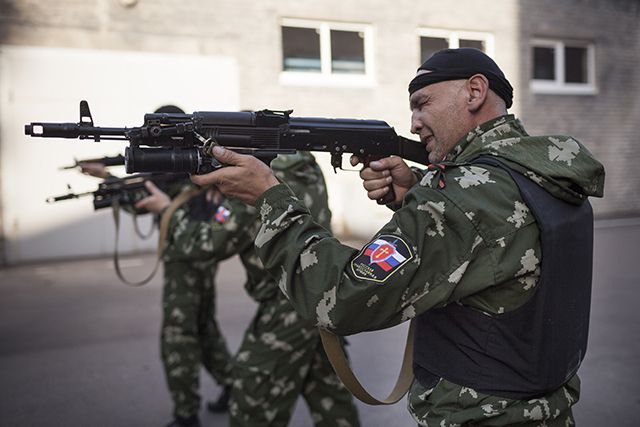
- And how do the Donbass priests relate to the Ukrainian Orthodox Church of the Moscow Patriarchate? Are they directly obeying Moscow?
- No, it so happened that the Ukrainian Orthodox Church is still the only structure that unites all the churches of Ukraine; The Diocese of the UOC [acts] both in the Crimea and in the Donbass.
- And they do not raise the question of retaliation?
- Not yet. Moreover, there was a decision of the Moscow Synod on what would happen that way. Church boundaries may not coincide with the state.
- It is difficult for you to bind purely organizationally and administratively with the Crimea and Donbass - it is difficult to get there.
- There is no need to get there - bishops in place. Here in the Donbass - the priests remained in place, no one left, dioceses, the bishops remained in place. That is, the administration, the city authorities, and the regional authorities left, and the churches remained. Because the church is just in the Donbass, including - tries not to participate in this political history, it is engaged in real people. Parishioners, in particular, in the Donbass are pensioners, people who could not leave. Plus, priests even fulfill the function of searching for prisoners.
- But this intensity in society affects the priests: some are killed, parishes are ruined.
- Touches. You see, if we live only in our world, it seems to us that it is the largest. If you look at the scale of what is happening today in the east [of Ukraine], then problems with priests are isolated cases. There are problems, but they cannot but be where they shoot from heavy weapons and “grades”. I would not distinguish us in a separate story: we are part of this society, and these are the problems of the whole body of the people, and not just the church bodies. We do not live torn off.
- Patriarch Alexy during the events of 1993 and the capture of the parliament tried to act as an intermediary between the parties. Can the Orthodox Church act as a peacekeeper and intermediary in relations between Russia and Ukraine?
- It was in Kyiv. During the Maidan, it was the religious community of Ukraine, Kyiv acted such an intermediary. The church was with the protesters, the church was an intermediary in the negotiations of the authorities and the opposition, even how paradoxical it sounds, the opposition and the Maidan, because the leaders of the opposition in some issues were not representatives of the Maidan. The great merit of the church is that the situation was overcome very quickly, including the change of power did not lead to some more radical actions.
And when the situation began in the Donbass, for a number of reasons the church fell out of this process. It seems to me that one of the reasons is that the level of religiosity and trust in the church in Kyiv and west [in Ukraine] is still much higher. Therefore, there was an opportunity for the church to be an intermediary in this situation - without evaluating, but trying to help people decide it. But the situation in the Donbass is slightly different, the level of real religiosity is lower.
At the first rally organized by the administration of the Donetsk region, the first was also given the word to the priest, Father George, and the press secretary of the Donetsk Metropolitan. And people with the flags of Russia and the Donetsk republics boiled him. That is, to me, the representative of the Moscow Patriarchate, they shouted “thank you” on the Maidan and took a blessing, and the priest of the Moscow Patriarchate in Donetsk booed, you see?
Plus, an external factor is already entering here. You can be an intermediary in Kyiv between Ukrainians. But when an external force enters the situation, which does not call us into intermediaries, does not listen to our appeals and statements, there is a great responsibility already in the Moscow Patriarchate.
If Russia is a participant in this process, then, probably, this peacekeeping function was to be performed in some way. But I have a big question for the level of religiosity and trust in the Church of Russian Society, the Russian establishment. This is also one of the components.
- On the Euromaidan, as I understand it, priests stood every day, and every day began with the service. Was these priests of the Kyiv Patriarchate?
- There were Grecokatoliki, the Kyiv Patriarchate, there were generally unidentified people.
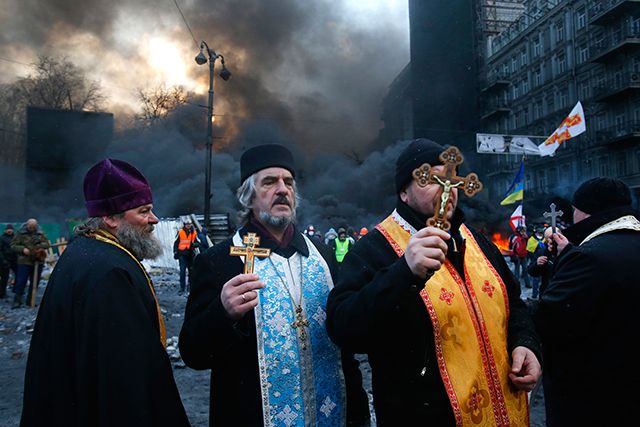
- The same “political religiosity” was fully represented on the Maidan.
- But this is our inner question, we must deal with him. Those who were on the Maidan testified themselves that thanks to the clergy, including the level of tension and aggression, the level of tension and aggression was reduced. After all, this protest lasted several months, that is, there were several points of boiling. It was a process, and the authorities refused to hear, listen to people, or they were watered from water bodies in the cold.
- But it still turns out that Ukrainian priests, together with the Maidan, opposed the authorities. Including you personally, despite the fact that then you were the speaker of the Church of the Moscow Patriarchate. You consulted with someone, what should I do? Vladyka [Metropolitan Vladimir] was already sick.
-All the messages spoke somewhere before, I just put it into a more media form. And most importantly: Vladimir always wanted it to be in the gospel traditions, so that it would not be a political declaration. After all, we tried to introduce the situation into some direction, so that people cease to see the faceless labels in each other. Even Boris Grebenshchikov has this on the last album: there are no people who are against it, those who are with us have no faces.
On the one hand, a helmet, on the other hand, is a balaclava, and there are no longer faces, there are no people, and also the division occurs. And we tried to be people.
When I walked in Kyiv during the barricades and the presence of “Golden Eagle”, I, as a priest, felt safer, being in priestly vestments. I spent freely - the “Golden Eagle” passed me through the barricades. There was, for example, a column of guys with shields, and at the sight of me they all took off their hats, greeted me and approached, took a blessing. You just look at what I said, and let's discuss not only the very fact of presence on the Maidan.
- You opposed corruption.
- Is this the wrong message?
- [Chairman of the Synodal Information Department of the Russian Orthodox Church] Vladimir Legoyda believes that you can talk about corruption in confession, and not in the square.
- I tried to translate into a language that is understandable to people, including their mood. Moreover, I said this for a reason, but after I brought several commandments - and translated it into the Maidan language. I also said: just remember, this applies not only to power, this applies to each of us.
Christ walked, preached, the apostles walked, preached, did not sit, did not wait somewhere, but went, and went there, to those communities that could not seem very respectable to everyone.
- You did not receive signals from Moscow after what you did?
-No, it somehow happened that they never called me from Moscow, did not indicate or controlled me. And they did not try. I don’t know for what reasons. But I was, let's say, I was spared from it.
- Orthodoxy in Russia is now represented by a “spiritual cross”, an explanation of the fact that we are not like Europeans; And only we, Orthodox, are the keepers of true moral values.
- You know, everything is very well written in the parable of the fund and the Pharisees. We must start looking at yourself. Is it really that everything is fine with us, in Russia or in Ukraine? I am not a big specialist in the level of morality in Russian society, but I have such a suspicion that not everything is as good there as they sometimes draw on posters.
I see more and more that Russia wants to be the Soviet Union. But we, as Ukraine, made our choice in relation to the Soviet Union, let Russia make our choice. We are not the Soviet Union, and we would like to build our state. But the question is different - we have the same problems. We are building our state, but sometimes we build in a Soviet way, so I have enough problems here. It seems to me that Russia should also have enough problems with its people.
- The Ukrainian Orthodox Church of the Kyiv Patriarchate in the fall convenes the Unification Council. Do I understand correctly that the idea itself is to separate from the Moscow Patriarchate - and that the maximum number of priests of the Moscow Patriarchate participate in this process?
- Right. But you see, here the question is different. With people who want to separate, you need to conduct a dialogue. Let's just say, the very idea of separating from Moscow is not an idea, an equivalent idea to separate from Christ. If people want to be Christians, Orthodox and do not want to be in the Moscow Patriarchate, let's find a solution for them. In the same way as for those who do not want.
But in order to understand how many of them, you need to conduct a dialogue, you need to be open. I am always confused by diplomacy in church relations. Perhaps I am naive or stupid, but it always seemed to me that the church should still be different from the world. The church is not from this world, but from the Lord.
- And why do Ukrainians need the Moscow Patriarchate?
- For me, this is not the most fundamental question. Sometimes we do not choose which family we are born and in which church we are baptized. I did not choose much in the 1990s, in which temple to start going. I remember very well a student of Kyiv University, I began perestroika, I went to Andreevskaya [Church in Kyiv] and heard the first services in Ukrainian. This, as you know, was an autocephalous church. And my favorite temple was the Vladimir Cathedral, next to the Red Corps of the University. But at home, in my hometown, there was a temple of the Ukrainian Orthodox Church, whose parishioner I was, which we restored, the young guys in which we created a Sunday school in which I was ordained. And so I became actually a priest of the Moscow Patriarchate.
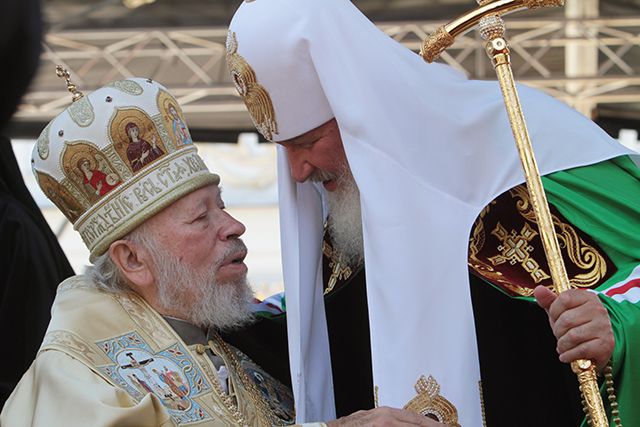
At the same time, I have no connections with Moscow: I did not study in Moscow schools, I did not work in the Patriarchate. I was born in Ukraine, I lived in Ukraine all my life, voted for the independence of Ukraine, but my fate is connected with the Moscow Patriarchate ... And it never embarrassed me, and we were brought up by the blessed metropolitan Vladimir in such a way that, you know, the main thing is not status, but unity.
Un -marginal people in Ukraine completely calmly go there and there, and there, baptize children in one place, get married in another. This de facto happens. Therefore, the church, perhaps, would have learned from people in something. Because the church is not only a bishop, not only the bishops need to agree. It is necessary to agree on the clergy, who also has an opinion, but which no one will ever hear or listen, considering the priest almost a mercenary at the temple. In the same way there is an opinion of people-it also needs to be heard somehow.
-How to agree-to hold a referendum?
- Well, the cathedral mechanisms that there were and were in the church. The united cathedral is not only the cathedral. Preparations for the cathedral should also be carried out as a cathedral, the issues should not be discussed in the backstage.
- The unification of three churches under the jurisdiction of the Patriarchate in Constantinople can be an adequate solution to the situation?
- We have to look. Constantinople once accepted Ukrainian parishes in the USA and Canada. Now these parishes - the UOC in the USA and in Canada - are part of the Patriarchate of Constantinople. Over the years, Constantinople was not part of Ukraine, he did not take any unfriendly steps towards the Moscow Patriarchate. But this does not mean that you need to continue to wait and do nothing. In 2004 and 2005, I was at the reception of the Ecumenical Patriarch-and he said that we must find a solution. They said: if you find a solution, and this solution will unite you, we will support you.
In fact, the Ecumenical Patriarch seemed to me much wiser in his messages and decisions, than this is drawn in such layouts ... conspiracy. That is, Constantinople is still a tradition that is ancient of us. Of course, this is a mother-church for us, and you cannot refuse it. Kyiv is a department, which is set by Constantinople. This is not someone's patrimony.
- Among the Russian Orthodox, the point of view is popular that [the head of the UOC of the Kyiv Patriarchate] Metropolitan Filaret is supported by the West, but the UOC of the Moscow Patriarchate is still our patrimony. How do you feel about this?
-For me, the world is not divided into Western and Eastern, I would still like to be part of the real world, where all people are brothers, no matter how trite it sounds. И в этом смысле на своем уровне я вопрос решаю таким образом: я считаю, что каждый из нас должен научиться видеть христианина в представителе другой конфессии, если он действительно христианин и живет по закону, и видеть верующего в представителе другой религии. Это тоже единство, понимаете? Потому что Господь не говорил: я буду в той или иной структуре. Он не ходит по кабинетам митрополий или патриархий. Господь говорил: где двое-трое собраны во Имя Мое, там Я посреди них.
Мы все пытаемся делать по-средневековому. А наши церковные модели еще более средневековые, мне кажется, по восприятию. Нужно найти какой-то новый язык и новые формы, которые бы не отменяли традицию, а, наоборот, могли бы ей помочь подлинно развиться. Потому что, к сожалению, вот эта вот модель — Запад, против Запада, за Запад — [неправильна].
— Что может произойти после того, как служители Церквей — маленькой и очень маленькой — создадут большое объединение величиной с половину всех ваших, то есть московских, приходов?
— Я считаю, что было бы хорошо, если бы их признали в Константинополе и они существовали на правах параллельной юрисдикции, а Москва этому радовалась бы, а не плевалась.
— Это разве может произойти?
— Да почему нет? Если люди, так сказать, вернулись в церковь…
— В принципе, Москва может вообще не обращать на это внимания, потому что если УПЦ останется с Московским патриархатом, то они будут управлять своими 12 тысячами приходов.
— Это был бы идеальный вариант, но никто же так не будет [действовать]. Будут опять анафемами разбрасываться.
— После объединения московские приходы будут сами отделяться от московского патриархата и массово переходить в новую церковь?
- They can. Сейчас почему этого не происходит? Потому что люди — в частности, священники — хотят все-таки в легализованном пространстве существовать. Ну это тоже не может продолжаться бесконечно. Мы же ничем не отличаемся. У вас есть харизмометр?
— Харизмометр?
— Ну, померить благодать. А такое ощущение, что в Московской патриархии он есть.
— То есть те, которые в 1990-м отделись, менее благодатные?
— Те, с которыми мы разделились 1000 лет назад, они благодатные, католики. Те, с которыми мы разделились 400 лет назад, благодатные, это грекокатолики. А те, с которыми мы разделились 20 лет тому назад, они не благодатные.
— Они должны стать благодатными лет через сто.
— Они и станут. Просто вопрос тогда — что мы сейчас делим? I have no answer. Москва продолжает себя считать церковью Советского Союза. Московский патриархат не стал Русской православной церковью, это Церковь СССР. Проблему надо разрешать, а не подвешивать, а не пытаться манипулировать с помощью карманных переговоров. Москва не дает вселенскому что-то сделать, пригрождает ему чем-то. Патриарх константинопольский медлит.
— Получается, оба патриарха используют Украину, и тянут ее на себя, решая свои проблемы.
— Разве это по-христиански, по-апостольски да по-пастырски?
— То есть Константинополь вас тоже использует в переговорах с Москвой?
— Конечно, конечно, конечно. Я хочу, чтобы моя Церковь была Церковью. Не надо из меня делать клерка. Клирик — однокоренное слово. Не надо из меня клерка делать. И я буду продолжать думать, что я думаю, а вы думайте, что со мной делать в этом смысле. Хотите меня запретить, отлучить — пожалуйста, тоже ваше право, используйте его, но я не должен этого бояться. Я считаю, что мы должны возродить этот дух, что мы должны быть Церковью, а не каким-то общественным институтом при дворе. Мы должны обсуждать сложные вопросы, мы должны находить консенсусные решения, а они все равно только анафемами умеют разбрасываться. Потому что они — это запретить, отлучить, прервать общение, анафеме предать. А можно же совершенно по-другому действовать. В Церкви должна быть возрождена подлинная соборность.
Ilya Zhegulev
Kyiv