
Translated material
Researcher and judge
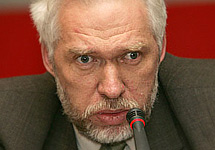
He died at the age of 98, Robert Conquest , one of the patriarchs of world councils. That revolution in the perception of the Soviet Union in the world, which was made by two of its truly great books, "Big Terror" and "Harvest of Sorrow", can be compared with an earthquake that destroyed the attitude to the Soviet experiment in the West as a noble in the goal, but not successful due to ineptness and evil will of the performers, and not at all because of the fundamental viciousness of the communist idea.
But the historian’s life path was at first the same as the members of the famous “Cambridge five”: in his youth - a passion for communism ideas and even membership in the Communist Party, and during the Second World War - a service in British intelligence. But Concvest, unlike Kim Philby and his friends, the work in Sikret Intelligence Service did not lead to espionage in favor of the USSR for ideological reasons, but to the deepest rejection of communism. He happened to work in Bulgaria just when the pro -Soviet communist regime was installed there. The one saw was enough for Concvest for life to become the most convinced anti -communist and anti -Soviet. But the terror that the Bulgarian Communists and their Soviet curators created was only a pale shadow of the Stalinist terror!
In the “Great Terror”, the historian on the richest material proved that the repressions were by no means aimed not only at Stalin’s political opponents, as they thought in the West, that terror was the essence of the Soviet regime, that the famous “Moscow processes” were only the top of the iceberg, that in fact the Stalinist terror destroyed millions of people. And here we can’t talk about certain errors of individual representatives of the authorities. The subtitles of the "harvest of sorrow" are characteristic: "Soviet collectivization and terror with hunger." The hunger, artificially caused by the Communists, rightly considered the same terror as mass executions for political reasons.
Then, in the late 60s, when the Great Terror was first published, the Western public was afraid to criticize the USSR too much, including for the invasion of Czechoslovakia, as she was afraid to bring the beginning of the world thermonuclear war. Well, just like in our days in the West they are afraid to criticize Putin for aggression against Ukraine too sharply: suddenly the whole world will be bogged down with a nuclear club. Conquest believed that the “big terror” happened because “Stalin put his faith in an unhoused ideology, and when it failed, he did not want to recognize this and show that he managed to create the appearance of success, the appearance of the desired reality - instead of the one that actually existed.” In order to bring the existing reality to the imaginary, terror and war were needed. How it all looks like the current inhabitant of the Kremlin!
Of course, when writing his main books, Conquest did not have access to Soviet archives, and his individual provisions could be outdated. So, today most historians consider the number of victims of collectivization given in the "Harvest of Sorrow", as well as the number of victims of the Stalinist regime of 20 million people. In the latter case, obviously, a lot depends on who exactly to classify to the victims of the regime. If, for example, add the Soviet victims of World War II here, for the outbreak of which Stalin made a little less than Hitler, then the total number of dead will probably exceed 50 million.
Conquest was not only an outstanding historian, but also a poet, a brilliant stylist. This also contributed to the popularity of his books and increased their impact on public opinion. And in today's Russia, where the school libraries are already withdrawn as “slanderous” and “defaming the Red Army” of the works of Anthony Bivor and John Kigan, there is a danger that soon the turn can reach the books of Conquest. After all, they completely destroy nostalgia for the USSR, on which the current regime is largely held. And today again there is a need for the emergence of a researcher of the scale of the Conquest, which in the new “big terror” would reveal the eyes of the Western public and politicians to Putin's Russia, with which too many would like to continue “business as usual”.