
Translated material
Drones will check the breath of whales
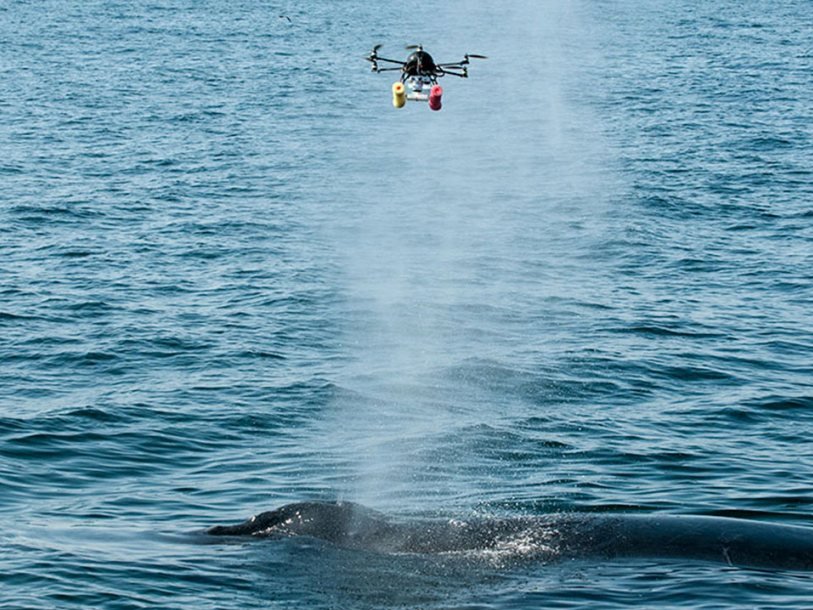
To check the prevalence of the infections of the upper respiratory tract in large whales, scientists decided to analyze the content of bacteria and fungi in their exhaled air. As you know, the nostrils of the whales are shifted to the top of the head and equipped with a special valve that closes them when the whale dives under water. After the sip of the whale, the nostrils, often called the “breath”, open, the whale exhales sharply, and the air that comes out of it, due to a meeting with the colder external, forms the Keith fountain-a column of condensed steam. It is clear that taking a sample of exhaled air at the whale floating at sea is difficult.
Researchers from the Oceanographic Institute in Woods-Hole (Massachusetts) and the National Administration of Ocean and Atmospheric Research of the United States created for this purpose “Whalecopter”-an unmanned aerial vehicle. From a technical point of view, it is a hexacopter, that is, it is equipped with six screws. The drone will be able to approach the whales floating in the ocean, take samples of exhaled air, take photos of high resolution, which will also allow to evaluate the health of the whale, for example, its fat and skin lesions. The tests of the apparatus took place over the past month in the Stellvagen-Bank Marine Reserve in the Massachusetts Bay. Kitokopter was able to hang at an altitude of 40 meters above a group of 36 whales, take photos of the general plan, then sank to the surface of the water, where he was able to take a picture and take 16 samples of exhaled air. The creators of the apparatus plan to go with him in winter to the Antarctic Peninsula area to check the health status of the whales living there.