
Translated material
Visiting the Himalayan Aryans


When developing in the autumn of 2014, the route of the 3rd West Himalayan expedition to SPBSU came across rather scarce information that in the north-west of the former Kingdom of Ladak there is a village where arias are still separately live, whose ancestors have once come here from the distant north. This mountain village, hidden in one of the gorges of the upper reaches of the Indus River, attracts the attention of orientalists from the second half of the 19th century. In the 1930s, Nazi ideologists in search of the descendants of the ancient Aryans even organized an expedition there.
In the 1970s, the Indian government limited the entry of tourists to this area in order to maintain its cultural authenticity and prevent visiting by the German neo-Nazis. The ban was valid until 1993 [1] .
When discussing the details of the route with our partner in the capital of Ladak, the city of Lech (LeH), it turned out that to visit the Aryan village, it is necessary to get a special permission. The road, not always marked even on modern tourist maps, passes near the so -called ceasefire, or control line (according to the 1972 agreement), which is actually today's border between India and Pakistan. To the north of it are the vast disputed territories of the high -mountain regions of Gilgit and Baltistan. As a result of armed clashes, these lands moved to Pakistan, but India considers them their own.
In Leha, we were warned that the road would be difficult: it goes outside ordinary tourist routes, there are no roadside dumplings ( Dhaba ) and hotels. Thus, in the evening we had to be in the town of Kargil (Kargil), which significantly limited us in time and did not leave the opportunity to make any long research stops during the trip.
On Sunny Half, on June 29, we left Oasis Lamuuru (Lamayuru) with his old monastery, many Chortenes and “lunar” hills. We had a rather distant path along the Upper Indian Valley between the Ladak and Zanskar ridges. For us it was a new route, and we were ready for various surprises.

Near the old village of Khaltse (Khaltse, Khalatse, 3443 m), immediately behind the next police post, the road turned to the north-west and for several hours went along the gloomy crama of Indus. On this site, the famous river (Indus River), which gave the name to the huge country (India), its population ("Hindus") and one of the world religions (Hinduism), looked as modest as severe.
The width of its channel is small here, from 25 to 65 m, but a powerful foaming stream that made its way through the gorges and canyons looked frightening. It was hard to believe that, breaking out of the tenacious ticks of the cold Himalayas and spilled among the hot plains of Hindustan, this indomitable river on its fertile shores sheltered once the first foci of disappeared civilizations.
On both sides of the Indus Valley, but more often on the right (Ladak) shore in the indo are stormy rivers. With their mouths, among the greenery of poplars and rakit, stupas, prayer wheels are visible; Razzia, sometimes very high, there are adobe houses with piles of brushwood on flat roofs. Here and there, hanging bridges are thrown across the river. In addition to small villages, now and then we pass military units, barriers, armed posts.

The only roadside cafe, promised by advertising shields, turned out to be a simple tent that we drove. The wading iron bridge, decorated with Buddhist flags, looked like a cruiser on a parade. Behind the bridge there is a fork, under it are boulders, a white strap, the cleanest mountain stream is the DAX River.
Soon the first sign of the distance to the village of Dach (or DHA) appeared. Her English spelling ranged: either Dah , then DHA (the letter H is not pronounced in Ladaka), but in literature it appears as DA and DHA-HANNU . It became clear that the village itself is somewhere nearby.

A soldier in camouflage uniform, with a helmet on his head and an Indian self -loading rifle in his hands, kindly explained that it should go along the right road. With zigzags, she went up in the lateral gorge, crossing the river several times. The slope became cooler, and the tops of the mountains are getting closer. But here is a stop, again barbed wire, barrier. Our driver Yasir announced: there is no passage further, a forbidden zone.
Time passed, we were hungry, far from Kargil, and the village was drowned somewhere! Forcedly turned back, deciding that, apparently, it was not fate to meet with the descendants of the ancient Ariyas, and suddenly they saw on a barely noticeable fork, which they almost had already traveled, an arrow on a small stone near the road with the word DAH . Yes! It was a pleasant moment, everyone immediately revived and began to show the driver where to go.
A few minutes later, after several turns, a shady dirt road, we found ourselves on a small platform with spreading stream water. Its edge was surrounded by barbed wire, and then there were dense thickets of shrub and trees. Dead end! Only among the huge boulders on the slope was a completely modern house with a closed door alone on the slope ... And nothing more and nobody! An annoying, dreary feeling arose that they had stopped there again. Suddenly there was a call voice of Danila, the youngest participant in our team. He managed to climb the slope and, having discovered a barely noticeable path among the stones, delve into it into the thicket, where he saw at home.
We climb over the fence, folded from the sun -nibblers and “fortified” with rusty barbed wire. We go down the dusty path to the edge of the willow thickets and ... we fall into another world. The first sensation - everything is fine here: the shadow, and silence, and calm. Under the cool canopy of the trees, the path passed into wooden bridges, and soon we were welcomed by a teenager and a man that appeared, inviting the tired travelers to visit them!
On the neck of a pretty curly young man hung an amulet with a horned head of a yak. Seeing our curiosity, they immediately explained to us that this is a symbol (wish) good health. As it turned out later, the young man was a non -fan, earnings in India. Its owner Mr. Sonam called himself Arym .

Immediately the question arose of rest and lunch. We said that we were in a hurry, and as a result we were offered to cook boiled rice with additives (a kind of vegetarian pilaf), as well as tea with lemon. To the question of the local, Aryan food, we were answered that it (PAPA) to cook for a long time, at least an hour and a half. So we were left without a dad.
Next to the "restaurant" in the form of several tables under a canopy from the sun was a two -story guesthouse (family hotel), painted in blue. It was called Makspon and, judging by the business card, was located in Aryan Valley ("Aryan Valley"). The rulers (Magspons, Maqpons, or “Princes”) of the village of Dah [2] were called a similar word in former times [2] .
While the food was preparing, we scattered in different directions to examine the village. Its western outskirts with a guesthouse were covered with a shadow of walnut grove. The path led to the White Chorten (stupa), behind which stood a small Buddhist temple with a large red prayer cylinder in front of the entrance, which was closed. Nearby was a clean infirmary, which was also deserted. The neighboring territory, overgrown with grass, consisted of many small cells, separated by low stone walls. These were protective fences from always hungry cattle.
The village of Dach is in the lower reaches of the river of the same name, the right tributary of the Indus. Here is the steep and deserted slope of the Ladak ridge, the crests of which go up to 5000-5200 m, forms a slightly inclined ruggedness that lies at the level of 2775-2780 m. Its length reaches 1100 m with a width of 150-200 m. In the south and west, this ledge breaks deeply to Hindu and the Dah River. road. The upper edge is occupied by buildings, the lower part is under the gardens and small sections of the fields.
The very village is buried in the shadow of tall trees. Garden areas are separated by lace stone hedges into a belt high, among which winding pedestrian trails are laid. Along the edge of the abyss from boulders, a wall is folded higher. Behind her - a failure, in the depths of which a muddy indt is noisy; Its channel lies at an altitude of 2715 m. Barley is collapsed in the field sections of the villagers, Donnik blooms.

The village stretched out among the trees along the "street", inconspicuous from the guesthouse. This is a path, in places very narrow, dirty and wet, passing between the stones along a narrow canopy, laid along the upper edge of the gardens. On one side of it there are stone residential buildings and outbuildings, and on the other - gardens, small fields, water collection places, etc.
With some imagination, this path could be called a boulevard, if it were more sprout. However, its width is sufficient to disperse two passers -by with shoulder baskets or take a row of three teenagers. The bizarre lace of boulders and stone fences forms peculiar gardens of stones, or rather, gardens among stones.
If the hospital, the Buddhist Temple and Guesthaus are built using reinforced concrete, but other buildings of the village that we saw were traditionally clay. Low houses in 2-3 floors with flat roofs, walls of gray raw brick and wooden (populated-iva) ceilings. From the houses of the Tibetan type on the highlands of incense, they differed in an increased size with windows (climate warmer) and the absence of platforms painted in dark tones. On the roofs, as everywhere, hay, kizyak, brushwood and other supplies of rural everyday life. However, on the walls, signs of our time are plates of satellite television.

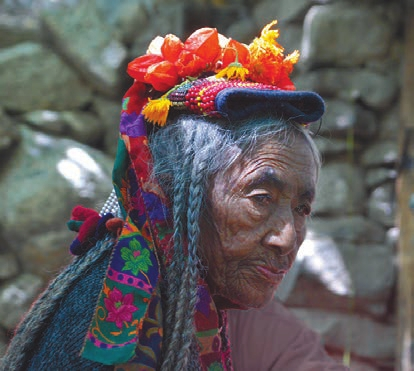
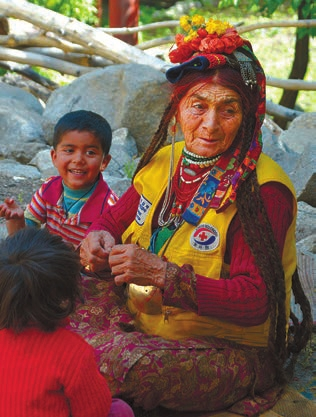
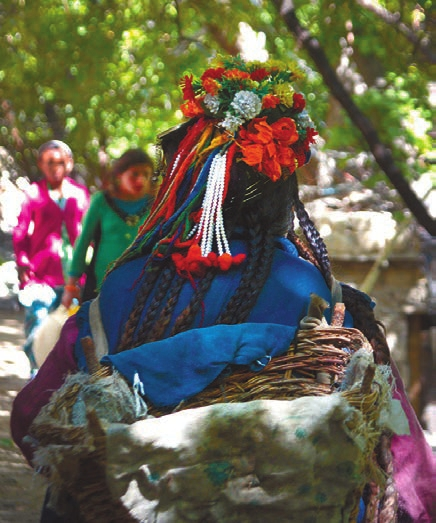
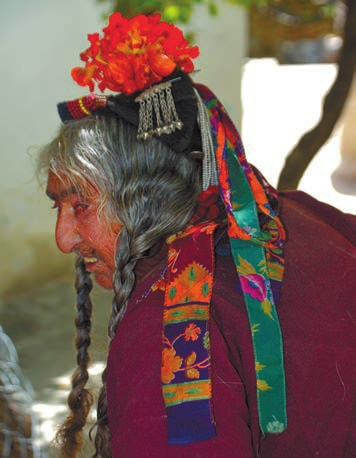
The narrow passages between the houses are paved with cobblestone and covered with roofs from poplar and talnik. Children, young women, occasionally men, but most often old women, are scurrying along the shady "Esplanade". Their heads were unusually decorated with baskets with bright bouquets of living or slightly dried flowers, orange pepper boxes. Braged among the braids, they were supplemented by bunch of beads on the neck, earrings in the ears and colorful ribbons on dresses. Such jewelry is characteristic precisely for the Aryans and in other areas of frets are not found. Among the garden gestures, these "flower compositions" flashed as a plumage of tropical birds.
At the shady of the “Main Street” we met a young man who spoke English well and confirmed that he was a local resident of the Ariyas. Having learned that we are from Russia, a slender black -haired Dorje with pleasure, but slowly and answered all our questions with dignity. It turned out that with the Russians he talked to Goa, where he worked somehow in winter.
Dorgey told the story of his people a friendly Dorge as if she was going on before his eyes. It seemed that we were talking with the very eternity. Here is what we managed to learn from our interlocutor (we omit the questions we ask).
There are no written documents (chronicles) in the village, but they lead their history from the time of the Sikander (that is, Alexander the Great!), When they had to move to the shores of the Indus from the west, from the territory now attributed to Pakistan. About 250 years ago, the Arias of the Dah took Tibetan Buddhism. Dorje himself also comes from the Buddhist family, and therefore he has a Buddhist name (it seemed to us, it was said with some regret or sadness in his voice).
In total, there are 38 in the village (according to the owner of the guesthouse, 35) houses, that is, more than 200 inhabitants. However, now there are almost no men in the village: some in the summer go to mountain pastures, others are hired by the Indian army or go to work. The villagers speak their own language called Brokpa (BroKpa); He is incomprehensible to other ethnic groups of Ladak, which was also confirmed by our driver-lady [3] .
Previously, the inhabitants of the village hunted Ibexes (wild goats), but now this is rare due to Buddhist prohibitions. Therefore, they are mainly farmers and shepherds. There are few cattle, and residents are forced to engage in agriculture and gardening, growing barley and even grapes from which they make wine for home consumption. Our request to try the drink politely, but firmly rejected, saying that we were unlikely to like it.
Apricots, peaches, apple trees, plums, mulberries, almonds, walnuts are also growing. Part of the crop is sold. The village itself and the garden are inextricably linked, and such a design is characteristic of the Aryans.
The local climate is generally not bad. In summer, the temperature rises to +30 ° C. Frosts are strong, up to –20 ° C; Snow lies from November to March. Therefore, a significant part of the year is isolated. In winter, residents who did not go to fishing do not go to neighboring villages and live in supplies.
Dorje emphasized that the inhabitants of Dach take care of their ethnic and cultural identity and do not encourage confusion with representatives of other nationalities. In order to avoid closely related marriages, brides or grooms, they find in neighboring Aryan villages, where they speak the same language, for example, in the village of Hanu Tohang and others located in the Hanu Chu River Valley, the right -bearing tributary of Indus. Young people get acquainted on holidays, then get married ...
The first foreigner (Frenchman) appeared in the village in 1915. Tourists began to visit the village in 1996, the first Russians in 1997. After the Kargil conflict with Pakistan (1999), the Indian army settled near the village, which paved a good road, which facilitated access to the village. Now from Lech you can come by bus twice a week.
We delicately asked Dorrge whether he heard about German expeditions that allegedly visited the village in the 1930s. It turned out to be in the know. According to him, Hitler, due to improper national ideology, later had “big problems” (Big Problems), and he finished badly!
In conclusion, we heard that the other day a Russian group would come to the village. It turned out that from time to time a certain Elena brings our tourists to visit the Arias. Residents are very happy about this and arrange a holiday for them: they dress up, sing and dance.
An elderly woman slowly passed by us. She tiredly carried a large square basket on her back, filled with branches with leaves (goat food). Such baskets are used almost everywhere in Ladaka, but in the very West in the Kargil area they have a rounded cone shape. The head of the old woman was crowned with a beautiful bouquet. Having allowed to take a photograph, the woman in return requested money and left pleased, taking 10 rupees.
We met several such dandies, but all of them were far from young. Probably, the tradition is slowly dying, and young people are engaged in such a “floristry” only on holidays or in the case of tourists arrived. In the meantime, children ran along the path, and middle-aged girls and women were in ordinary Indian clothes (Schalvar-Cams and a vest with some kind of application on the back).
Where did the Arians related to the Indo -European group of peoples come from in the Indus Valley? Historians and ethnographers reckon the inhabitants of the village of Dach to the Dardy group (Dards). Perhaps modern dardas are carriers of protorgisted culture (about 1700 BC), since some of their dialects contain signs of archaic, Rigvedia Sanskrit. In the Rigveda itself (“knowledge of hymns”), one of the oldest literary monuments of India (II millennium BC), the north of the country was called Ariavart , that is, the “country of the Aryans”.
It is believed that the Arians came to India from Afghanistan as nomadic wirewriters and settled the north of the Indo-Gang Plain. In this case, they could get into the Western Himalayas from the south. Perhaps the current Mona (Mons) are the descendants of those tribes. Skillful in stone carvings, they left their memory in the inscriptions and embossed images on stones and rocks in the Valley of Zanskar, where monks were once common; Their traces were also discovered near the village of Khalce, which we passed.
The carriers of early, even Dotibetan Buddhism, mona in the modern Ladak are few and occupy a low social situation, being representatives of castes of musicians, blacksmiths and carpenters. Apparently, more warlike Dards, once coming from the mountain Gilgit (now Pakistan), pushed Monov and colonized almost all of the fret, which is indicated by their songs and archaeological monuments. The ruins of the ancient castle over the royal palace in Leha are often considered the construction of Dardy. Однако, по-видимому, они не смогли завоевать Занскар. С дардами связывают появление в Ладаке такого вида спорта, как поло , и поныне здесь очень популярного.
О дардах и районе их обитания в верховьях Инда было известно уже древним грекам. Отец истории Геродот, черпавший сведения об Индии из сочинений Гекатея Милетского (546— 480 годы до н.э.), привел легенду о гигантских муравьях, выкапывающих золото. Страна дардов, производящая золото, упоминалась также Плинием Старшим. Действительно, драгоценный металл добывали здесь с древнейших времен.
Высказывалось мнение, что под «муравьями» могли подразумеваться сурки, которые действительно не раз попадались нам на пути, особенно в Занскаре. Однако тибетолог Август Франке (1870–1930), член Моравской христианской миссии, живший в Кхалце, обнаружил, что легенда о муравьях-золотокопателях издавна существовала в местном фольклоре, и ему даже показали их. Согласно ироничному комментарию этого известного специалиста по Ладаку, крошечные существа вполне могли подрасти в слухах по пути из Инда в Грецию.
В настоящее время дарды представлены на западе Ладака двумя группами, сохранившими свой древний язык. Одна из них обитает в районе селения Драс (Dras), а другая — в верховьях Инда. Первые приняли ислам около 400 лет назад, утратив многие черты своей культуры, включая фольклор и танцы. Вторые подверглись влиянию тибетского буддизма, но сумели сберечь культурные традиции. В отличие от драсских дардов, язык дахских ариев отличается от гилгитского диалекта, что говорит об их долгой изоляции.
Жители деревни Дах с их старинными традициями давно привлекают внимание исследователей [4] . Согласно А. Франке, раньше в этой деревне раз в три года, а иногда и чаще проходил праздник, позволявший местным дардам на время позабыть, что они долго находились под властью тибетцев или правителей клана Догра. На несколько дней селяне становились «сами собою», пели ностальгические гимны о прежних славных временах, вспоминали названия местностей в долинах Инда, некогда им принадлежавших, в том числе и к востоку от города Лех.
Дарды-арии оказали заметное влияние на развитие Ладака. Почему же они практически исчезли? Скорее всего, их потеснили монголоидные племена, пришедшие из Западного Тибета. До принятия буддизма они были приверженцами шаманистской религии бон и вели отнюдь не мирный образ жизни. В сказаниях о закате дардов повествуется, как они отказались повиноваться тибетскому правителю, пожелавшему сделать их рабами. Осажденные в замке, лишенные еды и воды, гордые дарды собрались в зале, сдвинули камни под колоннами и погибли под рухнувшими сводами. Последние тибетские цари запрещали дардам говорить на родном языке и платили доносчикам, сообщавшим о тех, кто нарушал запрет.
Возможно, исчезновение дардов происходило и менее драматичным путем. С ростом численности тибетского населения дарды отступали к западу, а в их обычаях всё более укоренялась тибетская культура. Однако их тибетский буддизм и по сей день включает элементы более древних религиозных представлений.
1. Dewân P. A History of Ladâkh, Gilgit, 2nd impression. New Delhi: Manas Publications, 2011. P. 23, 133.
2. Francke AH A History of Western Tibet. One of the unknown empires. Delhi: Pilgrims Book PVT. Ltd., 1999. P. 48.
3. Брокпа — буквально с тибетского переводится как «обитатели высокогорий». Согласно лингвистам, в деревне говорят на особом изолированном диалекте даххану бесписьменного языка шина́ (Shina), относящегося к восточной подгруппе дардских языков. Последние являются продолжением индоарийских диалектов древности и тесно связаны с индоарийскими языками, возможно образуя их подгруппу. См.: Языки мира. Дардские и нуристанские языки / ред. Эдельман Д. И. М.: Индрик, 1999. С. 14–15, 37–38. Ладакские варианты шина называют также broksakt. См.: Carla F. Radloff. The dialects of Shina // Sociolinguistic Survey of Northern Pakistan. Vol. 2. Languages of Northern Areas. Islamabad, 2002. P. 99.
4. См. также: Bhasin V. Social change, religion and medicine among Brokpas of Ladakh // Ethno-Med. 2008. Vol. N. 2. P. 77–102; Eakins N. Ladakh. A photographic journey. New Delhi: Hanish & Co, 2009. P. 63–68.
Лев Боркин, Александр Андреев,
Center for the Himalayan Scientific Research of the St. Petersburg Union of Scientists
TRV-hobby-information partner of SPBCU on the Himalayan project.
Все фото — А.В. Андреева, 29 июня 2015 года