
Translated material
Inexhaustible moser

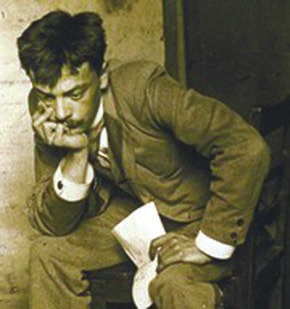
Unlike other outstanding figures of the Secession Association, who were professional architects, Koloman Moser (1868–1918) was an artist. He received a fundamental art education; Already his early works give out virtuoso schedule, and the last fifteen years of his short life, he has largely devoted to easel painting.

The history of the art of the New Age knows universal artists, but few can compare with the Mozer. He created furniture and interiors, theatrical scenery and jewelry, stained -glass windows and book illustrations, postage stamps and drawings for banknotes, congratulatory cards and theatrical posters. And of course, the Moser was an outstanding artist of the book and an outstanding master of both easel graphics and painting.
 The famous art magazine Ver Sacrum (published from 1898 to 1903), functionally similar to our "world of art", in many ways was the creation of the Corester. There is a whole collection of Ver Sacrum numbers on the Internet, which allows you to evaluate the passion with which these miracles of the graphics and art of the book were created ( www.johncoulthart.com/feuilleton/2011/04/28/ver-sacrum-1898/ ).
It is interesting that the mature moser was not at all a supporter of the same style: for example, his drawings for a children's book, designed as a gift to a little niece, where, among other things, an application made of bright fabrics was used.
The uniqueness of the ceremony manifested itself not only in the variety of his talents, but also in his constant innovation. Berta Tsuckerkandl, Austrian writer, art historian and mistress of the famous salon, back in 1904, marked the Mosher withdraw from the already familiar to Art Nouveau of winding lines. She appreciated the use of straight lines and geometric figures as a moser as a more adequate approach to design tasks, believing that it is the Moser leads in the creation of new forms.


It should be borne in mind that innovative aspirations united the participants of the “Setserian”, as well as the figures of Art Nouveau, to a much greater extent than their personal commitment to one or another private stylistic techniques.
Moser was the first to actively use gold in design - a fundamental element in the design of the main entrance to the Setzession building; He came up with the famous black-and-white cells as a constructive element for decorating chairs in the building "Sanatorium Purkersdorf", built by his friend and colleague by architect Joseph Hoffmann.
In 1903, Koloman Moser, Joseph Hoffman and the financier Fritz Wärndorfer, who supported them, created Viennese art workshops (Wiener Werkstätte). This was a unique association of artists, designers and masters of various specialties, which were supposed to implement the idea of Gesamtkunstwerk in practice.
Moser - along with Klimt and other artists and designers - participated in the first collective project implemented by Hoffman as the leader of the Vienna art workshops: this is the Stockle Palace near Brussels. There, the idea of Gesamtkunstwerk was embodied with the fullness, especially since the performers were not limited in money and everything was specially designed, including the door handles.
In general, the employees of the Viennese art workshops were supposed to be designed and embodied in the material of the product, which were then sold and had to serve as samples of taste , remaining focused on all citizens, and not at all on the elect. Thus, the founders of the Viennese workshops counted on a certain mass of demand. It was, of course, utopia. The products of the Viennese workshops were as beautiful as they were unique, and therefore forced roads. Nevertheless, in various forms, the Viennese workshops lasted in Vienna, Berlin and then in New York until 1932.
Moser left the Vienna workshops in 1908 in connection with financial complications. He continued to work actively as a designer, creating theatrical scenery, sketches for postage stamps, coins and banknotes and intensively engaged in easel painting. No wonder he was once nicknamed Tausendkunstler, which can be translated as "an artist of thousands of opportunities."
Since 1900, Moser taught at the Vienna School of Applied Arts, where he encouraged his students to work simultaneously in the field of “pure” art along with applied art. In 1911, his only personal exhibition was held.
... The fatal 1918 took Klimta, who died from pneumonia, and the Moser, which suffered from cancer of the larynx.