
Translated material
Poland wants to become a full eastern NATO flank
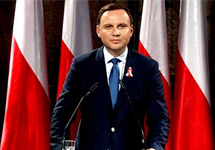
Poland should become the full eastern flank of NATO, and not to remain a "buffer zone" between Germany and Russia. This was stated by President of the country Andrzej Duda in an interview with Financial Times.
"We do not want to be a buffer zone. We want to be the real oriental flank of the Alliance," said Duda. In his opinion, NATO has not yet realized the "Poland's Transition from East to West."
Duda counts on more reliable guarantees of security and to expand the military presence of an alliance in Poland. However, according to him, Germany and some other NATO members blocked the calls of Poland and other Eastern European countries on the creation of permanent alliance bases on their territory.
“NATO should be here to protect the alliance,” the president emphasized. “If Poland and other central European countries form a real NATO flank, then it seems a natural and logical conclusion that the bases should be located in these countries.”
On June 14, The New York Times reported the Pentagon’s intentions to transfer to Eastern Europe , including the Baltic countries, heavy weapons for 5 thousand American soldiers. In particular, it is proposed to send tanks and infantry combat vehicles to the Russian borders. However, the placement of the permanent contingent of American soldiers in the region is not yet about.
Since 2004, when the Baltic countries were accepted into the Alliance, the United States avoided sending its equipment and military contingents to permanently accommodate the alliance to the eastern borders, as they counted on this or that cooperation with Russia.
On June 15, the Coordinator of the Office of the General of the Ministry of Defense, Army General Yuri Yakubov, said that Russia will strengthen the grouping of troops along the entire western border . There will be new formations of tank, aviation and artillery units. “The missile brigade in the Kaliningrad region,” the general noted, “will be re -equipped with an accelerated pace to new Iskander operational -tactical missile systems, and will undergo significant changes in the Russian combined arms group in Belarus, and so on.”
"If the heavy combat equipment of the United States as part of tanks, artillery systems and other military equipment will really appear in a number of Eastern Europe and the Baltic states, this will be the most aggressive step of the Pentagon and NATO since the Cold War of the last century," Yakubov said.