Translated material
KURILS - "SUSI" for the Japanese
Do not think that Japan is interested in the islands. It is aimed at expanding living space due to a huge water area
In friendship, too, know the border
Japanese proverb
Perhaps, in late August - early September, President Putin will visit the Land of the Rising Sun. True, the Japanese stated that the visit of the Russian president would only be held if Russia confirms that they agree to negotiate Japan not two, but all four territories - the islands of the Malaya Kuril ridge (or, as the Japanese, Habomays), Shikotan, Kunashira and Iturup. Apparently, in response to this condition, Putin in August is going to call on one of the Kuril Islands as part of the expedition of the Russian Geographical Society - to Shumsh. According to another version, Putin can go to Crimea. Of course, in Chersonesus Tauride there is a chance to find an ancient amphora by tradition ... But on an almost uninhabited Kuril Island, Shumshu, even without preliminary laying of artifacts with the presidential security service and eminent archaeologists, can be detected by Japanese dishes, a gas mask of the Second World War or the helmet of a Japanese soldier ...
The island of Shumsha
The stretched onion will weaken sooner or later
Japanese proverb
I must say that none of the Kuril Islands had such fierce battles as on the island of Shumsh, between the troops of the USSR and the Japanese Empire. There were 34 bunkers and 24 bunkers on Shumshu, several powerful strongholds, 310 firing points. Several military airfields were built on the island. One of them, even in the mid-90s, also accepted helicopters from Petropavlovsk-Kamchatsky. The naval bases and airfields had a powerful air defense.
In huge dungeons, there were residential premises, hospitals, communications nodes, food warehouses. Sometimes the depth of these underground shelters reached 50 meters, which completely protected them from powerful artillery shells. Some of these man -made caves are still well preserved.
By August 23, 1945, 526 Japanese generals and officers, as well as 11,700 soldiers, were disarmed on the island of Shumshu by the Red Army. In total, in the course of the liberation of the Kuril Islands until September 1, the 45th year, almost 60 thousand military were surrendered.
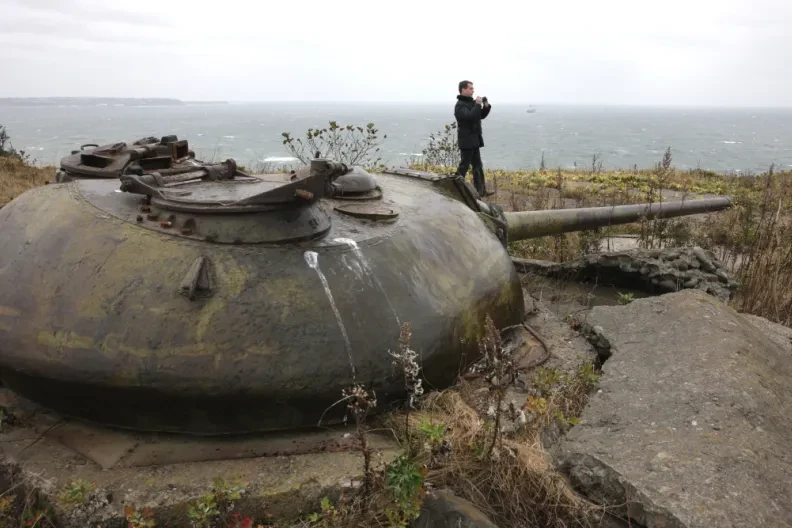
According to official figures, in five days of hostilities, 839 Soviet soldiers and officers and about a thousand Japanese military were killed on the island of Shumsh.
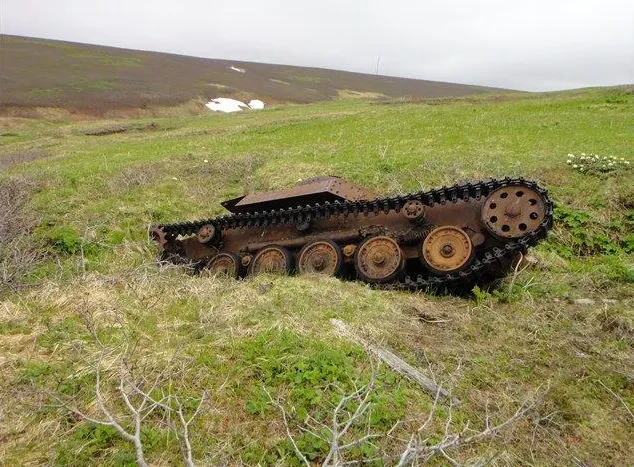
On Shumshu, to the places of fierce battles, now the Japanese often come on a visa -free exchange to worship the memory of the dead fellow citizens and leave candles and sweets on the broken Japanese tanks.
By the way, the Japanese do not need a visa (they consider this territory to be their territory, Russia and made them concessions so as not to insult their feelings), and for the Russians, entry into the smokers - exclusively by the written permission of the FSB border services, since the smokers are border zones.
Unconditional surrender
It is better not to talk about the Battles of the Broken Army about the battles
Japanese proverb
On August 14, 1945, the Japanese Emperor Hirochito announced the surrender of Japan. But according to the report of the chief of the General Staff of the Red Army, Army General Alexei Antonov of August 16, 1945, "the surrender was only a general declaration." “The order of the armed forces about the termination of hostilities has not yet been given, and the Japanese armed forces continue resistance. Therefore, the Armed Forces of the Soviet Union in the Far East will continue their offensive operations against Japan. ” This is a very important point, since the Japanese government all the time claims that the Kuril Islands were occupied by the Soviet Union after Japan’s announcement of surrender. So, according to the Japanese, the islands were “stolen” by the Soviet Union in peacetime. In fact, the official signing of Japan of the act on unconditional surrender occurred only on September 2, 1945.
Complete and unconditional surrender is fundamentally different from simply surrender, which means recognition of defeat in hostilities and does not affect the international legal personality of the defeated power. Such a state retains sovereignty and itself is negotiating about the conditions of the world. And the complete and unconditional surrender is the cessation of the subject of the subject of international relations, the dismantling of the former state, the loss of sovereignty and all the authority, which pass to the winners who determine the conditions of peace and the post -war structure. A new subject of international law arises on the site of the previous state. Germany, GDR and Japan are new states. They were created on the terms of allies within new borders, with new constitutions and authorities. Today's Japan is not a successor to the Japanese state, which began and lost the war, and therefore has no right to demand the “return” of the islands. By the way, in World War II, Japan lost 44% of its territories. “What does it mean to revise and return these islands? This means to admit that in relation to Japan, actions were unlawful. That is, Japan was not an aggressor, but a victim. And this is very important for Japan and its mentality, ”said Vasily Saplin, a former Genaconsul of Russia in Sapporo.
But this, for example, was said at the imperial meeting on July 2, 1941, the chairman of the Privy Council of Japan Hara Kado: “Someone can say that in connection with the Pact about the neutrality for Japan it would be unethical to attack the Soviet Union. But the Soviet Union itself is accustomed to non -compliance with agreements. If we attack the Soviet Union, no one will consider it a betrayal. I look forward to the opportunity to strike at the Soviet Union. I ask the army and the government to do it as soon as possible. The Soviet Union must be destroyed. "
In the argumentation of the official Tokyo on the belonging of the Kuril Islands, references to the contracts of the 19th century-the Simodsky trade agreement of 1855 (according to which the border was held between the islands of Urup and Iturup, and Sakhalin remained unlimited), as well as the St. Petersburg Treaty of 1875 (according to which Japan recognized the entire Sakhalin in exchange for the transfer of all the Kurilski Islands). However, the Russian-Japanese war of 1904-1905 crossed out all previous agreements, since under international law the state of war between states terminates all contracts between them. By the way, this was precisely what was indicated by Japan to the chairman of the Committee of Ministers of the Russian Empire Count Witte, who tried to preserve South Sakhalin for Russia in 1905, referring to the 1875 agreement. As a result, Russia lost all the Kurils and South Sakhalin through the Porkmut world to the victorious Japan, which has always been considered by Russian diplomacy as a great defeat.
Declarations, promises, recognition ...
The fallen chrysanthemum will not return to the bush
Japanese proverb
The Soviet-Japanese Declaration of October 19, 1956 talks about the termination of the state of war, as well as about the consent of the USSR to transfer to Japan the island of Habomai and Shikotan-but after the conclusion of a peace treaty. However, the declaration is not a contract, but a protocol on intent. And it is not about returning, but about the transfer , but about the transfer, that is, about the readiness to dispose of as goodwill with its territory.
The former Genconsul of Russia in Sapporo Vasily Saplin says about the 1956 declaration: “It was a big political game. This was an attempt to get Japan from the full control of the United States. There was an idea to make Japan neutral eastern Finland. How the USSR managed to do this in the 50s with Finland. And the rate was made that Japan depended on the USSR on the issue of joining the UN. The consent of the USSR was necessary. The second point is fishing. All these negotiations of the 56th year promoted the fish lobby of Japan. And the Prime Minister Hatoyam was also from this lobby ( Itiro Hatoyama was the Prime Minister of Japan from 1954 to 1956.-E.M. ) . But all these ideas were defeated by the challenge of the Japanese Minister of Foreign Affairs [Mamora Sigamits] in the USA, where the then Director of the CIA Allen Dallel “washed” the Minister of Brain and said that Japan should demand all four islands. If you agree to two, then you will not get Okinawa back. ” ( Mamoru Sigamitsa was the head of the Japanese delegation in London to restore diplomatic relations with the USSR. It was the Siegamitsa who signed the act of surrender on behalf of the Japanese government on September 2, 1945 aboard the Missouri battleship. Then the Sigemitsa was convicted by the International Military Tribunal as one of the main military criminals . - EM ))
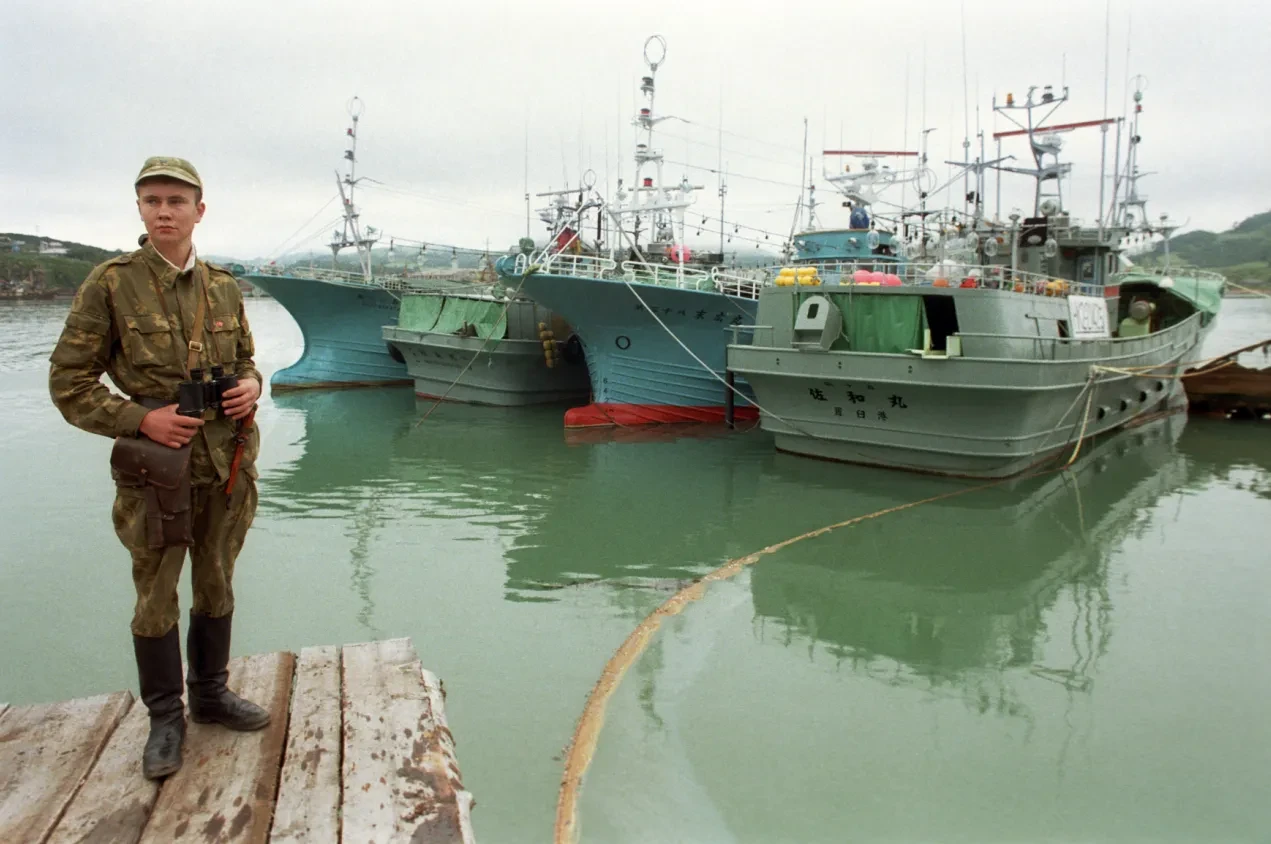
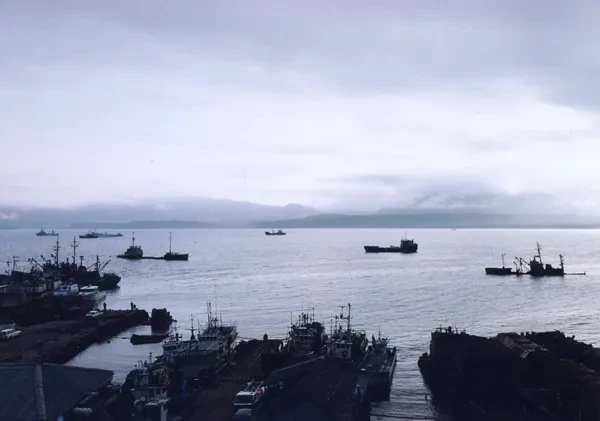
“The actual recognition of Japan of the Soviet border in the Kuril Islands is the fishing agreements signed by it with the Soviet Union, in particular, the agreements of 1963 and 1981.
( Agreements between the USSR and Japan on the fishing of sea cabbage by Japanese fishermen in the area of the signal (small Kuril ridge), which stated that “Japanese fishermen <...> must comply with the laws, decisions and rules of the Union of Soviet Socialist Republics acting in this area.” True, in the agreement of 1998, this is an important condition that has operated out more than thirty years, it has been said there: “The parties cooperate in order to carry out live resources by Japanese fishing vessels in the sea district <...> near the islands of Iturup, Kunashir, Shikotan and Habomai, as well as the preservation, rational use and reproduction of living resources in this marine district.” The waters, and does not allow him to lead this fishing for the corresponding fee, as is always the case in such cases .
The requirements of Japan on the transfer of the Southern Kuril Islands to it are nothing more than the unwillingness to recognize the territorial results of the Second World War, and therefore the signing between the Russian Federation and Japan of a peaceful agreement on the conditions nominated by Japan will mean a legal confirmation of the revision of these results, with all the dangerous consequences not only for the Asia-Pacific region, if we consider that it is potentially to consider that potentially is potentially that potentially There are more than enough conflict and disputed territories after the Second World War in the world, ”said Igor Latyshev, a doctor of historical sciences, a professor, a former correspondent of the newspaper Pravda in Japan.
“Returning to the logic of the Simodsky Treaty of 1855, Japan now does not mean its interest in Sakhalin <...>, but then [after the transfer of smoking] the next step will be officially a claim to Japan to joint ownership of the Sakhalin Island. <...> I see a great desire for the current leaders in the Kremlin to do everything in the name of common human values, the next step is the island of Sakhalin. And what will remain in the Far East? The Pacific Fleet ceases to exist, it will be just a mosquito fleet, torpedo boats. The Sea of Okhotsk is becoming open, now it is half-closed, almost the entire continental shelf belongs to Russia, the resources of the water thickness, and it will be open, which means the presence of foreign military forces, and the great damage will be caused to base the nuclear submarine fleet, ”said the Russian-Japanese territorial dispute: history, modernity, the prospects of the residence of Boris. Tkachenko, leading researcher at the Institute of History, Archeology and Ethnography of the Peoples of the Far East. True, the director of the Russian department of the Russian Department of the Foreign Ministry of Japan Coder Dziro will certainly answer all the fears of Russian scientists about the potential claims of Japan to the island of Sakhalin: “We will not demand Sakhalin from you is clearly.”
In the early 90s, the Japanese offered Russia money for the Kuril Islands-$ 28 billion. In just one year of official seafood catch in the Kuril Islands, more than $ 4 billion can be obtained, that is, after 7 years, Japan more than return this money. And this would be in addition to increased authority and willpower of the Japanese state in defending national interests. The third (extraordinary) congress of people's deputies of Russia (March-April 1991) accused Gorbachev of trying to sell part of the state territory to foreigners. The Kurils did not sell, but during his visit to Japan, President of the USSR Mikhail Gorbachev recognized the equal rights of the USSR and Japan in a dispute about the belonging of the southern smoking.
And then there was a five -stage plan of Russian President Boris Yeltsin to solve a territorial problem between Russia and Japan. In particular, one of the stages was supposed to be a joint protectorate of Russia and Japan over the southern smokers.
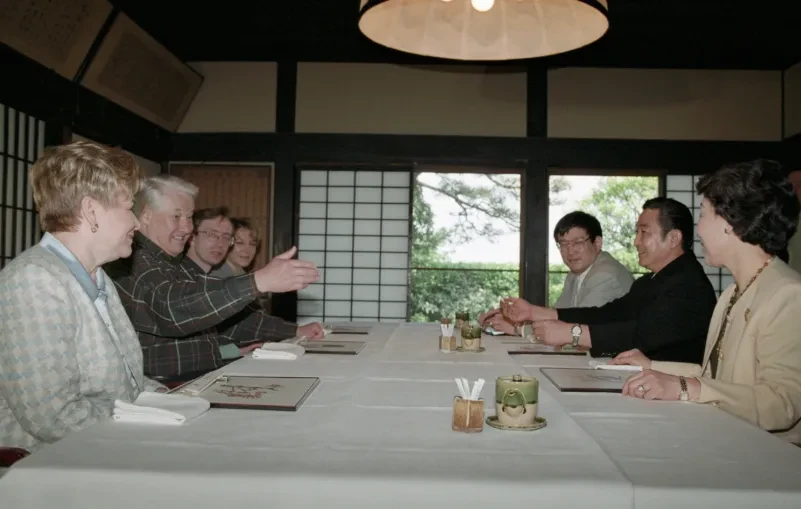
In 2001, at a meeting of President Putin and Prime Minister Mori, an informal agreement was concluded on the phased transfer of Japan “Northern Territories”: first the small Kuril ridge and the island of Shikotan, and only then the signing of a peace treaty. And the islands of Kunashir and Iturup will be given to the joint economic use of Russia and Japan until the final determination of their status.
“I have information that during the visit of Putin (2001) some memorandum was signed, where even the conduct of campaigning measures is provided for by the Russian media forces, <...> that is, it will not be Japanese propaganda, but the Japanese government will pay the Russian media <...>, where the Japanese point of view will be reflected and imposed on the public opinion of Russia,” said Boris Tkachenko, Boris Tkascenko, ”said Boris Leading researcher at the Institute of History, Archeology and Ethnography of the Peoples of the Far East at a meeting of the mentioned round table.
The next Prime Minister of Japan, Koizumi, has already demanded from Russia the return of all four islands before the conclusion of a peace treaty. “We adhere to the point of view that from 1945 to today at that time the former Soviet Union has occupied them, and now they are captured. The northern territories are an administrative unit of Hokkaido, ”said the former governor of the island of Hokkaido Tatsuya Hori.
In this regard, I would like to recall the memorandum of the Commander -in -Chief of the Union Powers MacArthur to the Japanese Imperial Government for No. 677 of January 29, 1946, according to which the Kuril Islands, a group of Khabomai Islands, as well as the island of Shikotan were excluded from the territory of Japan. In other words, the entire Kuril ridge is 29 islands.
"Back, Russian!"
Listen a lot - nothing to wish
Japanese proverb
The return of Kuril turned into a national idea for the Japanese. Every year, considerable funds are allocated from the state budget to the program to return the Northern Territories. In Japanese propaganda booklets and films, it is said that “northern territories” are the original Japanese land, and from the point of view of international agreements, they never belonged to any other country except Japan. ”
On the Japanese geographical maps of the island of the Malaya Kurilian ridge, the island of Shikotan, the island of Kunashir and the island of Iturup are painted in the color of the Japanese state, and the southern part of the island of Sakhalin and the Kuril Islands, starting from the island of URUP and ending with the island of Shumsh, are painted in white, which means that Japan does not recognize the sovereignty of Russia over these territories. And recently, the Japanese even released the handkerchiefs with the geographical map of the Hokkaido Island. On them, the Kuril Islands are painted in the color of the country of the rising sun.
“When we opened our exhibition of economic achievements in Tokyo and hung a map of our country there, the Japanese demanded to remove the map, since the Kurils were on the map as part of Russia. Only in this case, the exhibition was allowed if the card is removed. And our embassy did not find anything better than renting a card. In the 40s, in the 50s, Japanese maps reflected the real state of affairs, reflected the results of the Second World War, and the Kuril Islands and South Sakhalin were painted over in the color of Soviet territory. Repainting of cards began in the second half of the 60s. Of course, this is done with the knowledge of the Japanese government and at the direction of the Japanese authorities. The painting of these territories in the color of Japanese territory is nothing more than cartographic aggression. But, unfortunately, our diplomacy perceives it calmly, ”said Igor Latyshev, a doctor of historical sciences, a professor, a former correspondent of the Pravda newspaper in Japan.
In the last two decades every year on August 9, on the day of the beginning of the Soviet-Japanese war, Japanese activists have been conducting protests. On huge shields-a Soviet-Russian soldier with animal grin and a signature on Japanese: "The islands were taken from us."
And on February 7, the Japanese government was declared “the day of the return of the northern territories” - refers to the Kuril Islands. В этот день в Токио проходят многочисленные демонстрации «правых». У российского посольства в Токио «правые» на плохом русском языке скандируют в мегафон: «Долой, русский! Верни, русский! Умри, русский!»
На улицах Токио агитационные лозунги: «День возврата Северных территорий — день мира», «Настоящее доказательство дружбы — это возврат территорий». На острове Хоккайдо, уже ближе к островам, лозунги становятся конкретнее и резче: «Верните «Северные территории», «Мы не отступимся от «Северных территорий», «Верните оккупированные острова».
На мысе Носсапу на острове Хоккайдо японцы построили смотровую площадку. Отсюда в хорошую погоду можно увидеть не только Малую Курильскую гряду, но и остров Кунашир. Сюда посмотреть на Курильские острова приезжает более 400 тысяч японцев в год. «Когда человек реально стоит на этом месте и видит, как близко эти острова, видит их размеры, то, разумеется, японцы всей страны проникаются настроением, чтобы эти острова скорее вернулись к нам, и проблема была решена», — рассказывает Сугавара Хидэтоси, директор музея «Северные территории».
В методичке, разработанной японскими политиками и социологами, о дальнейшей судьбе Курил все прописано с японской тщательностью. Например, после передачи Курил Японии все коммунальные сооружения должны быть безвозмездно переданы японской стороне. Российские граждане смогут получить японское гражданство через пять лет, но только после особой проверки. Телерадиовещание будет прекращено. Российские дипломы о высшем образовании недействительны…