
Translated material
Explosion in the Middle Kingdom
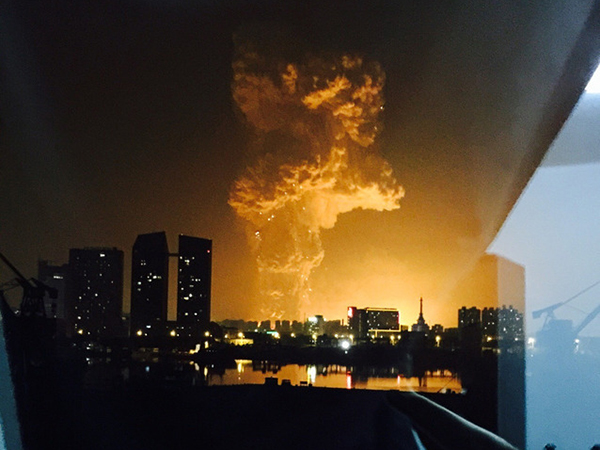
In China, they still cannot assess the scale of damage from the explosion in the port area of the city of Tianjin - and this is not surprising, even by the standards of the Middle Kingdom, this technogenic disaster can be considered large -scale.
Tianjin is a city of central subordination to the southeast of Beijing. The explosion itself occurred on the territory of the Binhai district - in the port of Tianjin and, accordingly, the nearest sea harbor of Beijing.
The explosions were preceded by a fire in the port warehouse of Ruihai Logistics, for the extinguishing of which at 22:50 local time (14:50 in Moscow) firefighters were caused. An hour later, at 23:36, with an interval of 30 seconds, two powerful explosions occurred, the photos of which after a few minutes began to appear in the photographs of all world agencies.
The power of the first explosion was estimated by specialists of 3 tons of TNT equivalent, the second explosion turned out to be much more powerful - 21 tons of TNT. The fire pillar rose several hundred meters from the ground, the magnitude of the earthquake, which was caused by explosions, was estimated by the nearest seismological station at the nearest 2.9. The Japanese satellite was even able to photograph the moment of the explosion.
As a result of the explosion and attempts to eliminate its consequences, at least 56 people were killed and another 721 people were injured - this is only official data, until all the rubble in the port are yet cleared.
Explosions were felt within a radius of 10 km, two kilometers from the scene in the buildings, glass flew out and there were damage to the roof. One of the local metro stations was partially destroyed, which is why for more than a day the work of one of the lines of the subway was suspended. The explosive wave was damaged by the building of the National Supercomputer Center, which was due to which one of the most powerful Tianhe-1A supercomputers in the world was stopped, although the machine itself was not caused.
Almost 10 thousand new cars Volkswagen, Toyota, Honda, Mitsubishi and Renault burned out in the port - it is through Tianjin to China that a noticeable part of a foreign car industry enters. Renault has already estimated the lower border of damage - $ 33 million.
The building of the warehouse on which the explosion occurred belongs to Ruihai Logistics and in 2014 was described in government documents as a dangerous object of calcium carbide, sodium nitrate and potassium nitrate. Ruihai Logistics was founded in 2011, the company is engaged in overloading dangerous chemicals in the port of the Tianjin, including compressed air, combustible and aggressive substances, oxidizing agents, toxic chemical compounds, etc. The administration of the seaport of Tianjin has an official agreement with Ruihai Logistics, so it works absolute At the time of the explosion, about 70 people worked on it, and in the port she owned warehouses with a total area of 46 thousand square meters.
However, after the explosion of the Tianjin authorities, it was not known that, in fact, it was not known that at the time of the disaster was in warehouses - customs data diverged from the information of Ruihai Logistics, and the company's office was destroyed by the explosion, so it is impossible to get the latest information about the location of tanks with various substances.
Actually, due to the fact that in addition to the two explosions that occurred at the fire site, anything could happen-both the leakage of dangerous gases and the new explosions-dozens of fire brigades were recalled by local authorities a few hours after the explosion.
The precautions were not unnecessary. More than 700 tons of sodium cyanide were in sewers - even the short -term effect of this substance can lead to the death of a person. On Thursday, several hundred meters from the explosion, traces of other toxic gases were discovered - sulfur dioxide, carbon monoxide and nitrogen oxides, but the level did not exceed established by national standards, and already two kilometers from the fire, at the request of the authorities, was clean.
The next morning after the explosion, military units, as well as special equipment, began to tighten in Tianjin. The government created 12 temporary monitoring stations near the scene of the explosion that could fix air pollution. To neutralize sodium cyanide, reserves were transferred to the hydrogen.
The government also took up the evacuation of the population - a temporary shelter was provided to 3.5 thousand residents of the surroundings of the port.
Naturally, special attention was paid to blocking the spread of unwanted information through the media and social networks. Journalists were not allowed close to the scene, in Weibo, the local analogue of Twitter, all messages with the words “Tianjin” and “explosion” were blocked. Television Tianjin for eight hours after the explosion preferred not to show the latest news from the port, but to soap operas popular among the population.
At the same time, the central television of China reported that both the chairman of the People’s Republic of Xi Jinping and the head of the State Council (Government) of the PRC Lee Ketsyan are “all efforts to help the victims” from the fire.