
Translated material
Skull shape: independent work
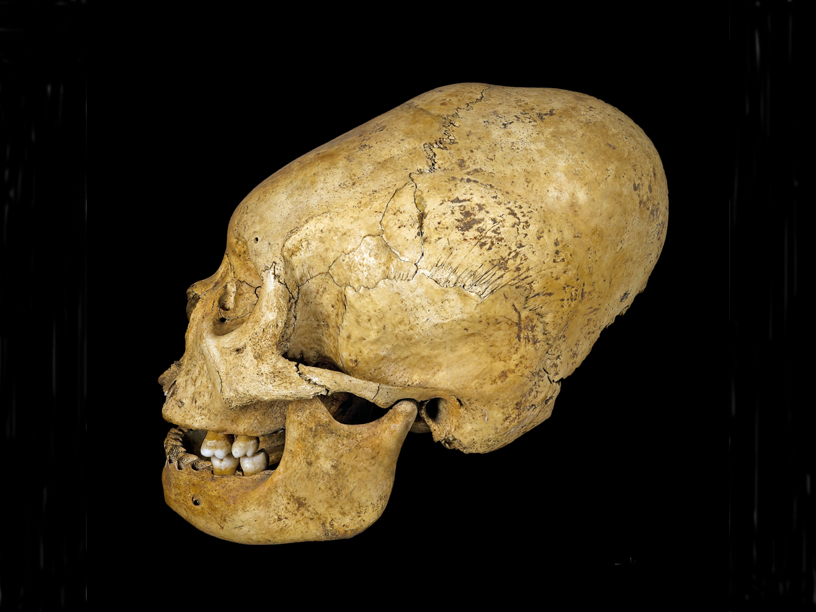
Honestly, having learned about this news, I decided not to write about her. I thought that the case, of course, is interesting, but not unique at all. A little later, the decision had to be changed. Let's start in order. On June 18, scientists who worked in the Archaeological Reserve Arkaim discovered a burial of the II-III century with a skeleton, whose skull was unusually stretched. The head of the museum, Maria Makurova, explained to the press that the Kurgan was probably built by representatives of the nomadic people of the Sarmatians, who had the custom to put a bandage on the child’s head, which for several years of wearing gave the head such a form.
Very little time passed, and on one foreign site this find was written that in Russia they "discovered an alien." At first it was just a joke and a way to give a catchy title. But the news was reprinted, far from always the word “alien” was in quotation marks, and soon on some Internet resources they began to talk about this seriously.
Alas, this is not the first case. When in 2012 in Mexico found the burial of people with similar skulls, journalists also wrote that skulls "could testify to the unearthly origin of their owners." Then again the source of the news was English. It makes no sense to figure out which of the authors spoke of aliens for the red word, and who is serious. Unfortunately, many of the messages are written so that an inexperienced reader will accept words about aliens for a pure coin. Therefore, it is worth telling about deformed turtles in more detail.
The elongated skull is not unique and, of course, does not have extraterrestrial origin. After the birth of a child, the custom was to pull his head with a ring -shaped bandage among a number of peoples. In Eurasia, in addition to the already named Sarmatians, they loved to act, for example, the Huns. The bones of the newborn are very plastic, in addition, the compounds between the bones of its skull have not yet been overgrowing (the so -called "fontances"), as a result, over time, the head acquired an elongated cylindrical form. True, the bandage for this had to be worn at least a few years. Perhaps such a deformation of the skull was a sign of high social status. Archaeologists found many such skulls as male and female. This, for example, also belonging to the Hunnic woman, is located in the National Museum in Budapest.
The skull of the Hunnic woman. Budapest
And here is an attempt to reconstruct the appearance. The work was done by Swiss Marseel Nyffenegger by the skull of the second half of the 4th century, found in a siter (Austria). It was presented at the exhibition "Atilla and the Huns" in the Historical Museum of Palatz in Shpeis in 2007. If you wish, you can see how it would look with six different hairstyles.
Reconstruction of the appearance of a Hun woman with an artificially deformed skull.
If now the find of the deformed skull is of interest, but not amazement, then in the 19th century it, at first, really became an event. Scientists were known about such customs among the Indians of Latin America, but they did not expect to meet such a skull at home. Therefore, when such a skull was found in Austria in 1820, even a suspicion arose that it was a Peruvian skull accidentally entering Europe. But in 1848, the second skull was found again in Austria. The skulls of this form began to be called Avar, since they were discovered next to the settlements that were considered to be the Avars. In Russia, in the Kerch area, at the beginning of the 19th century, deformed skulls were also found, which for some time remained unknown to a Western scientist. In the second half of the century, many such skulls were already known, and they began to classify and study them.
The finds of deformed skulls are represented by a wide strip of China through Central Asia, the Caucasus, the Black Sea region, the Balkans to Central and Western Europe. This custom was especially loved by some peoples. The scientist calculated that the Sarmatian burials of the 1st century. BC - I century. N.E. 35.7 % of skulls are artificially deformed, and in the burials of the II - IV centuries. N.E. 88 % of the skulls (therefore, a greater surprise would be if the skull found this year in Arkaim was not deformed). Massively into Western Europe, the carriers of these skulls penetrate in the 4th century, in the era of the great relocation of peoples. These were the Huns, Alans, as well as some German -speaking tribes: Alemanns, Burgundes, Thuringus, Gepides, Cherulas and others.
The skull of women is 30-40 years old, the VI century AD. Presumably, Alemann. Museum of Württart in Stuttgart.
Perhaps the most ancient mention of the custom to specifically pull their heads to the babies can be found in the composition of the line of the 5th - 4th centuries BC “On the air, water and areas” attributed to Hippocrates. It speaks of the peoples living near the Meotian Lake (Azov Sea): “First of all [I will say] about long -headed ones. There is no other people who would have a similar form of the skull. Initially, the most important reason for the elongated [shape] of the head was the custom, and now nature contributes to the custom, [what happened] from what they consider the most noble to those who have the longest heads. This custom is as follows: as soon as the child will be born, while his bones are soft, his head is straightened with his hands and forced to grow in length by means of bandages and [other] suitable devices, as a result of which the spherical shape of the head deteriorates and its length increases ”(the translation of V.V. Latyshev).
The people of long -headed (macrokefals) mentioned by Hippocrates some researchers suggest identifying with macrons that Herodotus writes about. According to him (II, 104), macrons live near the Feromont River (presumably Don). Living somewhere in the Black Sea region or north of the long-headed Caucasus mention the Karian skila, the Abydos and other authors. The direct identification of macrons and long -headed is found in scholia to the “Argonautics” of Apollonius of the Rhodes: “... they are called macron due to the fact that they have quite a lot of long -headed (macrokefals), like the Persians of Orlino -cr and -crusted.”
Information about the deformation of the head is found among Arab authors describing the population of Khorezm. Yakut al-Khamavi reports that they “tied bags of sand on the heads of children on both sides so that the head was inquired”, and al-Biruni says: “... they flatten the heads of breast children in width, squeezing them in the front and back.”
The inhabitants of other parts of the world did not lag behind the inhabitants of Eurasia in an effort to improve the form of the head of children to their taste. The first mention of deforming the heads of the Indian of America is already belonging to Columbus. More details about this are narrated by Bartolome de Las Casas and Diego de Landa. The latter says: “The Indian women raised their children very severely, because four or five days were put by the newborn from the genus of the newborn stretched into a small bed made of rods and there, turning upwards up, they laid their heads between two planks, one on the back of the head, the other on the forehead, between which they squeezed it with such force, and kept it there in torment, so far, after a few days, his head was after, his head was observed. I did not become flattened and deformed, as it was in custom. There was so much inconvenience and danger to the poor children that some risked to die ”( “ Message of Affairs in Yukatan ”, Chapter XXX). Of course, this practice was known not only to Mexico Indians, but also to the population of current Peru, Bolivia, and Brazil. It is also found in North America, Africa, Southeast Asia, the islands of the Pacific Ocean and in Australia.
Maya Skull (National Museum of History and Anthropology in Mexico City
Skull from Peru (NASK Museum)
Paul Cane Paul, demonstrating the process of deformation of the child’s head among the Chinuk Indians (the territory of modern states Oregon and Washington)
Photo from the Belgian Congo (1929-1937). Representative of the people Manbet.
The oldest finds of artificially deformed skulls made in China belong to the era of the upper Paleolithic. In the Mediterranean, the oldest tradition of deformation was found in Cyprus. It existed from the Neolithic (9900-7000 BC) until the Iron Age (1050-750 BC). The seventh - fourth millennia BC includes skulls found in the Middle East: in Jericho, Bible, Tortl Madhura, Kurban Khuyuk and other settlements. Neolithic finds are also known in Iran.
Some types of artificial deformation of the skull: pubic, occipital, ring, combined, parietal (ill. From Shvedchikov T. Yu. "Artificial deformation of the head as a historical source ..." 2010).
A long discussion between scientists arose around the family of the Egyptian pharaoh Akhenaten. In a number of images that have reached us, the appearance of the daughters of Akhenaten makes us suspect that their skull was subjected to deformation, most likely, ring -shaped.
Ekhenaton, Nefertiti and their daughters
Daughter of Akhenaten Meritaton with her husband Smenkara
Some authors were confident in the presence of artificial modification of the skull among girls, others considered the elongated form of heads to be conventional and a consequence of some kind of artistic tradition, others believed that there was no conventionality here and that ancient artists realistically displayed dolichocephaly (“long-grade”), which in this case is not artificial, but innate. Now many authors believe that some members of the Akhnaten family had a Marthan syndrome - a genetic disease, which is manifested in particular in high growth, an increase in the length of the hands, feet and the cerebral region of the skull.
It should not be assumed that the idea to change the shape of the skull of a child is characteristic exclusively for ancient peoples or inhabitants of distant exotic countries. Here is a quote from the novel by Emil Zola “Western”, which describes how Nana was born: “Ms. Lera, having examined the girl from all sides, announced that she was perfectly complicated, and added her ambiguous tone, that a reserved woman would come out of her; But since it seemed to her that the head of the baby was too extended, she, not paying attention to the cries of the child, began to lightly crush her with her fingers to round. ” Parents took away the daughter of Ms. Lera, but the other Frenchmen at the end of the 19th century believed that the appearance of the baby and in particular the shape of his head needed correction. In the essay of Margarita Lubart, dedicated to the customs of the peoples of France, related to the birth of a child, this is told in detail:
“In France, two models of skulls dominated - long and round. The "long" type had four varieties: Toulouse, San-Genenskaya, Poatvinskaya and Norman. The skull remodeling was achieved by tugting the head of a newborn from canvas, cords, leather belts, handkerchiefs and neck shawls. The child wore such a bandage for many years, and women sometimes all his life. The practice of stretching the skull, especially in the south, was based on the idea of the intellectual, moral and aesthetic superiority of dolichocephales. Later they began to believe that massage of the newborn head in order to give it an elongated form to protect him from meningitis.
In Brittany, the expression "Faire la tête" (making the head) meant giving it roundness, which was achieved by a special massage of the midwife. This procedure for girls was especially important: it was believed that a hairstyle looks beautiful on a round head. In Gascon, round -headed was achieved by special ways of laying a child in a cradle, which had a flat heading. It had a cavity in which the head was placed. The cradle had leather loops in which a scarf was fixed, fixing the position of the head.
The deformation of the skull (especially by the "long" type) entailed a change in the shape of the ears: they became flattened and pressed to the head. A change in the shape of the skull also influenced the bones of the nose: flattening of the forehead under the tightening tape led to the performance and curvature of the bones of the nose. The nose was "formed" and pressing the fingers on the still fragile cartilage of the newborn, and in addition, the tip was also pinned so that the nose was pointed. "
The Museum of the Human in Paris is stored by Sophie Gemymen Skull (1776 - 1831), an outstanding mathematician who demonstrates the Toulouse variety of modification mentioned by Margarita. Another skull, which was given this form, is stored in the Toulouse Museum.
Skull from the Toulouse Museum
A man with a Toulouse head shape. Photographer Eugene Druda (1840 - 1810)
The Slavs also believed that the born child should be given the appropriate form, by smoothing, compressing or stretching. Usually this was done by the midwife.
A number of peoples have a deformation of the skull associated with the rigid shape of the cradle. In this case, the nape of the child becomes more flat from constant contact with the bottom of the cradle. Even the famous Vesaliy believed that the Germans and the “short shape of the head” had the flat backs of the Germans, as the children in Germany are put on their backs. In Russia, in the 1880s, a study of the influence of the cradle on the deformation of the skull was conducted on the material of archaeological finds and descriptions of the peoples inhabiting Russia, Doctor of Medical Sciences E. A. Pokrovsky. In addition to the cradle, head dressings, especially common in Transcaucasia and Central Asia, also played their role.
A curious method of modification of appearance using a bandage describes the Apollinaris (V century) in the Huns of Sidonius: “A round bandage pressed still tender nostrils so that the nose would not be given forward and does not interfere with the helmet. Maternal love disfigures those born for battles, because in the absence of a nose, the surface of the cheeks is made even wider. ”
The subject of a long discussion among scientists was the possibility of the influence of artificial deformation of the skull on the state of health, psyche and intelligence of a person. Until now, there is no strict scientific evidence of this influence. In the 19th century, many authors suggested that the deformation of the skull in ancient times served to grow people with special qualities, for example, more bold and merciless warriors. Or, on the contrary, they will cause epilepsy and hallucinations, which will allow the owner of such a skull to become a shaman. The opinions were also expressed that the owners of deformed skulls should more often meet headaches and even mental disorders.
However, the examinations of children among the peoples of South America, which practice artificial deformation today, do not confirm these hypotheses. They do not find an increase in the frequency of any neurological or mental pathologies. Perhaps the deformation of the skull does not have a strong impact on the development and functioning of the brain, since only its shape changes, while no parts of the brain are destroyed. It is more likely to assume that artificial deformation increases intracranial pressure, since on modified turtles a clearer print of blood vessels on the inner surface of the bones (endocrane) is found.
What function could this custom perform? First of all, he was one of the "rites of the transition", in this case, the transformation of a newborn into a full -fledged person. The born child was perceived only as a “blank”, which still had to be turned into a person. In particular, forming the head correctly. The specific form was determined by local ideas about beauty. Somewhere beautiful, an elongated head was considered, somewhere round, somewhere-the forehead bending back, somewhere-a straight line. Also, the shape of the head could play the role of a sign that separates a group of people from others. The distinguished group could be both ethnic and social. The famous Rudolph Virkhov in 1892 wrote that the modification of the skull was caused by "the desire ... to consider the deformed skull as a highly characteristic sign of the tribe."
This role is played not only by the deformation of the head, but also by other so -called intravital bodily modifications: tattooing, spraying, piercing the skin, removal or file of teeth, and so on. Arnold Van Gennep, who introduced the term “rituals of the transition” into circulation, wrote in connection with this: “... the body was considered as a simple piece of a tree that everyone was wrapped and adjusted at their discretion: they cut off what performed, perforated partitions, treated flat surfaces, sometimes with a real rustling fantasy ...”.
It should be remembered that if the deformation of the skull seems to us frightening exotic, then the modern person perceives other types of bodily modifications calmly (piercing, tattoo). The French anthropologist Paul Brock on this occasion noted: "A tendency to deformation or a change in the natural form of some parts of the body is common to human nature in any, familiarity to us, its expression, most primitive and barbaric and most civilized and refined."