
Translated material
With the full support of the media
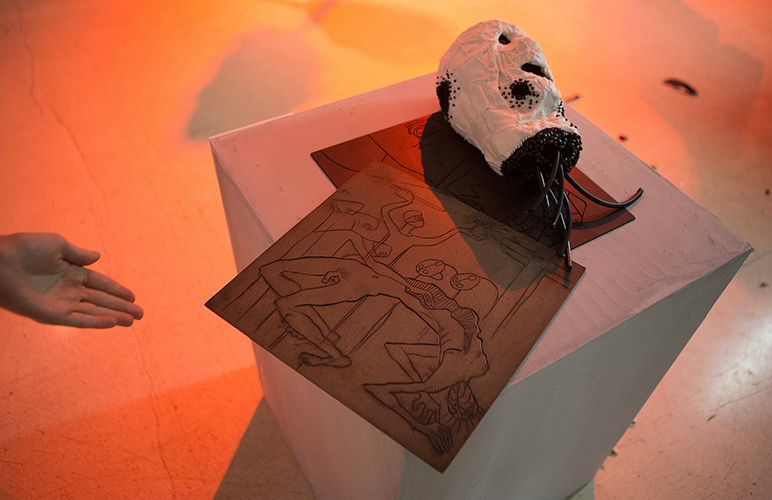
This story is not like the persecution of Avdey Ter-Ogagan, because of which he had to leave Russia in 1998, and the defeat of the exhibition "Caution, religion!" In 2003, although it would seem that these events - from among the domestic - come to mind when you first find out about what happened in the "arena" on August 14, 2015 .
Actually, Enteo (Dmitry Tsorionov) is vandal not just because he invaded the exhibition and destroyed the works, but because he attacked things, in fact religious. For whom the image of Christ was not a joke is for Sidur and his comrades to unite Les (Nikolai Silis, Vladimir Lemport). Sidur is such an existential neo -Avangard, inside of which the Christian discourse of the victim is associated with the situation of the thaw. Then, to one degree or another, both artists and writers - searched for the formula for “veracity”, in which one could fit the truth about the war that had just been experienced, about just recognized repressions - and which would not have been literally protest, accusing or denying the Soviet system, but rather general humanistic. Sidur's work fits into the universalist discourse of the Cold War, where the memory of past disasters connects with the thought of a possible future catastrophe of a nuclear explosion, which can end humanity in one fell swoop. Hence all these large (and therefore woven and flat today) existential generalizations - life, death, a person who are plastic in Sidur on the verge between a recognizable human figure and abstraction. It is good or bad, but the image of Christ (first of all, in the human hypostasis, of course) for Sidur probably meant much more than for the professional provocateur Enteo. In general, if Enteo went to the Tretyakov Gallery to smash the “Calvary” by Nicholas Ge (which, by the way, may well happen, it all depends on what development the current story will be obtained) - the meaning would be approximately the same.
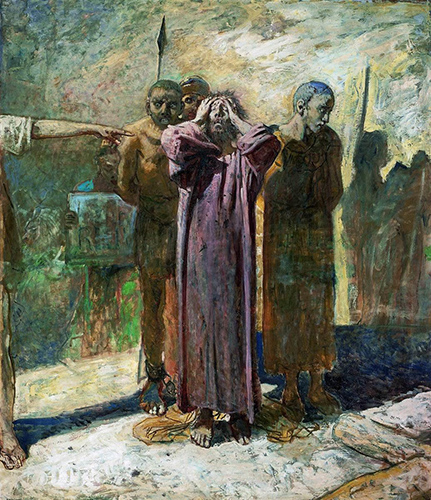 © Assembly of the State Tretyakov Gallery Nikolai Ge. Calvary. 1893
But the problem is that at the level of the media scandal, all these subtleties about Sidur with his sixties religiosity are absolutely not read by anyone. After all, Enteo is a media activist and knows what he is doing - and he does it with the full support and sympathy of the media. Everyone wrote about the action - from RBC with the “ribbon” to “Kommersant” and Lifenews ; The news has been hanging in Yandex for several days, and everyone reprinted the phrase taken from the Manezhevsk press release that some works of the 1960s were destroyed "in the style of basement non-conformism." Torn from a cozy art history context, this definition suddenly sounded suspiciously and marginally.
However, the absurdity of the situation is that, having attacked the work of Sidur, Enteo attacked the Soviet intellectual religiosity, which, of course, does not coincide with his version of religiosity. To a large extent, thanks to this intelligent religiosity (and Orthodoxy in particular), the Russian Orthodox Church restored itself as an institution after the fall of the USSR. And in a sense, Sidur is connected with Enteo more than the latter would like. That is why it is important today the sculptor’s work is shown and commenting.
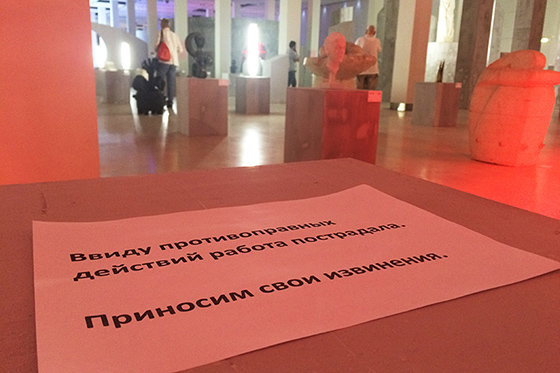 © Elena Karneeva / MVO "Manege"
But mass media does not read all this - and sometimes they intentionally replace. For example, the head of the information and analytical department of the Synodal Department of the Russian Orthodox Church Vakhtang Kipshidze in the comment “Rain” says that “I have not seen the exhibition”, but at the same time it is guessed to remember that “the beginning of the 1960s for believers is associated with the promise of the Soviet leader Nikita Khrushchev“ show the last priest on TV ”-it means that it is quite possible that the exhibition is anti-religious, and Enteo receives Enteo's exhibition. The presumption of innocence. To clarify who is Sidur, the official of the Russian Orthodox Church did not bother, but the quote is published without an editorial comment, and the entire rain audience, whose employees probably sincerely sympathize with the organizers of the exhibition, will continue to believe that Sidur is an anti -religious author of the era of the militant Khrushchev atheism. Mass discourse is so thick and so effective today, it is so frantically and irreversibly starting from the slightest sparks that any subtleties and details are drowning in the avalanche of delusional interpretations, which helps both Enteo and cautious speakers from the Russian Orthodox Church. And now Enteo gives an interview , culturally posing against the background of the works that he destroyed.
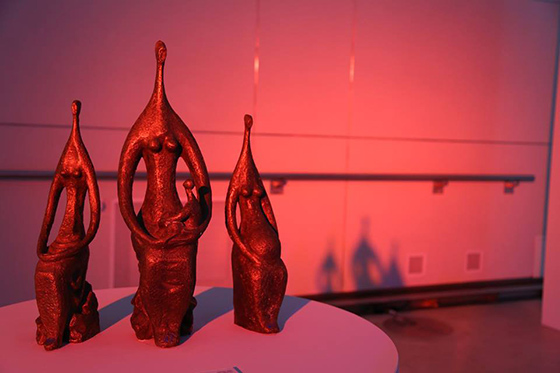 © MVO "Manezh" Nikolai Silis. Hypostasi bronze ceramics. 1992
As a result, the Sidurovskaya general humanistic model of mystical religiosity is in the same garbage basket with “postmodern” right ideologies like Dugin with Prokhanov too difficult for the current situation. They were successfully used in this conservative turn and can be thrown out by ideologists of a new aggressive model of religiosity in the trash. Trolls and bots will still do their job - and peer into the details of specific works in order to at least figure out what it is about, no one will become. And the main, most painful, the question now consists in how the cultural comment should be made from what place should be uttered, which could, by audibility and impact on the course of public discussion, compete with the “interpretation”, which was given to the same Sidur Enteo.
Another association with the Enteo attack on Sidur’s works - the actions of the well -known and, as they now write everywhere, “prohibited by extremists in Russia, who, in addition to killing people, destroy cultural monuments in the Middle East. But there is one “but”: there is no power over the pogromers, they are power on the territory they controlled; Here, Enteo and Co. - just small performers, sometimes allowing themselves to be a gag. And here the power, no matter what this word means in this case, does not yet declare their opinion - the inaction of special employees, who protect the “arena”, during the attack of the vandals in this sense, is extremely symbolic. They do not understand how to react: it seems to be Enteo “their own”, but also the injured exhibits “their own” belonging to the state, and not to the conditional Helman. Dead end. Friendly Fire . (The proposal of the artist Gorhala calling himself to deal with all at once-the curators-“provocateurs” and pogromers-works according to the same model: the press service of the Kremlin and the Russian Orthodox Church has not yet explained exactly who the enemy, which means not to be mistaken, need to accuse everyone.)
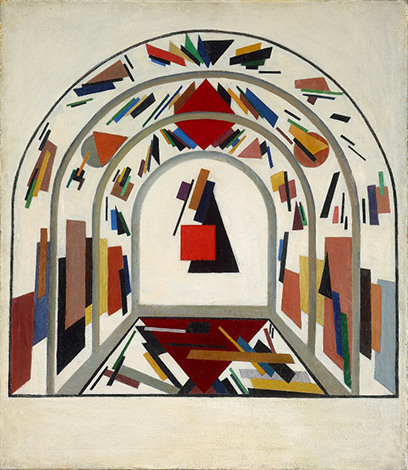 © Assembly of the State Tretyakov Gallery Ivan Kudryashev. 1st Soviet theater in Orenburg. The project of the Suprematic painting of the auditorium. General scheme of painting. 1920–1921
Only a court can persuade the scales to the side of the mind, through which, in theory, despite the stories about the mythical “insult of the feelings of believers”, one can achieve recognition of what happened by vandalism, as well as a violation of constitutional norms - freedom of speech and freedom of conscience. The museum is not a temple, Christian mythology is not privatized by any one social group and can be widely interpreted, including visually. As for the topic of “religious feelings” that it is supposedly possible to insult, it is necessary to fight this not for some cases, but as a system - that is, to initiate a campaign for changing the law and removing this wording. It's time to do it. It is clear that it is so elastic, just like the notorious “foreign agents” and “propaganda of non -traditional sexual relations among minors”, so that it is convenient to use it for repressive purposes, but the authorities themselves do not always use it, but the “enthusiasm of characters like Enteo is able to turn repressions into the conveyor in the future. Do officials need such hunveibins that have already begun to destroy state property? Indeed, for the authorities it is one thing to keep a candle on the camera and completely different - to follow Orthodox traditions, especially in radical versions.
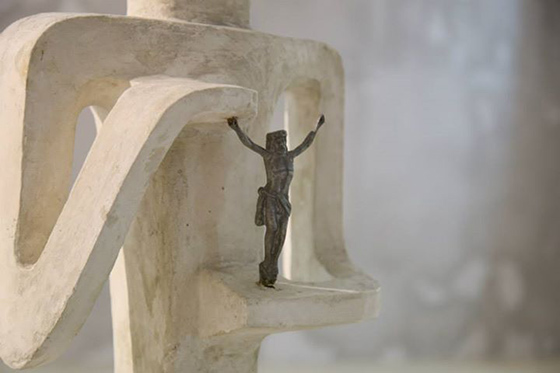 © MVO "Manezh" Vadim Sidur. Prophet. 1969
In order to put an end to such cases, the museum and expert community should not only speak out-to offer the same cultural comment-and take a place in the media, at least comparable to the press service of the Russian Orthodox Church and vandals, distributing endless interviews, but also actively engage in legal struggle. Because in this case it is a struggle for the existence of both museums and exhibits. Or maybe lives in the future.