
Translated material
Purely Russian know-how
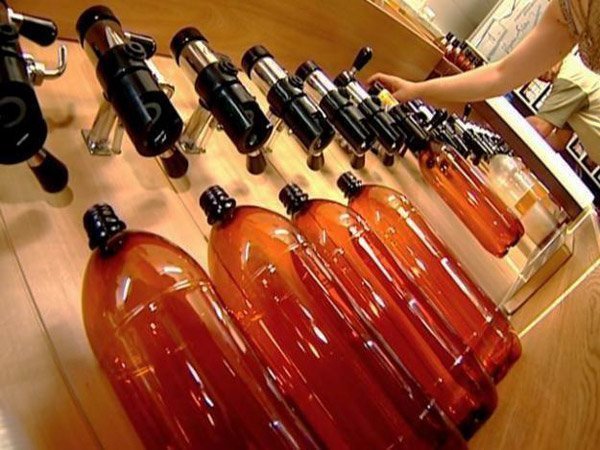
 PET Tara Photo: Nokstv.ru
The struggle against drunkenness is replaced by the fight against the packaging for alcohol
According to the World Health Organization, about half a million people die from alcohol annually in Russia, and according to the results of 2015, this figure may increase. In the vast majority of cases, the cause of the tragedies is not just alcohol, but precisely the faded alcohol - fake vodka, moonshine, alcohol surrogates. People are looking for an opportunity to save, but find death. At the same time, compared with last year, the situation was aggravated - mortality from alcohol poisoning this year increased by 3% in April, 7% in May and 16% of July.
What is the reason for the appearance of a negative trend, and how can one fight the unexpectedly increased alcoholization of the population?
There are many reasons, but the main one is financial. The crisis, a decrease in salaries, growing unemployment - these are the initial prerequisites for a person to begin to “drown longing” in alcohol.
At the same time, to solve the issue with the help of economic levers: stimulating the development of industries, creating jobs, and social protection of the family - the state becomes beyond the power. From here the ideas of all kinds of restrictions are born. Restrictions on advertising of alcohol, places and time of sale, and the last initiative, which has not yet affected beer - restriction of types and volume of packaging.
The initiators of the project decided not to go through banal prohibitions (the results of the “dry law” of the Gorbachev era, we all remember), but proposed a bill, which was essentially aimed at the redistribution of the packaging market. According to the document entered into the Duma, the capacity of polymer containers for the production of any alcohol products from July 1, 2018 will be limited by 0.5 liters. At the same time, a gradual abandonment of the PET Tara of large volumes is supposed - from January 1 to July 1, 2016, plastic 1.5 -liter bottles can be used for drinks with a strength of less than 6%, and from July 1, 2016 to July 1, 2018 - by a fortress of not more than 4%. And although formally we are talking about any alcoholic beverages, it is obvious that the ban on plastic packaging will hit beer, because the bulk of the beer sold has a fortress within 4-6%, and at present more than 50% of brewing products in Russia are sold in PET-Tare.
The argument of the vice-speaker of the State Duma Andrei Isaev, who personally oversees the bill: if you make the packaging less, then the beer will be more expensive and it will be less drinking. However, the level of alcohol consumption is affected not by the volume of fluid in the package, but by the content of alcohol in it. It's no secret that the main cause of alcoholism in Russia is the consumption of cheap strong alcohol. The new law will spur the next increase in beer prices, and, as a result, the Russians will again switch to cheap vodka, it is possible that illegal origin. Already now, at the cost, a bottle of vodka is equivalent to three bottles of beer. In the USSR, this ratio was one to ten.
The goal of state anti -alcohol policy aimed at reducing the share of consumption of strong alcohol while reducing the general level of alcohol consumption could be achieved, but not by reducing the availability of “soft” alcohol, economists and sociologists believe. World experience shows that this is achieved by changing the structure of the consumption of alcoholic beverages - that is, the transition from strong to less strong. In the “Concepts for the implementation of state policy to reduce the scale of abuse of alcohol products and the prevention of alcoholism for the period until 2020” The mechanism was laid, according to which people had to gradually abandon vodka and switch to wine and beer. To drink "like in Europe" - they did not "bend a degree" and did not poison.
The most amazing thing is that the government in this direction managed to achieve noticeable progress. According to the last VTsIOM survey, the Russians have a significant shift to the “European type” of consumption: only 25% of our compatriots still choose vodka. Whereas wine is 33%, and beer - half (50%) of Russians. At the same time, 14% of them consume beer weekly, 19% - a couple of times a month and 17% - less often a month. In the Soviet Union, the structure of consumption was completely different. In 1980, 62.9% of the population consumed vodka in the middle lane, 15.1% - strong wines and only 3.4% - beer, the rest were dry wines (32.7%) and home drinks (0.9%).
The trend, as they say, is there - people today are ready to give preference to low -alcohol drinks - beer and guilt. Yes, and fake beer, unlike strong alcohol, you will not meet in the market. This is a technologically complex product. As a result, over the past 10 years, as a share of weak alcohol in the structure of consumption grows, mortality associated with alcohol abuses and poisoning has consistently decreased, decreasing by 56% in 2013 compared to 2003 indicators.
Meanwhile, from 2010 to 2014, in Russia, rapidly (as a result - 6 times), excise taxes on beer increased, as a result of which prices for products of brewing plants were constantly growing. “Our answer to Chamberlain” was that citizens again began to switch to fired goods and surrogates or cologne and lotions, the excise tax on which did not change.
In 2015, the price of beer reached a maximum over the past 17 years. The reason is in the state policy of regulating the industry, and in excise taxes, and in the economic crisis. But this is only the beginning-according to expert estimates, the law on the ban on economical plastic packaging, into which beer spills, will lead to the next round of the cost of products by 20-25 percent. Firstly, beer in glass and aluminum containers is more expensive than in PET Upakovka. Secondly, to buy the usual volume of beer for the company, you will have to buy several units of containers. Thirdly, when limiting plastic packaging, beer transportation is getting more expensive and complicated, which reduces the profitability of the supply of this product to regions and outlets, which are the main distributors of beer.
The negative consequences of the adoption of the Law on the restriction of PET packing for beer are obvious. But it is not yet possible to prove his benefits for healing the population. Not a single reasonable economic or medical study has been represented so far, which could confirm that switching to a half-liter PET Taru would lead to a decrease in alcohol consumption, in particular beer.
But there are other studies that reveal a direct dependence between the growth of beer consumption, the simultaneous reduction in the consumption of strong alcoholic beverages and a decrease in mortality from alcohol. The report based on the data of Rosstat was presented in January by the Institute of Economic Research. E.T. Gaidara and clearly demonstrated the negative consequences of the restrictions that affected the brewery, for the population. Among them are an increase in mortality from alcohol, switching to strong drinks, an increase in statistics from traffic accidents in a state of intoxication.
By the way, in no country, the WTO has no restrictions on the volume of packaging. In the countries of the European Union, plastic bottles with a volume of more than 1.5 liters are used for beer, in the USA, a plastic package for strong alcoholic beverages use about a third of manufacturers. Last year, 1 billion of PET buuttors was sold in Germany last year. In the Czech Republic, the share of bottles with a volume of 1.5 liters among all types of plastic packaging is almost 70%, and two -liter - 30%.
It turns out that the restriction of types and volume of beer packaging is purely Russian know-how, which looks very strange against the background of the fact that the bill does not apply to glass and aluminum containers. In supermarkets, expensive five -liter tin aluminum beaches of beer are sold, and vodka products are spilled mainly with 0.7 liters.
Dmitry Zhuravlev, Director of the Institute of Regional Problems