
Translated material
And here you do not block
Sultan Suleimanov - about how Wikipedia teased Roskomnadzor

On August 24, Roskomnadzor introduced the article “Wikipedia” in the register of prohibited sites: this is the first time when the Law on blocking was applied against the Internet encyclopedia. Prior to this, Roskomnadzor repeatedly indicated forbidden information on Wikipedia, but there was no threat further-the department understood the importance of the resource and, apparently, was afraid of possible reputation losses. Medusa journalist Sultan Suleimanov talks about the confrontation between Wikipedia and Roskomnadzor.
On June 25, 2015, the Chernoyarsky District Court of the Astrakhan Region satisfied the request of the local prosecutor and recognized the article “Wikipedia” on the drugs of Charas containing prohibited information. The prosecutor indicated that the material describes the method of manufacturing the drug, its composition and dosage.
For almost two months, the court decision reached Roskomnadzor (RKN). On August 20, the department responsible for blocking sites spoke about the ban on the article “Wikipedia”-this was the first time when the court in the Internet encyclopedia was recognized by the court, not the FSKN or Rospotrebnadzor.
There are two obvious threats in the RKN statement. Firstly, if Vikipedia administrators do not delete the article, it will be entered into the register of prohibited sites-and will instruct Internet providers to limit access to it. Secondly, since the Internet encyclopedia operates on the secure https protocol, the providers will not be able to unite individual pages and they will have to block the entire site entirely. “We are convinced that the owners and administrators of the Internet resource will take a constructive and only right position in relation to the court decision, and the illegitimate content will be deleted,” the representatives of Roskomnadzor wrote, not very believing in their words-before Wikipedia did not really obey such instructions.
The Executive Director of the Vimedia.ru Foundation Stanislav Kozlovsky was not afraid of the threat of the department governing the Russian Internet: he said that Wikipedia is ready to block throughout Russia since 2012. Kozlovsky indicated that this article, like others, was written with reference to various sources - in this case it is the UN website.
Roskomnadzor (who has recently been telling about the news of the department not on his website, but on social networks), published statistics on drug addiction in Russia - "so that the tough position of state bodies in relation to drugs and drug addiction is clear." Judging by the comments, the readers of the department on VKontakte did not understand what the Internet and Wikipedia have to do with it.
Simultaneously with statistics, Roskomnadzor prepared a new post with threats. The agency, offended by the refusal of the administrators of the Internet Encyclopedia to fulfill the court decision, emphasized that such a decision "puts the interests of numerous users of the Russian-language version of the site." Roskomnadzor was perplexed why the site administrators "for unknown reasons decided to conflict with Russian justice." The agency emphasized that the period released “Wikipedia” to delete the article expires. This did not frighten representatives of the encyclopedia: they were bored with Roskomnadzor, indicating that the law released by law had already passed.
There was an evening of Friday, and the site was not included in the “black list”. Usually, Roskomnadzor is resting at the weekend and does not block sites. Meanwhile, the participants in Wikipedia continued to discuss the further fate of the site. Some insisted that what the court indicated and calm down. Others are to abandon the HTTPS protocol so that providers can block individual pages without interfering with access to the entire site. Still others were sure that no special actions were required - let it be, what would happen.
As a result, the community decided to change the address of the page telling about Charas, designating it as a “narcotic substance”. Such a move is not directly related to the requirements of Roskomnadzor: community participants realized that the word “Charas” has many meanings, and carried out the catalog of all (including unwritten) articles on the common page of Charas. However, the side effect of the address can be “evasion” from the blocking: in the court decision a specific link is indicated; There is no more prohibited information on this link.
On August 24, Roskomnadzor remained silent on August 24, but the Izvestia newspaper made a response to the address of the prohibited page - with the heading of the “Wikipedia address address, to avoid blocking”. The material with reference to the anonymous source of the publication in the government said that on August 24, Roskomnadzor could block the Internet encyclopedia: “The decision in Roskomnadzor has already been made, but the department still wants to resolve the conflict with the Russian representative office of Wikipedia without radical measures.
The article also has a comment by Stanislav Kozlovsky, who explained that so far the fund does not plan to dispute the court decision, because such decisions can be “stamped” a lot, and the organization is not ready to spend all the money on lawyers and their trips around the country. The situation around Wikipedia was commented on by the Chairman of the Board of the League of Safe Internet (an organization that initiated the Law on the Register of Prohibited Sites) Denis Davydov: he assured that Westton actually makes decisions on Wikipedia, and the Internet encyclopedia allegedly engaged in political activities, confrontsing the court’s decision.
Davydov spoke the same thing a little earlier in the commentary “Russia-24”. But the plot of the federal television channel can hardly be characterized as negative in relation to Wikipedia: it also gave the position of the representative of the RAEK, advocating to mitigate the legislation on blocking, and the possibility of easily bypassed these blocking was mentioned.
On the morning of August 24, the Russian Wikipedia greeted readers on Twitter and talked about one of the ways to read the encyclopedia without the Internet.
On Monday evening, Roskomnadzor decided to the next step: the department instructed the Internet providers to block the Wikipedia page. If the encyclopedia does not abandon the HTTPS protocol, Wikipedia will have to be blocked entirely.
* * *
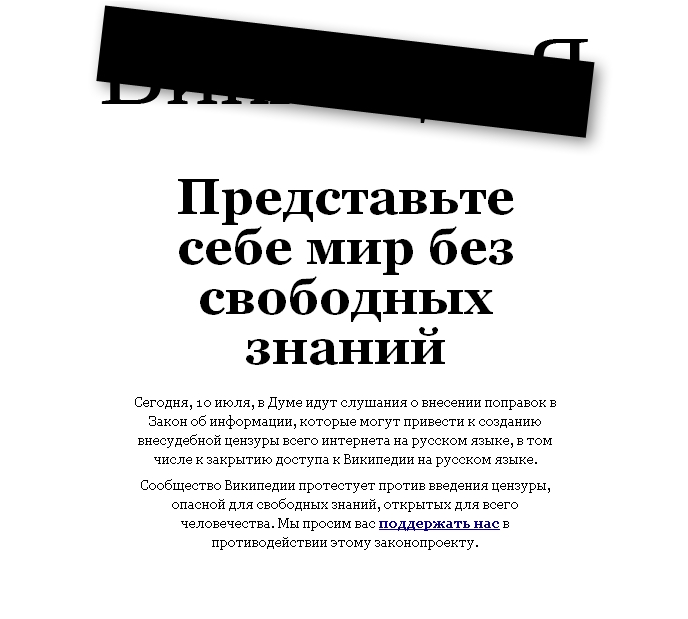
In 2012, when the law on the registry of prohibited sites was discussed, it was the Russian Wikipedia that turned out to be the driver of online processes in Russia: on July 10, it closed for the day and inspired the largest Internet resources to similar steps. On the encyclopedia, then a banner appeared about the dangers of extra -court sites of sites. The protest did not work: in November of the same year, the “black list” of sites began to work. And a few months later, Wikipedia was also in it. Over the next two years, Russian government agencies recognized three dozens of Vicky-Stati about drugs and suicide dangerous, but they never decided to close access to the site.
Ironically, Wikipedia, which protested against extrajudicial locks, eventually blocked after a court decision.
PS usually an article about Charas on Wikipedia gained 200-400 views per day. On the first day when Roskomnadzor announced a court decision, this page was opened almost 30 thousand times. A few tens of thousands of views fell on the following days.
Sultan Suleimanov
Riga