
Translated material
Two years without new products
From the Max 2013 air show-to Max 2015: what has changed?
In Zhukovsky near Moscow, the MAKS-2015 air show opened-the largest Russian exhibition of military and civil aviation, which takes place once every two years. As a rule, it is to her that airlines try to confuse the signing of major contracts, and manufacturers are to show the latest news, to tell what was done in the reporting two years. In 2015, everything will be different: there are no big contracts without the participation of the state, there is practically nothing to show new things, and in the flight program the appearance of the “wings of Taurida”.
What has been done in two years?
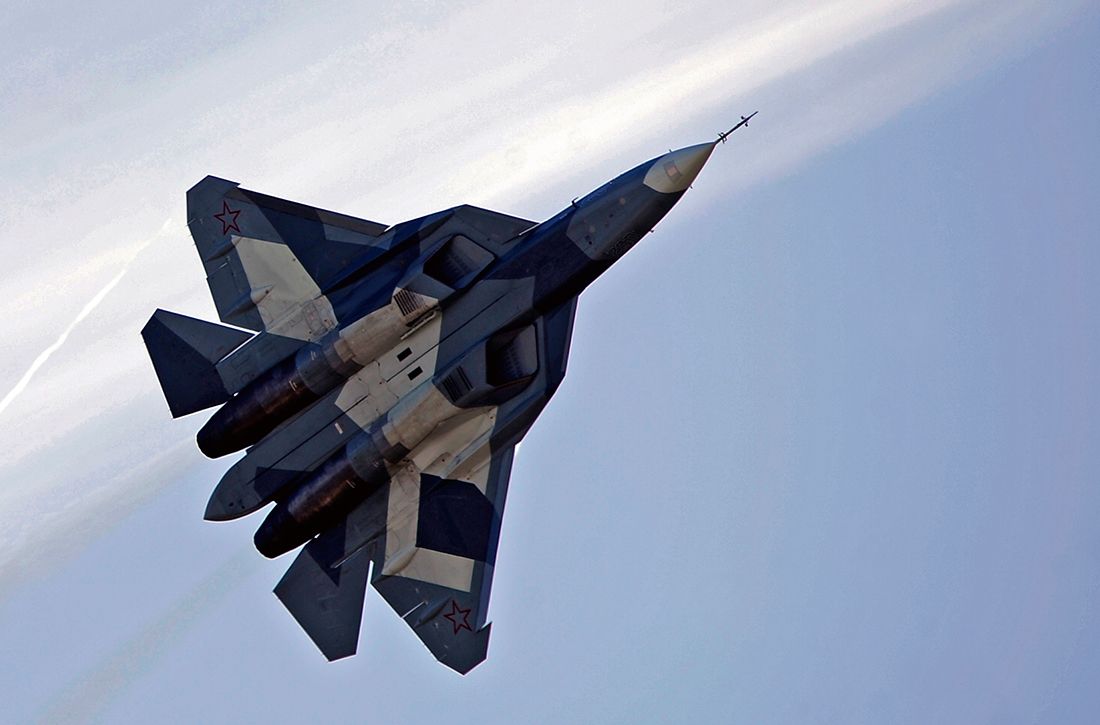
In the last decade, it is convenient to monitor the state of affairs in Russian aircraft construction. In 2007, the Hedliner was a cargo IL-96-400T, in 2009-civilian Sukhoi Superjet, which could be considered both on a static platform and in the sky during demonstration flights-and this is two years before the official start of operation. In 2011, the demonstration flight was completed by Park FA, a fifth-generation fighter-they plan to put it into operation in 2016. In 2013, for the first time showed a group aerobatics on Park Fa, and also introduced the Su-30SM, which had previously hidden from the general public. In addition, the premiere of the IL-76MD-90A transporter took place on Max-2013.
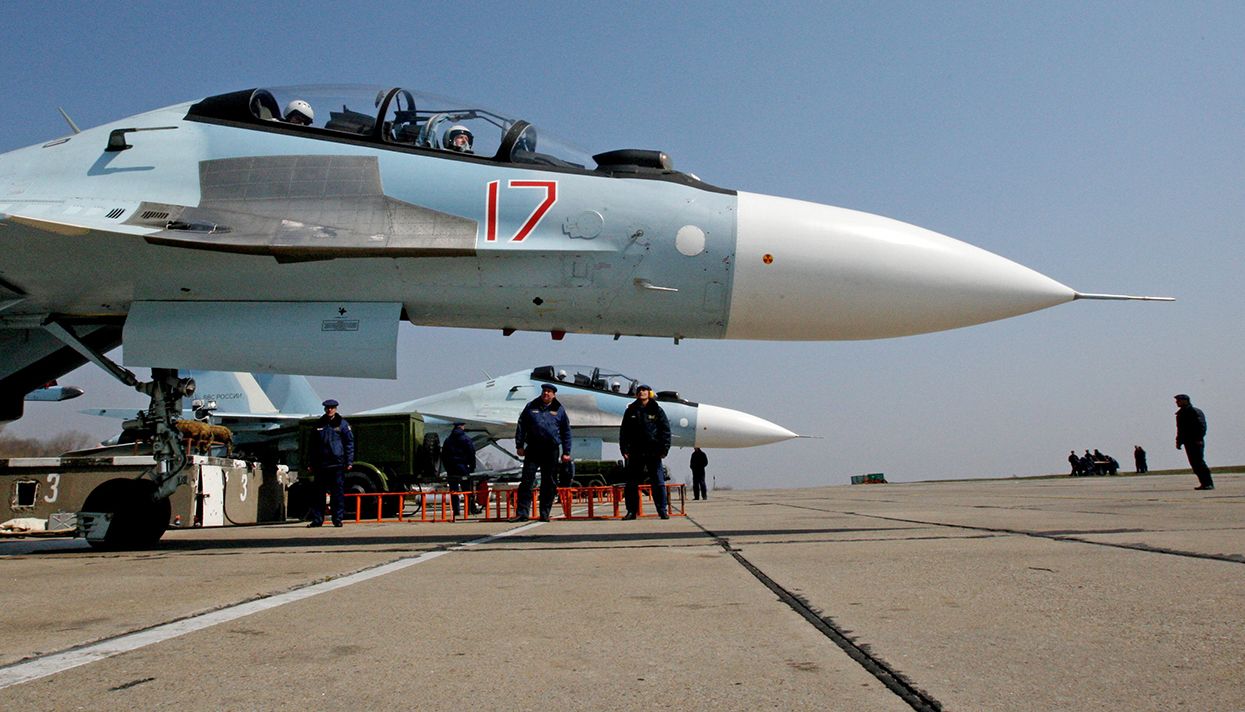
In 2015, there is nothing comparable with the premieres of previous years. With a strain, the novelty can be called the same Su-30SM, but not an experienced sample, but the one that carries the service in the Navy. It will be presented in the “marine” two-tone coloring (dark gray top and light blue bottom) with the Andreevsky flag on the fuselage next to the cabin of the pilots.
Su-30SM is the most modern fighter in the Russian armed forces. It has a category of “4 ++”, that is, it uses elements of the fifth generation fighter, as well as advanced technologies from the Su-30MKI-Indian assembly fighters, which are considered the best representatives of the Su-30 family. For example, on-board systems for the Su-30MKI were developed by the consortium of Russian, Israeli, French and Indian companies-this was the requirement of India. True, the fighter is delivered to the Russian army with domestic electronic equipment.
Su-30SM supplies to the Russian army began in 2013, and since 2014, the fighter receives the Navy. In particular, the Su-30SM is sent to the Black Sea, where the fleet needs strong modernization.
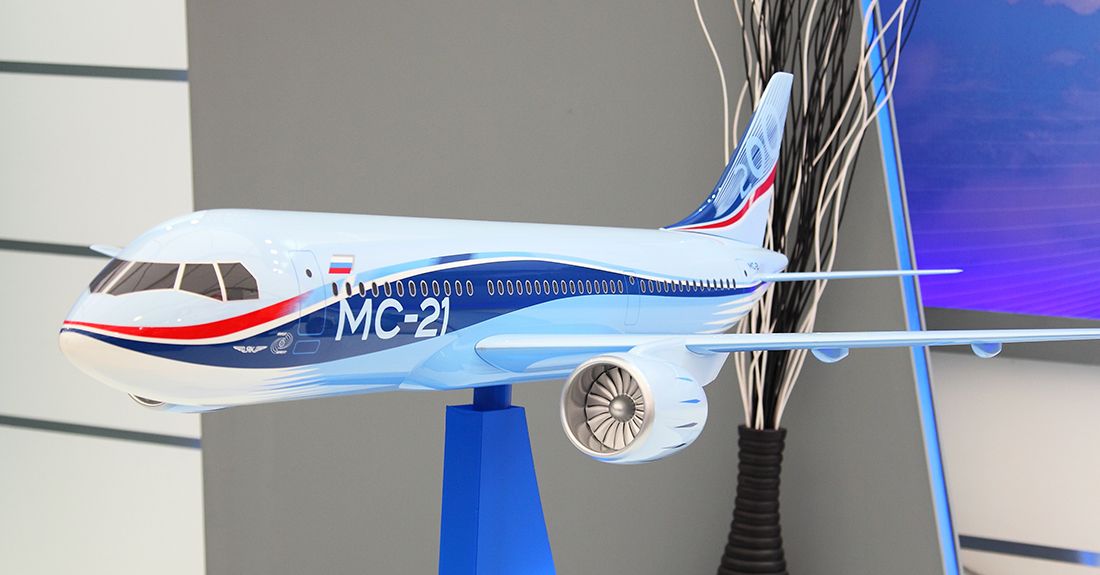

Another novelty that will be presented at the air show near Moscow will be the fuselage and the engine of the promising passenger aircraft MS-21. This liner, developed from the second half of the 2000s, appears in front of the audience, like a puzzle, by pieces: either they will show a model of the aircraft, then part of the compositional wing, then part of the cabin, then the cabin. According to the developers, all this should aiming the interest in the aircraft and demand for it, although all these parts of the puzzle have already managed to be pretty bored visitors - I would like to look at a life -size liner.
It is expected that the first flight of MS-21 will take place in the spring of 2016, and the serial production of liners starts in 2017-in general, there is a chance that at the 2017 MS-21 air show, it will be represented in some form. It will not be possible to fly in it soon-the certification of the liner is scheduled for 2017-2018, and it will be delivered to customers from 2020. For buyers, the liner will be available with two types of engines: one of the versions of the PD-14 or American PW1400G. Thanks to the power plants, the MS-21 will be able to fly at speeds up to 850 kilometers per hour, and the flight range will be more than six thousand kilometers. MS-21, depending on the version, will accommodate from 135 to 212 people.
On this, the officially declared new items of Max 2015 end. Everything else will be traditional: all the same Su-35 fighters and Pak FA, passenger plane SSJ-100, Transport IL-76MD-90A, Miles and Kami helicopters.
Contracts and spectacle
As a rule, large contracts are announced in advance, and signed on Max. This year, the excitement around the exhibition is noticeably smaller - Russian companies are silent. Of the major transactions at the air show, only a contract for the supply of 20 Lainers MS-21 Sberbank Leasing is expected. In addition, the Russian Ministry of Defense may acquire a party of 48 Su-35 fighters in the amount of $ 1.4-1.5 billion.
Finally, the United Aircraft Corporation can sign an agreement with the state transport leasing company, in which, according to unconfirmed data, about 50 SSJ-100 passenger aircraft. The cost of the contract can be about a billion dollars. Even at the maximum skilled prices, about five billion dollars are obtained-not to compare from $ 21.3 billion, which were spent during the Max 2013. Perhaps the manufacturers “hold on a sleeve”, but in the face of total lack of money and a crisis, this is hard to believe.
It is characteristic that every year the number of foreign participants in the air show is reduced. So, in 2009, the exhibition participants in Zhukovsky were 711 companies, of which 275 were foreign. In 2011, 800 companies participated in Max, including only about 200 foreign ones. In 2015, according to the official data of the air show, 850 firms and enterprises will come to Zhukovsky. Of these, only 150 will be foreign - a peculiar sign of time.
There were no unchanges in the flight program: due to the sanctions, traditional Max participants did not come to Russia-the Patrouille de France pilot groups and the Italian FreCce Tricolori. But the program included the “wings of Taurida”, the pilot group of the Russian Air Force, organized in 2015.
A decrease in the number of large contracts and the absence of new technology in itself does not mean that Russian aviation in a crisis is in the end, the planning horizon in this industry is much more than two years, and it is possible that Max 2017 will be a real breakthrough.
Vasily Sychev
Moscow
Alexander Polivanov
Riga