
Translated material
The person who took the brain for the key
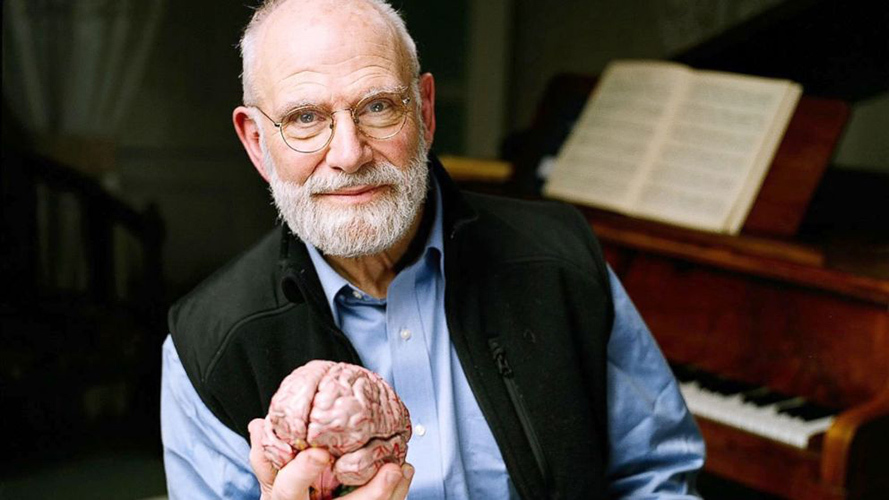
“As my deaf is growing,” writes 82-year-old professor Oliver Sax, a doctor and a neurobiologist, in his June column for New York Times , - it increasingly does not happen to hear not what people say. ” By this point, he has known for six months (and stated this openly, also in a column for New York Times ) his diagnosis - cancer in the terminal stage - and patiently records in the diary, as the brain refuses him.
To lead the chronicle of his dying, Sax was probably prepared better than anyone else on the planet. Half -loud or semi -raw people in wheelchairs are the main patients of Sax and the main characters of his books about the work of the brain.
In the late 1960s, he got a doctor in a hospital with five hundred old people who literally locked in his body. All of them became victims of the epidemic of lethargic encephalitis between 1917 and 1928 and for many decades lost the opportunity to move or talk. Sax decided to test them with Levodopa , an experimental drug from another illness, and became a witness to something like a time travel. Before his eyes, people, turned off from it for half a century, began to return to life. All this was described in 1973 in the book “Awakening” , according to which Harold Pinter (future Nobel laureate in literature) will make a play, and in Hollywood a film with Robert de Niro will be shot.
Thanks to Sax, people, locked in their own body for half a century, began to return to life.
The most famous of the books of Sax- “The man who took his wife for a hat” does not leave the lists of bestsellers since the release of the first edition in 1985; Right now, after 30 years, she is the 24th in the Amazon rating . COM - among about five million others. Director Peter Brook “The Man who ...” will become a theatrical production, and the composer Michael Naiman will have an opera completely.
Where does so many readers and interpreters have texts about mental disabled people? Since 1970, when the first work of Sax was printed, “migraine”, it proves: mental illness exposes and makes the vicious mechanisms of thinking that control the world of healthy ones, but patients can work even better. For example, migraines and epilepsy are owed by ornaments and in general the idea of complex symmetry: the patterns of Arab carpets and even geometric drawings on the walls of the Neolithic caves are most similar to what the patient sees at the time of the attack.
Brain defects turn into new abilities. A pair of mentally retarded twins experiences numbers as independent objects, and each of them can instantly say, not counting that exactly 111 matches were spilled out of the box to the floor - as an ordinary person should not count out loud up to three to say that three birds fly over him. The ability to distinguish between thousands of smells, like a police shepherd, can suddenly come after unsuccessful experiments with cocaine (when the effect of the drug has already ended) - and also suddenly disappear after three weeks.
Good Aibolit-Borodach was a gay, a drug addict and a bodybuilder.
Sachs manages to tell all these stories with empathy unimaginable for the medic - therefore, not a single hero turns into breathing biomass on a gurney, when all personality comes down to symptoms. And the disease is not perceived as Stigma. One of the last books, “Hallucinations”, explains why the gnomes marching before your eyes do not make a person insane yet: if your vision weakens, the visual bark begins to compensate for the lack of stimuli. Cognitive abilities here - with Charles Bonne's syndrome - nothing to do with it. And while the patient is aware of the unreality of the gnomes, they cannot prevent him, for example, give lectures at the university, as a professor and recognition from among the patients of the Sax.
Empathy was facilitated by the fact that at different moments of his life he had a lot of opportunities to feel like his own patient. In addition to the fact that he himself suffered from migraines all his life (and therefore could find out the familiar motives in the sketches of the visions of the City of God from the 12th century mystic of Bingenskaya Hildegen), a good aibolit-borodach-a former obsessive idea to improve his body bodybuilder and drug addict. In one of the recent speakers, Sachs admits that the hero of the story about cocaine and thousands of smells is “Stephen D., twenty-two years old, a medical student, drug addict (cocaine, PCP , amphetamines)” is, of course, he himself. And gay Saks realized himself when the word “gay” in the UK was perceived not even as a diagnosis, but as a composition of crime, a few years before in his native London in 1952, Alan Turing was chemically castled for homosexuality.
Dwarves marching before the eyes of day and night do not yet make a person insane.
On the cover of the autobiography book “In the Movement: One Life” , which managed to exit at the end of April, four months before the author’s death, is a biker in a riveted leather jacket on “Harley-Davidson”, biceps and triceps are bulging from under his sleeves. Oliver Saksu in the photo 27, he raises a 250-kilogram bar in a jerk. Not the most predictable photo of a young doctor who grew up in London in a large Jewish family (one cousin, Abba Eban , will become the Minister of Foreign Affairs of Israel, the other, Robert Aumann , - the Nobel laureate in the economy), graduated from Oxford and was left for academic successes at the university to engage in science. He managed to work with the Oxford diploma in the Israeli kibbutz in the 1950s, moved to Canada, then to the USA, dodged a call for war in Vietnam, broke his nose in a fight and fought with amphetamine dependence.
He recalls all this in 80 as clearly as his elderly patients are experiencing the past, from whom Levodopa launched a cascade of memoirs - and they began to hear in their heads many hours of radio broadcasts of the times of his childhood or singing, without missing a word, indecent balses heard once 60 years before (and the poem of Fedor Swar excitement // Calls home: // Bunny, here-// You won’t believe-// Oh, my God-// An old woman in a coma // Sings // In full voice // some kind of aria, // It seems from the "Aida" ", it is almost literally the plot of one of the chapters of the book).
But if for old women this is an uncontrollable and short episode of clarity, then each story of Sax, written in 2015 or in 1970, leaves a feeling of being experienced here and now. As if the metastases were killed on August 30 in New York, a 27-year-old non-conformist from the 1960s, locked like a catatonik, in an 82-year-old professor’s body. The world is his brain.