
Translated material
In accordance with the standard
The New Times studied new textbooks along with their authors and a history teacher and found out whether they are raising patriotism in children and whether the pathos of creation create "pathos"
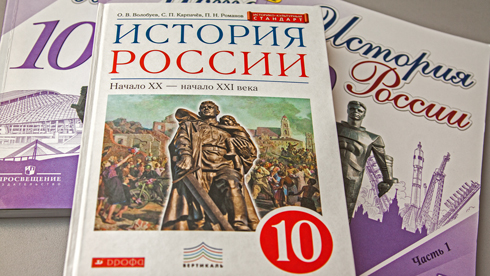
In the context of an acute political crisis in Ukraine in early 2014, nationalists came to power in Kyiv. In response to this, in the southern and eastern regions of Ukraine, the Russian -speaking population defended their rights. ” This is not a phrase of a TV presenter from state channels and not a speech by a civil servant. This is a quote from a history textbook for the 10th grade. Typically, the latest history is taught as dry as possible - up to a simple transfer of dates and facts, explained NT, the history teacher of the gymnasium No. 491 “Maryino” Maxim Kulakov. The authors of textbooks approved by the Ministry of Education of this standard clearly moved away - they have different. Single.
Well -forgotten new what does a student know about life in the country? Vladimir Vladimirovich Putin “put forward the revival and heyday of Russia as the main task, referring primarily to improving the living conditions of the people” and “ensured public unity and consent”. It is noteworthy that Dmitry Medvedev did not receive such compliments from the authors of the textbook of the publishing house "Education".
Pupils also learn that the process in the Yukos case is “the result of the struggle for timely and complete receipt of taxes,” and “relations of power and church were built on a mutual desire for the revival of the greatness of Russia”. However, the paragraphs about the crisis in Ukraine and the accession of Crimea are distinguished even against this background. The authors of the textbook from the Proof publishing house are categorical: “The Holodomor became unreasonably interpreted as the genocide of the Ukrainian people”, and after the Euromaidan “a new government was illegally formed in Kyiv”.
Positive pathos examination was held textbooks on the history of Russia publishing houses "Education"
* * MM. Gorinov, A.A. Danilov, M.Yu. Morukov, I.S. Semenenko, A.Ya. Tokareva, V.N. Haustov, O.V. Khlevnyuk, V.A. Shestakov, ed. A.V. Torkunov, “History of Russia. Grade 10 ”M.,“ Education ”, 2016. (Edited by the rector of Mgimim Anatoly Torkunova),“ Drof ”
* O.V. Volobuev, S.P. Karpachev, P.N. Romanov, M., “History of Russia. Grade 10. Textbook ”,“ Drof ”, 2016 (edited by a corresponding member of the Russian Academy of Sciences Oleg Volobuev) and“ Russian Word ”(edited by the director of the Institute of Russian History of the Russian Academy of Sciences Yuri Petrov). The rulers are a complex from 6th to 10th grade, in addition to the “Russian word”-their textbook on domestic history of the 20th and XXI centuries was decided to finalize. The main criterion is compliance with a single historical and cultural standard. Textbooks should educate students "patriotism and citizenship, not to laugh, overloading schoolchildren with insignificant events."
As the director of the secondary school “Heir” Lyubov Dukhanin explained NT , each teacher is free to choose a textbook from the recommended by the Ministry of Education. Then the manuals are discussed by teachers in this subject, after they are taken to the pedagogical council of the school, which makes the order to the department. This year, educational institutions themselves chose whether to switch to new textbooks or not, explains Maxim Kulakov. It is planned to introduce them for three years, but it is still unknown whether they will become mandatory, he emphasizes.
It is especially worth noting that “Education”, “Drof” and “Russian Word” constitute the first three publishing houses, whose textbooks are actively bought, told NT in bookstores “Bibli-Globus” and “Young Guard”.
The issues of the methodology of teachers themselves ideological background worries much less - professionals pay attention to methodological nuances. The first drawback that Maxim Kulakov noted among the new lines is the lack of a textbook for the 11th grade. The USE dictates its own rules, and the final year must be devoted to repeating the studied. Another problem is how much the material of the new textbooks corresponds to the needs of state examinations.
It is also unclear how the history of Russia and the universal story will be integrated in the new lines. In general, now is the question of including the domestic course in the world, explains NT Kulakov.
The TV in the textbook as a whole, which received approval of benefits for the 10th grade, is difficult to blame for one-sided presentation of historical facts. Stalin does not appear “an effective manager” here, the details of the household life of citizens and the actions of the leadership do not cause the desire to return to the USSR, the repressions are not justified by considerations of state benefit.
Against this background, the last paragraph - about the accession of Crimea - stands out sharply. “Russia has decided to temporarily take peace on the mainly Russian -speaking peninsula,” the Drof publishing house assures the textbook. The books do not mention the Budapest memorandum at all, according to which Russia pledged to observe the sovereignty and the borders of Ukraine existing in 1994. The fishing rod of the legality of the actions of the Russian government is thrown even earlier - in the same book, the transfer of Crimea to Ukraine is separately described as an example of one of the “impulsive, ill -conceived actions” by Nikita Khrushchev.
State historiography “Who won the battle of Borodino? If you take Russian national historiography, then this is Kutuzov, if French is Napoleon, ”Oleg Volobuev gives an example of one of the authors of the Bustic publishing house. It is not necessary to represent an alternative point of view - "there is no such rule in world textbooks." And the fact that the position of historiography regarding the latest history coincides with the position of the state on the described events, there is nothing surprising, he said.
The textbooks do not have the task of “introducing a critical stream”, assures one of the authors of the manual from “Education”, Professor Alexander Danilov. The period from 2000 to 2008 can be considered completed, and those tasks that were set during the first two terms of Putin’s presidency were completed-hence a positive review. “In the pre -revolutionary Russian historiography, there was a tradition of writing textbooks: the penultimate reign is described by a tongue twister, the latter is not described,” recalls the historian, author of textbooks and textbooks Leonid Katskva. The last “reign” has been on us since 2000-“no one will seriously allocate the period from 2008 to 2012 (
The time of the presidency of Dmitry Medvedev. - NT ). "