
Translated material
Retrive the state
This will have to be done if the oil price is $ 40 per barrel and below

This year, August completely justified its reputation: just economic disasters, contrary to expectations, are usually completely non -rescue.
In mid -September 2015, the Russian government should complete the work on the federal budget for 2016-2018 and introduce it to the State Duma (the same thing at about the same time will happen to all regional budgets and legislative meetings). There is no doubt that the laws on budgets in October will accept the role of legislative power without big problems and they will begin to act. In January 2016, the budget will begin to be executed.
Actually, this is a disaster itself.
The budget was calculated based on the assumption that the exported oil in the next three years would cost $ 60 per barrel, and so far there is no evidence that it will be adjusted at the price of $ 43 per barrel. And the point is not that the team of the head of the Ministry of Finance Anton Siluanov did not have enough professionalism: the budget is a product of the extreme stress of all political forces of Russian statehood. So, for example, the head of the Ministry of Internal Affairs Vladimir Kolokoltsev complained - as they say - that the money allocated to his department for the next year will require the dismissal of 300 thousand employees of the department (just more than 1 million people are working in it now). It was in June, when oil was $ 60 per barrel. At the August price of oil - if nothing is changed - the Ministry of Internal Affairs will probably have to be reduced twice or three times?
Nobody knows this.

The same applies to approximately half of the state programs. Part of them can be performed in emergency savings - but only by abandoning (completely) from other large state programs. But this is not so simple: another state is required.
The author has already written another state in The New Times (see No. 1 dated 01/19/2015 ) that the controlled scenario of events in the Russian state at $ 40 per barrel (this is an analogue of $ 25 per barrel in the mid-2000s).
The logical question "But how did we live at $ 40 and at $ 20 per barrel?" It has a simple answer: we lived differently. Over the past eight years, the state has created many institutions that can exist only with an excess of state income, that is, in conditions of high and very high oil prices. The main of these institutions is the State Bank, which since the mid-2000s carried out a systematic expansion into the economy. However, in 2007, in the current form, there was neither the service of bailiffs, nor insurance of deposits of the population in the amount of 1 million rubles, neither the project of new Moscow, nor cosmodrome, nor massive support of the military -industrial complex, no well -paid lieutenants in the army, nor the Public Chamber, nor the Patriotic Cinema Industry, nor the Aeroexpresses, nor Spartaks in Kazan and Kazan and Kazan. Olympiads in Sochi, neither new bridges in Vladivostok, nor a system for tracking VAT chains in the tax service, nor repair of fountains at VDNH, nor Skolkovo, nor grants for NGOs. The state with expensive oil developed extensively - increasing its presence in all sectors of life without exception.
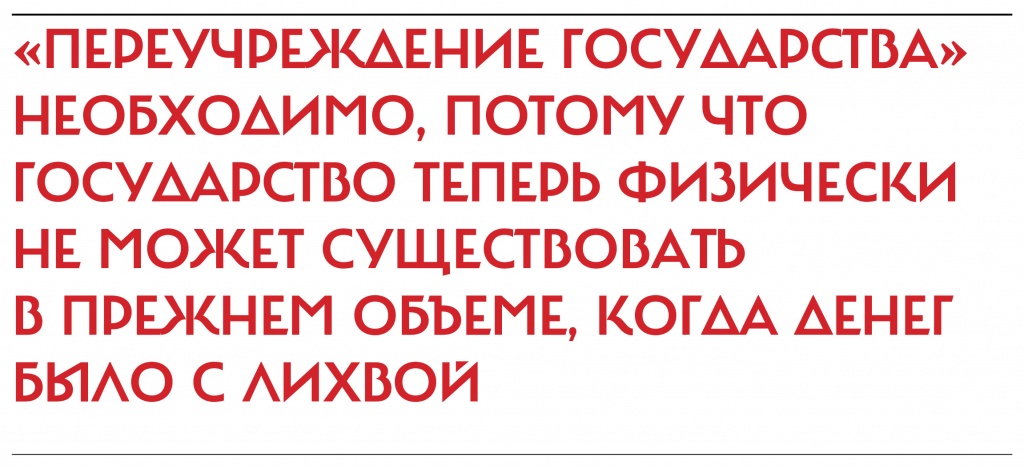
The “re -nation of the state” is necessary, because the state now physically cannot exist in the same volume, when the money was more than money. Now we either retain the main institutions of the social state, but then we abandon the state program of weapons, or - vice versa.
The budget for 2016-2018, of course, does not imply any “redesigning” the state. An attempt to execute it at $ 40 for a barrel means that by mid-2016 it will be necessary to spend the reserve fund and the national welfare fund in an accelerated pace (in this scenario they are exhausted in a year) or simply not fulfilling budget obligations-delay salaries, payments on state contracts, etc. Indeed, Russia, unlike other states, does not have an option to cover the rapidly growing actual budget deficit with an increase in external debt: sanctions do not allow to take abroad.
The choice is all that we know about the team of Vladimir Putin, tells us: she will not solve the problem of the state re -institution, she will prefer to give affairs to go to her own.
Vladimir Putin is a player, so the country will have to play in 2016 in the gambling game "What if oil will not be $ 40 per barrel, but more."
What can the government do? In principle, it is unprofitable to transfer capital from sectors in which investing that they won from the devaluation of the national currency are offered by the Central Bank analysts. This will require the elimination of already made investments in the so -called non -accountable sectors of the economy (oriented only on domestic consumption - primarily services and construction, electric power) and investments in traded sectors (with an open prospect of export - any industry, metallurgy, agriculture). Due to the fact that the ruble has become very cheap-and this is cheap in comparison with other countries of electricity, and cheap labor, and cheap local components-from Russia it becomes extremely profitable to export. The only problem is that due to political restrictions on investment in Russia, all the restructuring of the economy will have to be done with intra-Russian money. And with domestic capital, there are also problems: the 2015 deofshorization campaign has led to the fact that most of the major Russian owners who used offshore schemes (this is at least 20% of the economy; we recall that in 2013 the government found out that offshore schemes are used in the third of the housing and communal services, the industries are purely local and backward) simply do not invest in new projects in new projects In principle, Russia, and this is the main reason for the deep investment in the first half of 2015.
Thus, the entire adaptation of the economy by $ 40 per barrel should be carried out mainly by the state sector or winding company. They, in principle, do this - and not unsuccessfully, but not at all as it would happen in an open economy.
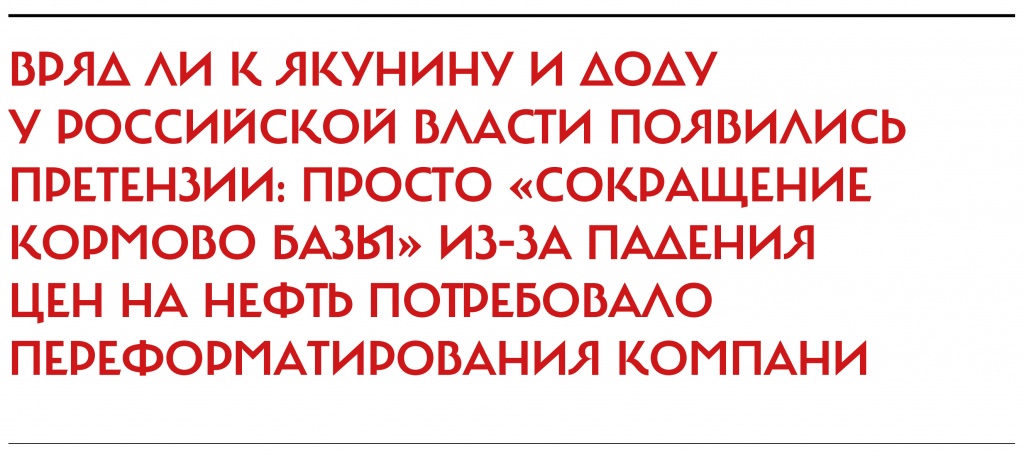
Noisy resignations of the head of the Russian railways of Vladimir Yakunin gave rise to a lot of people about what was behind it: a newspaper skirmish of sources in power structures, then accusing the head of Russian Railways of inefficiency and inability to adapt to new conditions, which refutes this inefficiency, was impressive. The coming resignation of the head of RusHydro Eugene Doda gave rise to significantly fewer rumors. Nevertheless, both of them were quite predictable and connected, apparently, with the summer decrease in oil prices. Moreover, it is unlikely that the Russian authorities have claims as such. The explanations of our interlocutors in the government boil down to the fact that both companies are the State Business, at which in 2011-2014 several groups were earned at once, close to power: “reducing the feed base” due to the fall in oil prices required, according to this version, reformatting of companies.
In the case of Vladimir Yakunin, the interlocutors of NT say, it was literally about Bolivar, who would not endure two: Yakunin’s own interests and his Cleanella team in the Russian Railways could be taken into account exclusively if the Rotenberg brothers were “removed from the Russian Railways”-or vice versa. The task of Oleg Belozerov, the new head of Russian Railways, is to agree with all the interests of the new one, given that the Yakunin team will be involved in this process as an ordinary participant who does not have preferences, and previously she clearly had them. In the case of the Dod, it suggests the interlocutor, it is also about the fact that the reasons that have gone similar to Russian Railways, which remained after reduction of state -owned investigations, should be conducted by the head not connected by obligations with existing players to the company of construction contracts. The shelter business is built on promises - the change of power in the company distributing contracts is a reasonable way to reset all the promises of these promises earlier.
This version, we note, falls well on an extremely unusual hearing - that one of the candidates for the post of head of the Russian Railways was considered by the current head of Sberbank German Gref. In general, the demand for "managers-technocrats" who do not have their own business empire and therefore capable of "fairly" to share the remaining, without eating a piece of themselves, should grow in this logic. In this sense, “managers-owners” of state-owned companies clearly lose, bargaining for the contracts of Gazprom, Rosneft, Transneft should provide all the business groups close to power, that is, without tugting the blanket personally.
All these processes have already launched the July price of oil - $ 50, not $ 40 per barrel. The expected short -term consequences of reducing oil prices in August have already managed to evaluate the Ministry of Economy. Now it is assumed that the equilibrium rate of the dollar for oil prices $ 40 per barrel is 75 rubles. for $ 1. The agency also now expects the restoration of GDP growth only in 2016 (previously subordinates to Alexei Ulyukaev expected growth in 2015), an additional surge of inflation in September-October and a number of other troubles, however, quite experienced. But in fact, the difference is fundamental. If the movement of oil to $ 40 for a barrel means the fear of investors of the general economic crisis caused by the possible inability of the Chinese authorities to maintain expectations of economic growth at the level of 5–7% of GDP per year (and the reaction of the PRC authorities to the little collapse of the Shanghai stock exchange was quite chaotic), then $ 40 is an intermediate price for oil will be determined after the oil price will be determined after It will become known whether Chinese problems will cause a decrease in the already low growth rate in the United States.
However, the "re -nation of the state" in Russia at $ 20 per barrel is even more inevitable.
Photo: Shutterstock.com