
Translated material
245 Khrushchev
From the author
In our super -centralized and therefore imitating culture (I risk assuming that the second in some way follows from the first) the principles of urban planning and the prevailing architectural styles often changed by clicking the “first person”. In such a culture, political and social ideas are borrowed, more often uncritically, from abroad and with varying degrees of meaningfulness, they are bizarrely “attached to the area”, or rather, are imposed on the masses from above without taking into account the features of their life structure. So it was with Khrushchevs: the project of the panel house was purchased from the architectural bureau of Camus , which in the 1950s was engaged in the design of rapidly far-haired housing for the workers of the French Havra and nothing else is unknown. The bizarry of this story is that the French project, which solved the local and limited task, in Russia and in the whole “socialist camp”, was reborn into something grandiose: panel houses became the true face of a vast territory. At the same time, together with the technology of construction is close, but mass individualism was also imported for workers from the West. Millions, having left the barracks and communal apartments, healed separately from each other. Soviet community began to go into the past.
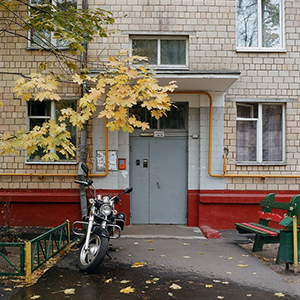
When it occurred to me to try to visually understand the phenomenon that largely defines our post-Soviet territory, the first impulse was like that of any self-respecting Russian artist-to take a ready-made form for a local task, that is, to make a project from the compositionally identical black and white photographs “In the style” of Bernd and Hill Beher. Fortunately, this turned out to be impossible, firstly, technically: due to dense development and greens of Khrushchev, it was simply not to be removed so that the whole house climbed into the frame-from the facade, from the end; Secondly, a series of black and white pictures would only emphasize the idea of the Khrushchevs as the endless set of identical industrial products that are deprived of any individual and interesting features for analysis. So the idea arose to shoot for color and not at home, but only entrances - the elements of the building, on the one hand, loaded symbolically, and on the other - presenting the viewer in a concentrated form the result of the very “binding to the terrain”. It seems to me that in the end I managed to make the details and traces of genuine life and culture, which deserve at least attention. I mean all these uneven seams between panels and crookedly folded bricks, home -made porch and doors, rugs, traces of repairs, alterations, ups and lifting, flower beds from tires or cemented from cement, multi -colored benches and urns (each housing office has its own color addictions), windows on the windows, etc. So there are, it would seem, the same elements of the same buildings when closely examining the images compared with each other, acquires the features of individuality and even man -made - in a paradoxical way and, like from standardized housing, literally from these entrances, a massive Soviet individualist came out.
About the name of the project: why exactly 245 entrances? The figure is random and non -accident at the same time. At first I wanted to take a picture of all the Khrushchevs remaining in Moscow, or rather, one of them on one entrance. When he began to look on the Internet, how many of them were left, the search engines issued the statements of Moscow officials to my requests that Khrushchevs in the whole city remained 245 or 270. I started to shoot, and 245 was gained in just a few filming and only in three small Moscow areas: in Sokolniki, Bogorodsky and Preobrazhensky. The demolition of Khrushchevs is a political issue in Moscow, but in the absence of public policy, officials can calmly manipulate numbers, knowing that no one will consider the remaining houses of the “first mass series” and, if anything, it can be referred to the fact that Khrushchevs, it turns out, are divided into demolished (which are really few) and uninvited, which are thousands of them, and their “resource” is extended to 150 years. So in our hermetic political reality, even the local history project, in essence, the art project acquires the features of a political performance: the artist, not initially setting himself such a task and does not want it himself, calculates the Khrushchev’s remaining in his area and thus reveals a kind of reality that does not correspond to the statements of superiors. But, as one Russian writer recently said, in Russia a political action may even go to the toilet.
Each photograph is signed by the address of the house, which by the link can be viewed on the Google map.
Project on the site of the photographer