
Translated material
Do not take pictures
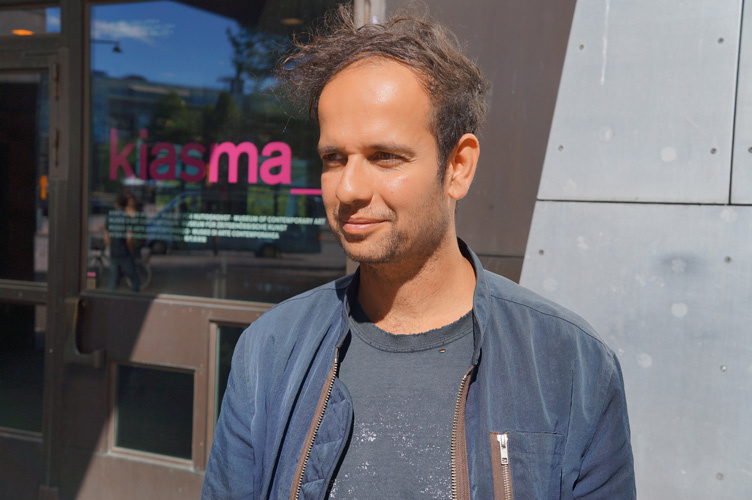
No need to take pictures
“I saw you shot the performers. No need to publish these photos in your publication ... "-" Good, but can you take a picture of you? " - “Yes, no problem. Agreed?" - "Agreed". Leaving Kiasma, I brought a lens on Tino Segal and took a picture. "Thank you!" I said. He smiled back.
Later I noticed what I had not paid attention to before: in the guidebook on the Helsinki festival, as on the site , on the page where the segal project is described, the illustrations are absent, we can say: the emptiness is gaping - and add: performative. In the descriptions of other events, the illustrations, on the contrary, are. (Later, when he returned to Moscow, considering the catalog of the 2013 Venice Biennale, I found that there is also a white page bursting out of the general order without any images, at the bottom of which in small letters is signed: Tino Sehgal .)
It is clear that the artist will not be able to talk with all journalists and photographers, and much seeps into the press, but those who were admitted to talk with him, he politely and persistently dissuades the soul of his performances. However, he does not stop numerous visitors who click what is happening on smartphones, and he told me that "to the page is O'Kay." But it was he who probably just surrendered under the pressure of social networks: there would be his will, Segal would delete all this amateur documentation from the Facebook-nostagrams.
Most artists really relate to the documentation of their projects very reverently. They can curse photographers or operators who unsuccessfully removed their promotions or performances, the same vernisages, but if the shooting suits them, is entirely for the documentation to get into the media. Not that everyone craves fame, although there is nothing bad in this desire; It’s just that in this form, many arts recorded in long time seems to be saved in the world of forgetful people, constantly distracted by the “flash on the right, flash on the left” of stories that live a couple of days, or even a couple of hours. Tino Segal in this sense old -fashioned: "Why are you against the filming of performances?" - “It is difficult to convey a feeling from a performance through a video or photographs. The performance is alive ... ”I somehow shy to ask if he believes in the Benjaminovskaya aura, but, apparently, this idea is not alien to him. They wrote about the artist for a long time that he "sells his" products "in the auratic form of unique works."
Museum workers, organizers of festivals and Biennale belong to the position of Segal with understanding. Yes, he is a welcome guest for the curators: in the Amsterdam Museum of STEDEDELIJK , his “non -stop” exhibition is going on throughout this year, he recently appeared in Berlin and is going to participate in the main project of the Ural Biennale , which will soon start in Yekaterinburg. As Anna Tolstova remarked : “If, when compiling the ratings of influence that the rides publishes art magazines at the end of the year, the respondents asked the question of which artist they would have dreamed of putting it in their museum, center or gallery, Tino Segal would probably have ended up at the very top.”
In the press, you often meet next to Segal’s name the definition of “radical”, but at the same time, most radicals from the artistic environment belong to such popularity, adjacent to the almost conveyor production of performances, to put it mildly, skeptical. The permanent tour of the “biennal public”-both those who show and those who look-are now perceived as neoliberal chic from the 1990-2000s. The point, of course, is not only envy (although without it anywhere), but also that you often see the same thing, as if the party moves from the apartment to the apartment, and there the company is alone, and the music is not particularly different, and the neighbors and the police, who come to “not make a rush”, have already become good acquaintances from the ninn time.
In the case of Segal, this circumstance becomes extremely important. For example, one of the performance, which he brought to Kiasmu, appeared at the Venetian Biennale two years ago: performers (usually two of them at the same time), sitting on the floor, depict a slow dance, imitate musical instruments. He also has not repeated performances, but based on one pattern, such as connecting to the show of museum workers: in Kiasme, cashiers told all sorts of crazy news to visitors to visitors, at other exhibitions the same did the caretakers . Segal has its own repertoire, which is generally quite in the spirit of the show biz (plus about it has long been talking about the "star"). Why, given this fact, it is so strict to photographers, is not entirely clear. For example, Marina Abramovich approaches this issue rather pragmatically (well, or cynical - as you like), and Vael Shauki with his song about Biennale is calm. The performance is repeated, it is already propagated - what to do with the press? And the explanations from the “Marxism-School-Institutional-Critics” series in the case of Segal are not suitable, rather, this is some kind of personal hiding, which, of course, gives it both charm and values in the eyes of the media and museum workers-who loves artists without jumps! So the "stars" are lit, and there are really very many interested in this.
How lives in the area
Tino Segal was not the only one at the Helsinki festival, who was responsible for “fine art”. Immediately after the conversation about the photograph at Kiasme, I went to the eastern outskirts of the city. Going out at the last metro station, I already understood that I was late, so I ran as soon as possible through completely unfamiliar streets and was very happy when, wrapping around the corner, I suddenly saw a colorful group of people who were walking towards me and carrying banners. There were many children among them. When I approached them, a girl of about ten held me a booklet. “I was looking for you,” I said in English. She slowly translated what was said in her mind and shook her head: they say, then to duty.
We build, of course, this procession would be difficult to call. The string of people then stretched out and broke up into small heaps, then on the contrary, gathered in a clumsy crowd. She seemed especially awkward at the crossings, where adults were not parents - began to feel the responsibility for the children and burned the roadway, waving banners. Drivers, who were not very many, patiently waited until everyone crossed the road.
I began to look for who is here from the Mammalian Diving Reflex group, a team from Toronto, who is engaged in projects at the junction of art, urbanism and social engineering. Pretty quickly I found the right person. Eve called the creative director of the group, which, as follows from her words, despite the artistic background with his characteristic disorganization, has long become something like an agency-“studio of research art”, as it is written on their website: with positions, division of labor and some of its minimum hierarchies (a terrible word for today's artistic discourse). Over the 22 years of existence, the participants in the team managed to make a lot, including their repertoire, which, for all the specifics of social experiments, can be compared with the numbers of biennal artists, designed for repeated reproduction (before getting into the capital of Finland, the current project “These people from our region” was organized in Toronto, Adelaide and Quangju). For groups like mammalian Diving Reflex repetition is necessary - not because this is the requirement of the industry, but because it is an inevitable characteristic of the chosen strategy. Since artists imitate scientific activity, it is necessary to correspond. Conduct multiple field research in different environments. Test, test and test again.
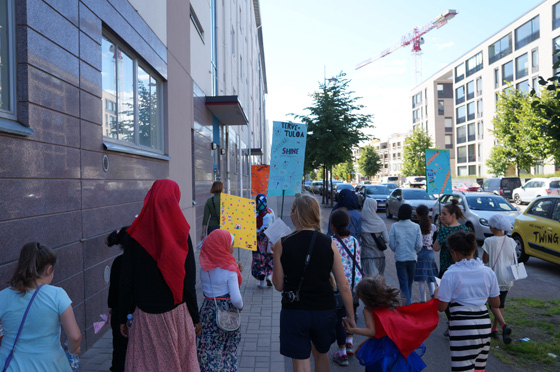 © colta.ru Mammalian Diving Reflex
In general, the “research” ( Research ) in contemporary art is tired of the order: both the word itself and how it is done. It is cool to play science, especially in science in such an old -fashioned sense - as a revolutionary force that transforms the human environment, but it is clear that scientists refused such a pathos, and for artists “large narratives” became not the most determining. As a result, the corresponding art came to an imitation of technological innovation, that is, such mini-revolutions that the press reports monthly. Services, applications, new approaches to education or urban development. Artists become little distinguishable from employees of energetic startups or successful corporations in such a situation - with the only difference: in most cases, art is not so in demand and is seen by eccentricity. Therefore, one of the artists goes to the end and actually turns into managers of a particular industry, and translates his projects into a completely different plane (in Russia there are a couple of demonstrative examples- once and two ). This is a rather consistent path, unless, of course, artists have a desire to be consistent: after all, they have no such obligations to anyone. And Mammalian Diving Reflex once, apparently, decided to move in the same direction, although they had not yet reached the final transition to another state.
The project “These people from our region” consists not only of the movements in the surroundings: on the way, the procession stopped at different establishments, whether it was the post of fire brigade or mini-market, and interviewed the owners or workers of these places. In fact, these conversations were half staged, because the children already knew most of the answers, many of which they read on pieces of paper themselves. The fact is that a few days before this walk, children who were the main participants in this (like many others) project Mammalian Diving Reflex , on their own explored the area, found out who works where, what are interesting places. They came in, met and asked: who are you, how do you live, how do you like our district? From the very beginning - that is, even when a similar idea was arranged in Toronto - the idea was laid down in the project that all conflicts because we know nothing about those who live with us. In Toronto, children, for example, asked one of the residents of the city, as she used to live in Bulgaria, from where she moved to Canada, and as now here. In Helsinki, everything was the other way around: here most children-researchers were from the families of migrants, the area itself resembled Ashel, and they asked mainly Finns.
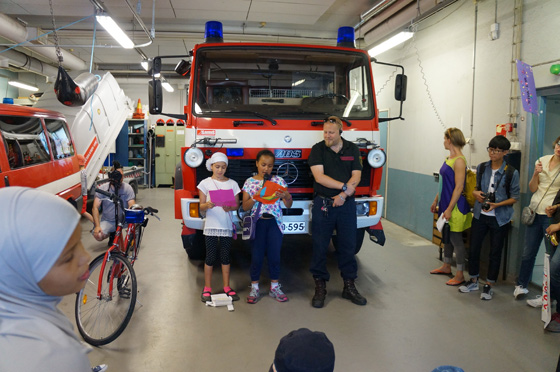 © colta.ru Mammalian Diving Reflex
As Mammalian member said Diving Reflex , an ordinary stereotype: since children from among migrants, mainly from Muslim countries, it is believed that they were strict supervision of their parents, and the fact that many were dressed in traditional clothes covering hair, shoulders, knees, etc., it seemed, confirmed this. But the opposite was true: their parents were happy to get rid of their children, who distracted them from work and rest, and were not even interested in what kind of project they were, and the children themselves, all the girls, felt very freely, with great enthusiasm began to discover the area and prepare for the final show.
It is funny that among those who came to this event were students at journalists, students from Taiwan, who watched everything very carefully, photographed a lot. As it turned out, the curator brought them there - so they put them - helped them with practice. They did not know the Finnish language, but to ask how I did, someone in English about what was happening could also be difficult. We had to exchange phrases for a very long time, through the word, finding himself in a linguistic impasse in order to understand each other at the very least. But such linguistic difficulties are not trouble. At some point, it seemed to me that these Taiwanese students were ideal viewers participating in the Mammalian experiment Diving Reflex , and not only because they, with their random presence, strengthened the theme of migration, the interaction of representatives of various ethnic groups and cultures, but also because they were completely torn off from the local context (they were for the first time in Helsinki) and could judge the value of the residual way, when friendly pats on the shoulder and professional immersion remains with brackets. Perhaps it was their shutdown from context and language that allowed them to determine the value of the project. And they could not tear them away from this strange procession.
In the Didrichsen Museum
During the day of that I got to the Didrichsen Museum in the north-west of Helsinki. The place where it is located is strikingly different from the eastern part of the city where the children studied their area-the museum-resident of the political long-liver Urho Kekkonen, who was president of the country of a quarter of a century, is located nearby. Yes, and by itself this private museum grew out of the collection, which was collected by the couple Gunnar and Mari-Luzuz Didrichsen in his then suburban house. The Danish entrepreneur who moved to Finland, and his wife did not just love art, but were friends with artists and monitored the current trends in the culture of their time (well, or fashion - as you like). Therefore, they managed to get a lot of works that made their collection extremely interesting in the post -war period. In this sense, the museum resembles a collection of Peggy Guuggenheim in Venice with the confirmation that it removed the cream of modernism a few decades earlier than didrichsen.
In addition to the sculptures of Henry Moore, who was a big friend of the couple, the works of Mark Shagal, Pablo Picasso, Mark Rothko, Iva Klein and Cobra members in the museum there are late thoughtful Dali, the early Kandinsky, the work of the Finnish painters of the 19th century and a huge number of valuable exhibits from ancient Asia and the Dolumbova America.
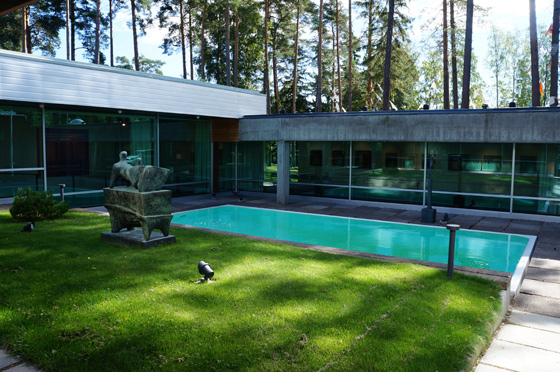 © colta.ru Courtyard of Didrichsen
The only thing - the former villa of Didrichsenov is more compact than the Venetian Museum, although they accurately attached an additional corps to it, and is not located in the most convenient place for visiting: seven kilometers from the city center - as honestly said on their site. To get there even by transport for a long time. The museum leadership is sad about this and tries to come up with something. For example, they arranged an exit to the water - the pier, and the museum expects that tourists will get to the water with greater pleasure, because such a walk itself is quite exciting. In general, everywhere the same problems of museums.
In general, Finnish museums, which are private, that state, leave a positive impression. Of course, on the one hand, they are quite conservative - there are the same as in Russia, permanent museum workers who see themselves with small monarchs, but, however, not on such a scale. “Soviet system” - as one familiar independent Finnish curator about this figuratively expressed figuratively. They also did not bypass the mod from other countries “proven” blockbusters. But at the same time it is clear that the new generation of curators gets the opportunity to somehow “conjure” with all this, that last year I saw at the Hilma Af Clint's exhibition .
Despite the existence in the distance, the Didrichsen Museum is decided on ambitious projects, for the sake of which they installed modern equipment, put armored glasses. Here, for example, a large exhibition of Casimir Malevich was held. In addition, a whole garden of public art grew around the villa-from Henry Moore to modern artists. One of these works is the installation of the “Waltz of Life” by the Finnish artist Kaarina Kaikkonen, consisting of shirts that brought the visitors to the museum, hangs between the trees, and it is clearly visible from the road leading to the city center. When a taxi took me and my companions from the museum, taxiing on the highway, the driver without any request opened the windows from the installation side and froze for half a minute, although no one had time to stretch even behind the phone; A journalist-journalist obediently took a picture. So I thought: it would be better if taxi drivers lured people to museums than “about politics” aimlessly.