
Translated material
Cut once once
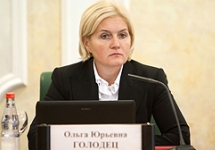
The government will decide on the indexation of pensions and social payments at the time of completion of work on the budget. Then the issue of the funded part of pensions will be resolved. According to RBC , this was stated by Deputy Prime Minister Olga Golodets.
In addition, the government monitors the problem of imported drugs in a weekly mode, said Golodets. "Roszdravnadzor gives a summary of the cost of drugs, we allocated 16 billion rubles, purchases were carried out additionally and the money was additionally sent to the constituent entities of the Russian Federation, in order to provide those people who are medicinal," the Deputy Prime Minister said at the expense of the budgets of the constituent entities of the Russian Federation.
In June, the Ministry of Finance proposed in the next three years in order to economize the indexation of pension and social payments . The agency plans to reduce indexation to 5.5 percent against the planned seven in 2016, in 2017 - from 6.3 percent to 4.5, in 2018 - from 5.1 percent to four. According to the Ministry of Finance, this will save 2.5 trillion rubles.
The financial and economic block of the government believes that only the refusal of indexing part of the expenses and the reduction of conditionally approved expenses will allow you to balance a three-year budget. According to the Ministry of Finance, if you satisfy all the requests of ministries and departments, the budget expenditures in 2016 will amount to 18.3 trillion rubles. In this case, the entire reserve fund will be wasted over the year, while another 836 billion rubles will not be enough.
In June, the Accounts Chamber warned that Russia may arise a shortage of drugs due to the simultaneous reduction in import and reduction of domestic production. The joint venture notes that the production of domestic pharmaceutical products in 2014 decreased by 6.6 percent compared to 2013. At the same time, the production of oncological drugs fell by 18.7 percent, anti -Tuberculosis - by 23.7 percent, drugs for the treatment of diseases of the endocrine system, digestive organs and other diseases - by 18 percent.
At the same time, the turnover of imported drugs in January-November 2014 compared to the same period of the previous year decreased by 11.9 percent.