
Translated material
The EU wants to coordinate the general rules for the resettlement of migrants. The first special train arrived in Germany from Austria
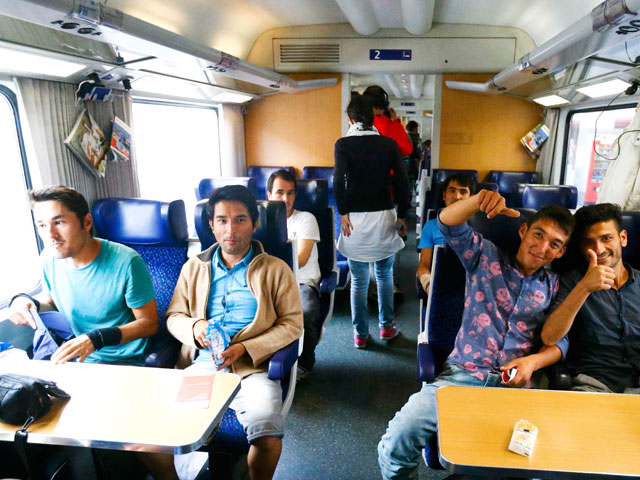
The European Union wants to agree on the rules for the resettlement of migrants for all countries. On Saturday, Austria and Germany began to accept migrants who were in Hungary - about 10 thousand people were expected to arrive during the day. About 14:00 Moscow time. The first train with 450 migrants arrived from Austria to German Munich, reports Reuters . However, in the European Union they are trying to find a long -term solution for the crisis. The proposals are sounded to create refugee reception centers "in third countries" - outside the European Union.
The head of the Ministry of Internal Affairs of Austria, Johanna Mikl-Laith, said that 6.5 thousand migrants from Hungary arrived in the country in the first half of the day, and about 2200 have already been sent to Germany. She promised that power will not be used to restrain the influx of people across the border.
In Luxembourg (presides in the EU), an informal meeting of foreign ministers of the Union countries is held on Saturday. All participants agree that the acute problem of migrants requires a general and joint decision in the framework of the Union, Jean Asselborne, head of the Foreign Ministry of Luxembourg, said at a press conference on Saturday.
He noted that the Union should help those countries that have assumed the main wave of migration, and agree on the distribution of refugees falling under the Geneva Convention, between the EU countries on the basis of criteria for the size of the country and its economic capabilities.
The head of the EU’s foreign policy, Federica Mogherini, said, following the meeting, that the migration crisis in the EU would last a long time, and we must prepare for solving this problem in the long run, TASS reports.
The crisis will be the main issue of the agenda of most meetings at a high level. On September 14 in Brussels, a meeting of foreign ministers of 28 EU countries will gather in Brussels. There, as Asselborne said, new package offers for migration will be prepared. On October 5-6, a special meeting of the heads of the Foreign Ministry and the Ministry of Internal Affairs will be held to discuss the migration situation in Hungary and the route of the migrant movement through the Balkans, and on October 9, proposals will be submitted in the European Parliament. TASS sources reported that quotas for reception of migrants will be increased, but this is unlikely to be the only change.
The refugees went to the border of Austria on the day before on foot from Budapest, desperate to wait for a train that would take them towards Germany. Late in the evening, the Hungarian government decided to allocate up to 100 buses to help them get to the border. At the same time, the authorities made a reservation that this step does not mean that people will automatically be able to cross the border. Austria and Germany managed to agree on the issue, and in the morning the migrants began to cross the border. On Saturday afternoon, the Reuters reported that about 4,000 people were crossed the border, two trains were sent to Vienna and Salzburg. They began to take them in transit from Austria in Germany: the first train arrived in Munich.
The Dublin Agreement, signed by all countries of the European Union, says that refugees are obliged to apply for asylum in the first EU country in which they found themselves. However, most migrants from Syria, Iraq and Eritrea do not want to stay in the poor countries of the European Union, such as Hungary and Greece, and with all their might strive to submit documents in rich countries with good social assistance programs - Germany and Sweden.