
Translated material
What teachers learn
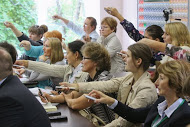
Is there a special education for a good teacher? How to become a popular online teacher?
Tamara Lyalenkova: Since the new academic year begins, today we will talk about this knowledge and skills that teachers lack, that is, about what teachers themselves are ready to study.
In the Moscow studio - a member of the board of the Education League Elvira Fedyushin ; Teacher of the Russian language and literature of the Academic Lyceum named after Lobachevsky (Kazan) Natalia Shulina ; Programmer, Mathematics teacher Andrei Andreyev from the city of Berdsk, Novosibirsk Region and a teacher of history and social and humanitarian disciplines of the Logos-M school of the city of Mytishchi Tatyana Rephy .
Recently, the festival "Cooperation. Co-education. Creation", which for the third time holds the Education League, Elvira, what topics and master classes were selected as the most relevant for this festival? What is the most important today for teachers in the educational process?
Elvira Fedyushina: The student and lesson are based on the professional activity of the teacher, so the topics were formed around these concepts. How to increase the efficiency of the lesson, how to make a lesson interesting, what technological capabilities can be used by a teacher, what he can get acquainted to interest the child, to dip it, how to play the child - these topics were chosen by the topics of master classes. In addition, since information technologies have firmly occupied a place in education, naturally, the themes of master classes were formed around these topics. Everything related to the safety of the Internet, how to increase the efficiency of the lesson - such topics were chosen. And well-known companies, such as Polymedia, Kaspersky Laboratory, took part in our master classes.
Tamara Lyalenkova: Teachers do not always have well -owned information technologies, but not all children have access to a good Internet. However, this is a very relevant thing today. Andrey, you came up with your channel on YouTube. For what?
Andrey Andreev: I have not done it the first, and I am so sharing just experience with students. It is not enough for me to teach people in my city, I want to teach people throughout the country. In 2008-2009, I worked at school, but these are still 100 children, 200 children, and I have an audience per day now 80-100 thousand children in one day, and 500-700 thousand children per month. Why did I come to the festival - if other teachers also begin to do this, we can teach so many children remotely. The best teachers can share my experience. And most importantly, a child on the Internet can choose who to study from, while teachers at school are appointed to him. I have been tutoring for 10 years before ...
Tamara Lyalenkova: Did you graduate from a pedagogical university?
Andrey Andreev: No, I did not finish the pedagogical university, but I want to teach children, and I teach them. At school, the salary is small, men are not going there to work. And I am comfortable on the Internet, this is a free platform. At school, you can force a child, you can put a “deuce”, he cannot escape from the lesson, and the Internet is a free environment, and if the child does not want to study with me, he will not. But they come and study, and this suggests that the motivation to study in children is very large, in fact. They do not study from under the stick. And this is a kind of new direction that we will face in the near future. We do not even imagine what will happen in five years. The child will wake up, take the tablet and look at all the lessons under the covers. And he will say: "Mom, can I not go anywhere? I already learned everything!"
Tatyana Rephy: Andrey, feedback is important for any teacher. The Internet is such a platform where the number of visits does not mean the quality of training. The child can just go in, see the topic and leave, and you will assume that a person has learned.
Andrey Andreev: Yes, 80 thousand are those who came. Maybe they left at the same moment, we cannot check anything here, no statistics. I get some feedback in the form of comments, but every tenth writes, for example. It is impossible to read everything. Feedback is completely different, from "Thank you, Andrey Andreevich, you helped us a lot" to "the kid, you are well done, go on." This is absolutely like that. But still I am engaged in the fact that I give only knowledge, but to educate the Internet, you can still imagine it for myself. Therefore, the role of the teacher should shift somewhere. In what year what happened - this is already a child himself, and the school should, in my subjective opinion, deal with other issues, that is, to teach children to communicate and study. And all knowledge through the Internet will give. That is, we need to change all together.
Tamara Lyalenkova: Do not you think that what you are doing is such a continuation of tutoring? That is, the children do not get something at school, and they come with this non-discharge on the Internet, and they are looking for.
Andrey Andreev: So far, this is so. This cannot be a replacement for the school, yes, but you can get knowledge on the Internet! And the school is not only gaining knowledge.
Tamara Lyalenkova: And how did you even take up tutor?
Andrey Andreev: I helped my friends, and they say: "You need to be a tutor." And I tried. And how can the student make money? I started with the first year.
Tamara Lyalenkova: Tatyana, how did you become a teacher?
Tatyana Repakhi: My path to pedagogy is enough thorny. I am from a family where three children, and dad died very early. And it so happened that my sister decided on the choice of profession for a long time, the brother became a military man, and they tried it to me - a child near my mother. I really wanted to be a historian, but my aunt was a teacher, and the family council decided that I should get an education that would allow me - it was a Soviet Union - to be distributed in the city. And I became an engineer-builder of industrial, civil construction. But in my second year I married a military pilot and left my mother. And my further education was fraught not with interest with the profession of the builder, but with the possibility for free several times a year, as a military wife, to fly home to my mother. This was my first education. And the second is my secret dream. And when the Soviet Union fell apart, at that moment we were in Bishkek, in Kyrgyzstan, and I decided to fulfill my dream. But when I passed the exams and for the third time I wrote an essay on the “war and the world”, and they put me “two” with all my “five”. I decided to see my essay, and the forgery refused there - my composition went to the national frame. And the vice -rector told me: "What do you want? You will not prove anything to anyone!" Of course, I could no longer study there, I could not do it. The Soviet Union broke up, and we moved first to Novosibirsk, and then to Krasnoyarsk. And I entered there, and I began my pedagogical activity in Krasnoyarsk. As soon as I acted, I immediately went to work. My husband was transferred to the Moscow Region, and I was already graduating from a Moscow university. And from that moment I am a teacher.
Tamara Lyalenkova: Natalia, the same question for you. This is important because talking constantly about whether the teacher should have a pedagogical education, special.
Natalia Shulina: I was finishing school, clearly knowing that I want to be a teacher. It often happens that some teacher at school is a little more than just a teacher, and a dream arises to correspond to this teacher, some kind of ideal arises. It was a Russian language teacher, but not my teacher. It was a huge sympathy, respect and admiration for the skill of the teacher who came once, replaced several lessons and left such a deep mark.
Tamara Lyalenkova: Tatyana, you had a large and serious master class related to information technology, and thereby was difficult ...
Tatyana Repakhi: About the First World War, yes, "to the anniversary of the forgotten war." This master class was not quite devoted to the very project, these are slightly different things. The implementation of the project is a thematic thing, an integrated educational project, there is not only history, there were many subjects: chemistry, physics, geography, computer science, history, social studies ... The design technology is heard by everyone, and it is not necessary to explain its pedagogical audience. The question is who, how does this term "project" perceive. We began to do this when it was not obligatory when there were no GEFs. We had to find some kind of motivation that would prompt children to study, not from under the stick, but at will. And for this it was necessary to make a lot of efforts, so that for everyone there was some creative moment in the educational process. The project is a collective study of some topic in a very specific way, when each child becomes a researcher. The question arose, how to keep all the threads of this creative process so that I can support children at any time, help, direct. Then these new information technologies became in demand, which allowed us to simultaneously edit some documents remotely. Then there were no such prohibitions that children could not go there, and we somehow sat google services, began with them. And we found for ourselves a platform that meets our requests so much that now all our training projects are carried out on this platform - Google, on the Internet. All the last prohibitions of us naturally touched us, and we had to look for other options. Companies responsible for such technologies are quite sensitive to everything. Now the Google-s platform has appeared, in my opinion, this is exactly the same, only for children. Here the state allows us this, and we work on this platform. And in this we have been living for many, many years.
Elvira Fedyushina: It was not by chance that the Logos-M school was chosen by the site, and it was no coincidence that they agreed to accept our festival. They have, firstly, the base and the entire educational environment for design and research activities that they are engaged in the very foundation of the school.
Tatyana Repakhi: We have been working so seriously for a long time, but with the involvement of all these services, information technology - 8 years.
Elvira Fedyushina: And the audiences are equipped in this way, and the whole environment is thus built that each student can engage in project activities for each subject. Probably not all schools can boast of such opportunities.
Tamara Lyalenkova: How did the teachers reacted who signed up for your master class? It was clear to them or was it some other life completely, not familiar to them?
Tatyana Rephy: I can not speak for everyone. I will only say for those who spoke out. I must say that it was not just positive, but it was a certain euphoria from what he saw and a desire to try. That, of course, I was very pleased. But there is such a moment, very important when I conducted this master class, I did not show only one project. Because the impression is created: one made and walks everywhere. And when you open an account, and on this account of several dozen projects you choose one, this is a completely different effect. And when you open a google disk, on which for several years a methodological base is collected for each class, for each project, and this is all laid out in daddy, the teachers immediately have a feeling: yes! This is a resource, this is work! And the teachers are very responsive.
Natalya Shulina: I was at Tatyana at the master class and I can say on the other hand. Tatyana is absolutely right, and despite the fact that the project is now a very fashionable and demanded technology in the educational space, we still take certain steps and is at different stages of mastering this technology, and there is something to learn. Tatyana, in my opinion, is at the top of this tower now! And I was struck by not only the amount of work done, which certainly causes great respect for the teacher and the guys who work with him. I was still struck by how interactive communication with students is in the process of working on the project. If there are no such opportunities that Google provides, this site, this is all complicated, in fact. And here you can very quickly, pointily respond to all stages of the student’s work.
Tamara Lyalenkova: Many teachers complain of a great load at school, and even a project, but while you master information technologies ...
Natalia Shulina: Indeed, the load on the teacher at school is still large. And this is an additional load in terms of mastering the information technology by the teacher, and this is an additional time to work with the student. But again this is the distance that you need to go in order to become a winner in order to come to a certain result. This is not always a short distance, and this is already a question for the teacher, whether he wants to learn this for children to work in new programs, with new technologies. That is, this is just a matter of teacher’s self -esteem, desire and desire to go forward.
Tamara Lyalenkova: Project activity is basically one for all objects, as a tool, as a mechanism, or is there a big difference what you teach and how to build it?
Tatyana Repakhi: In scientific circles, project activities are now considered technology, which I do not agree with.
Tamara Lyalenkova: But they also say that not all children are capable of project activity.
Tatyana Rephy: Technology is that you can go through certain stages and get a pre -programmed result. This is not the case. As a methodology, as a form of organization, this can be taken - this is my position. The project for each teacher is something transformed into a convenient and understandable to him that he himself can, is ready to implement. On the other hand, there are some points without which it is impossible. Any child, when he sends training, also wants to know the rules of the game. What is a good project in the form in which we carry out projects, just that every child knows exactly what is expected from him, in what form, and how he can change in the process of his research path. That is, the project gives the right to error and the ability to fix it. This is not a control that I wrote and - I'm sorry, it all ended, there is no way back. In the project, this is different. This technology is good.
Elvira Fedyushina: Yes, that this is an element of creativity, that you can improve and improve your project, continue to work on it.
Tatyana Repakhi: And if you are on the network, you don’t succeed in something, and you have to wait for recommendations, meetings, or, conversely, you think that you succeeded, but everything is wrong, you will have to redo it - this is the project on the network excludes this moment. I am always on the pulse, I am nearby, and at any moment I can, in a word, commentary, link to help the child.
Tamara Lyalenkova: You are not a state, you have an autonomous educational institution, as I understand it.
Tatyana Rephy: Yes.
Tamara Lyalenkova: Andrei represents himself in this case. It turns out that teachers who use important advanced technologies are outside the system.
Natalya Shulina: And for many years I worked in a state educational institution and only a few years in a private educational institution - the Academic Lyceum named after Lobachevsky.
Tamara Lyalenkova: But is there really more opportunities for the development of a teacher in a non -state school?
Elvira Fedyushina: This is a controversial question ...
Tatyana Rephy: Probably, a lot depends on financing. We know that we have donor regions ...
Tamara Lyalenkova: Where is more freedom for the teacher?
Tatyana Repakhi: The festival was gathered by a rather motley audience, motley, young people, and very old people, and sometimes I had a displacement, why the young people were not reacting like that, and people are now ready to gnaw at the granite of these services and everything else. (laughs) I asked, talked. And the degree of equipment is different, there are schools that are equipped no worse than ours. After all, the question is not the presence of iron and programs, but in the presence of creative people. Rather, our question should now be raised by the revival of the status of a teacher, a creator teacher.
Elvira Fedyushina: We had Andrei Sidenko, who was taught in Mytishchi, only at the state rural school, who is engaged in projects with children, really makes projects to improve the city, social projects, and at the same time I realized that their school was not equipped enough. That is, there would be the desire and desire of the teacher to do this with children! And if we talk about feedback, those teachers who were at the master class at Tatyana, and who have no such opportunities at school, maybe they will be inspired to make such a project, and then the business may move out of the dead point.
Tamara Lyalenkova: Andrei, you also had a master class, and how did the teachers react to what you said?
Andrey Andreev: They asked a lot of specific questions: what, where, how to do, where to press ... asked how ideologically, how technologically it to adopt it, this experience. No one said, of course, that “I will go to do it now,” but the ideas were picked up.
Tamara Lyalenkova: Why not go to do? I watched the videos, everything seems to be not so difficult there ... And each child is aimed at you, he can return to some incomprehensible moment. Can teachers at school use your technology?
Andrey Andreev: Here one woman told me: "I turn on the video tutorials in my lessons, strangers." She interpreted this in such a way that children should be able to study with different teachers.
Тамара Ляленкова: Может быть, отчасти она и права, переставляя фокус таким образом и привлекая внимание детей.
Андрей Андреев: Тут вопрос цели, какая у нас цель стоит. Если передать знание, то интернет это сделает гораздо лучше!
Тамара Ляленкова: А вы чувствуете в себе силы стать полноценным учителем, чтобы передать весь школьный курс?
Андрей Андреев: Прикладный предмет - конечно. Но только математика не сделает человека счастливым, успешным, не научит его общаться, учиться и так далее.
Татьяна Репях: Более того, такой способ обучения исключает такие возможности.
Андрей Андреев: Я об этом и говорю. Когда ребенок учится в школе, вроде бы цель - квадратные уравнения научиться решать, но он параллельно со сверстниками общается, еще что-то происходит.
Тамара Ляленкова: Андрей, вы объясняете просто упражнения из учебника?
Андрей Андреев: По-разному. Я за то, вообще, чтобы все люди делали по-своему, пускай расцветает сто садов, а я делаю это так.
Тамара Ляленкова: Фестиваль проходит в третий раз, это очень интересная история, которую Лига образования придумала, чтобы поделиться передовым опытом. Не столько обсудить проблемы, наверное, сколько все-таки поделиться опытом.
Эльвира Федюшина: Да, фестиваль проходит уже в третий раз. В 2012 году он проходил в Павловской гимназии, это был международный фестиваль. В прошлом году он проходил в Протвино Московской области. И вот в этом году - в Мытищах. На самом деле, идея фестиваля была - вдохновить. Как идея педсовета, когда перед 1 сентября собирается педсовет, где обсуждаются проблемы, строятся планы на следующий учебный год. во наша идея была - вдохновить учителей на весь год в такой неформальной обстановке. И надо сказать, что традиционно у нас уже выстроилась такая форма проведения фестиваля. У нас есть "вдохновение дня", когда мы приглашаем известных деятелей образования, чтобы они прочитали... ну, даже трудно назвать это лекцией или докладом, а это именно вдохновение. Сергей Казарновский в этом году был, Артем Соловейчик, и они действительно вдохновляют аудиторию свои опытом, своим просто даже присутствием, своими словами. Обязательно проходят в эти дни фестивальные у нас мастер-классы, их проводят не только именитые мэтры, эксперты образования, но и сами участники фестиваля, кто хочет показать свои наработки, свой опыт. И в программе фестиваля у нас есть вечернее мероприятие, неформальное общение, и обязательно мы приглашаем звезду. В этом году такой звездой был Андрей Сиденко, это абсолютный победитель Всероссийского конкурса "Учитель года России", недавно признанный одним из самых влиятельных учителей мира. И мы придумали еще такой новый формат - "Ярмарки образовательных возможностей", когда есть возможность показать не только урочные какие-то технологии и разработки, но и внеурочную деятельность. Это была большая образовательная ярмарка, где каждый мастер показывал, что он умеет делать. Это было и бисероплетение, и какое-то декоративное творчество в стиле декупажа, и графический рисунок, и так далее.
Тамара Ляленкова: И я хотела еще спросить, какие в этом новом учебном году нас ожидают сложности? Известно, что новые учебники истории ожидаются...
Татьяна Репях: Концепция образовательная - это всегда стезя государственная, это было и будет всегда. Произошел некий возрат. От чего ушли, к тому и пришли. Уходила я от двух концентров по истории и обществознанию, когда я точно знала, что в 9-м классе я должна закончить 20-ый век и в 10-11 классах на каком-то ином, более углубленном уровне, сосредоточившись на компетенциях, проходила бы курс истории. Сейчас я знаю, что существует новый перечень учебников, и я точно знаю, что не одна линия, а три ОНК созданы соавторскими коллективами, которые могут использоваться педагогами, которые коренным образом меняют наше устоявшееся учебное время, и мы, судя по всему, переходим к линейному процессу.
Тамара Ляленкова: Надо объяснять, что раньше до 9-го класса проходили практически весь цикл школьной истории, и потом на более сложном уровне, более подробно повторяли то, что было. Теперь протянули это до 11-го класса, и те, кто уходят после 9-го, соответственно, остаются без 20-го - начала 21-го века.
Татьяна Репях: Да. Но, с другой стороны, те, кто сейчас собирается на пенсию, они точно помнят, что все преподавали линейно. У меня к этому двоякое отношение. С одной стороны, устали от того, что все время приходится пересматривать программы, учебники, подстраивать уроки под это, выстраивать процесс образовательный, то есть не дают отдохнуть и застояться. С другой стороны, как ни странно, я могу порадоваться, потому что, осуществляя проектную деятельность, ведя процесс по концентрической системе, мы столкнулись с тем, что у нас абсолютно не коррелируется то, что должно соотноситься, это литература и история. Когда мы изучаем 19-ый век, они изучают 18-ый.
Наталья Шульгина: Да, а хотелось бы идти нога в ногу, чтобы предметы поддерживали друг друга, создавались межпредметные связи.
Татьяна Репях: И у нас сейчас будет параллельный процесс, мы очень на это надеемся. Хотя мне, как педагогу, сложно понять, что я буду делать в 11-м классе. Раньше школьная история заканчивалась 2010-м годом, было все до современности, и в этом смысле ничего не поменялось. Просто выстраивание курсов изменилось. И плюс ко всему должен быть какой-то переходный момент. Потому что получится так, что 7-ой класс проучился по концентру, а на следующий год еще раз поучится этому же самому. Должен быть переходный момент, состыковка должна быть. Мне кажется, плюс еще в том, что педагоги, которые не успели включиться в проектную деятельность, а по ФГОСам теперь нужно, могут вернуться к пройденным темам и снова их рассмотреть через эту призму. Попробуйте осуществить проект!
Тамара Ляленкова: А как словесники будут себя чувствовать в этом году? Сочинение пришло в школу, и это такая дополнительная нагрузка...
Наталья Шульгина: Сколько было разговоров по поводу сочинения, дебатов, необходимо ли его вернуть! Несколько лет назад сочинение отменил в связи с введением ЕГЭ, а до этого сочинение по окончании 11-го класса было главным и первым экзаменом, где ученик должен был продемонстрировать знания по русскому языку, по литературе. Но сочинение в той форме себя изжило, и первая задача была - найти эту форму, каким должно быть сочинение. В декабре был первый пробный камень, и ученики были озадачены, потому что многие годы они не писали экзаменационных работ в форме сочинения. Это особый вид работы, особый вид экзамена. Это больше творчество, чем проявление знаний, это непростой процесс. И если ребенок говорит: "Я не умею писать сочинение" - это может вызвать гнев преподавателя, но мы должны понимать, что это особый вид работы, и не всем детям он под силу. Тем более если ограничено время, и это еще называется экзаменом. Но тем не менее, я уверена, что нужно вводить этот экзамен. Сейчас просто упущено время, был вакуум, и дети просто разучились писать сочинения. Да, у нас есть определенные упражнения, задания, в планах у нас это есть, но этого мало. Нужно перестроить работу, чтобы сочинение не вызывало у детей ни страха, ни стресса. И я думаю, в апреле был Всероссийский педагогический марафон, который был организован издательством "Первое сентября", перед нами выступали очень известные люди, которые стоят у истоков всех наших новшеств, и по итогам декабрьского сочинения они отчитывались, говорили, какие были сложности, проблемы, как производить оценку. Конечно, мы хотим, чтобы оценка была объективной. Проблем и вопросов очень много, но постепенно они будут решаться.
Тамара Ляленкова: Но вам жизнь это усложнило, по большому счету?
Наталья Шульгина: Да. Но вообще, учителя руского языка и литературы ведут два предмета, и это обязательный экзамен, вернее, его называют - доступ к ЕГЭ, с правом пересдачи, то есть это "зачет" или "незачет", есть возможность пересдачи в феврале, в мае, - условия достаточно мягкие. Еще неизвестно, будут ли меняться критерии, потому что критерии в этом году тоже были достаточно лояльные, мягкие, в пользу ученика. Let's see what will happen next.
Эльвира Федюшина: И вузы учитывали баллы за сочинение в этом году.
Наталья Шульгина: Да, тоже ходило много разговоров. Говорили, что это будут учитывать только вузы гуманитарной направленности. Я не могу однозначно сказать, все ли вузы учитывали, по итогам работы приемных комиссий, но я знаю, что даже и в некоторые технические вузы были прибавлены баллы к общему суммарному баллу по итогам сдачи ЕГЭ.
Тамара Ляленкова: А вы сами понимаете, что вы для этого будете делать, для себя вы что-то придумали?
Наталья Шульгина: Мы делаем! Конечно, компетенции формируются в течение очень длительного времени. Тем более это непростое умение - связно, логично, последовательно, грамотно при этом излагать свои мысли в письменной форме. Это именно литературное сочинение, несмотря на то, что заявлены направления, в рамках которых уже более детально будут сформулированы темы сочинений, которые ученик получит на экзамене. И ученики раскрывают темы именно на основе литературного материала, с обязательным анализом литературного произведения.
Тамара Ляленкова: А кто проверял сочинения? И кто будет их проверять?
Наталья Шульгина: Да, это дополнительная нагрузка на педагога. По итогам первого года сочинение проверялось в школе учителями-предметниками. У нас школа небольшая, и говорили о том, что должен быть обмен преподавателями, чтобы была объективная оценка. Есть критерии, и если учитель профессионал, он должен одинаково грамотно и правильно оценить работы. Потом была перепроверка на муниципальном уровне.
Тамара Ляленкова: А как вы относитесь к разговорам о том, что, может быть, нужен единый учебник и по литературе?
Наталья Шульгина: Безусловно, произведения - это первоочередное. Но чтобы глубоко понять произведение, авторский замысел, мы не можем обойти стороной биографию писателя, ни эпоху, в которой он жил и творил, поэтому учебник как некий опорный материал, безусловно, нужен. И несмотря на то, что сегодня очень много говорится об использовании мобильности в образовательном процессе, что планшет приходит на смену учебникам... Один из мастер-классов на фестивале был, кстати, посвящен этой теме, были даже предложены такие интересные фрагменты, когда при помощи планшетов меняется структура урока, и учитель может дать материал более компактно, чем при классическом уроке, что дается при обычном раскладе за три урока, здесь можно все уместить в один урок. Думаю, эта тема только набирает обороты.
Тамара Ляленкова: А единый учебник по литературе вас устроил бы?
Наталья Шульгина: Сложно сказать... Единый для всех, универсальный?
Тамара Ляленкова: Ну, примерно как случилось с учебником истории. Есть три линейки, которые в школу начнут поступать, их печатали в конце августа, и предметно говорить о них мы пока не будем. А вот если то же самое случится с литературой?
Наталья Шульгина: Не могу однозначно ответить на ваш вопрос. Я думаю, каким бы ни был учебник, самое главное, если говорить о литературе, чтобы у ребенка не исчезла любовь к чтению, а она развивалась и проявляла себя, чтобы это не убило желание читать. Я в школе работаю достаточно давно, и есть какие-то произведения, которые обязательны, на мой взгляд, для изучения. Если мы хотим представить какое-то направление или эпоху, в русской классической литературе есть много писателей, которые представляют разные направления, жанры, эпохи. Но есть какие-то неизменные составляющие.
Тамара Ляленкова: Что можно было бы убрать из школьной программы по литературе?
Наталья Шульгина: Всегда очень сложно и непросто проходят уроки по теории литературы. Потому что для нас прежде всего литература - это художественные произведения, сюжет, авторский замысел, герой, совершающий те или иные поступки, и те мысли и ощущения, которые у тебя остаются после прочтения произведения. Но есть теория литературы, есть стихотворные размеры, и дети иногда пугаются этих понятий и терминов. Может быть, такие специфические вопросы именно теории литературы, глубинные, стоит вынести за рамки обязательного изучения.
Тамара Ляленкова: А для математика имеет значение автор учебника, по которому вы занимаетесь?
Андрей Андреев: Самое главное, чтобы человек состоялся, чтобы он был успешным, счастливым, а такого предмета в школе нет. А какие именно учебники - это не важно, на самом деле.