
Translated material
Budget with wide -closed eyes
The power of oil for $ 40 per barrel prefers the power to ignore the reality - this was also shown in the first week of September the Eastern Economic Forum in Vladivostok

Heads of Rosneft and Gazprom Igor Sechin and Alexei Miller at the opening of the economic forum, Vladivostok, September 4, 2015
The August collapse of oil prices forced the Kremlin and the White House to act. True, the first response for $ 40 for a barrel was estimated by analysts as not too convincing. The government will be transferred from an emergency from a three -year budget to an annual, refuse to save the owners of the most problematic private businesses and activate negotiations with the countries of Asia on the sale of raw materials and transport assets. However, the problems of the Transaero airline will become Aeroflot problems, the growing Chinese influence will be compensated by Indian and Arabic, and it was decided not to believe in ultra -low oil prices.
The financial extortion of the decision on the transfer to the annual budget has become the main state news, which completes the nightmare for public finance of Russia summer.
Back in July 2015, when the main budget bargaining was completed, the government was decided: in the last days of August, several meetings will be held that formalize summer victories and defeats of the Ministry of Finance in the struggle to reduce the budget, after which the “three -year -old” (2016-2018) will be submitted to the government and then go to the State Duma. Recall that the summer budget process was perhaps the most difficult over the past decade. The department of Anton Siluanov already in 2014 worked de facto with an emergency budget: additional rubles received from devaluation in the second half of 2014 (about 1.2 trillion rubles) were not spent, but used in the first half of 2015 to plug various budget holes (primarily for the completion of the banking system) and for the supernomantial) Advance of budget recipients, including the military-industrial complex.
Since January 2015, the Ministry of Finance has prepared a new three -year budget, laying realistic, according to its ideas, the parameters - oil, smoothly expensive from the level of $ 60–65 per barrel in 2016 to $ 75 in 2018, in real terms of federal expenditures by more than 7 % with a stable budget deficit, continuing the anti -inflationary policy, and the collapse of the number of the most expensive long -term state programs.
In August 2015, this work was finished, and literally then it became clear that it was conducted for nothing. On August 27, the preliminary parameters of the economic forecast of the Ministry of Economics were made public, in the pessimistic version of which the fatal for the current political and economic structure of the Russian Federation appeared (see The New Times
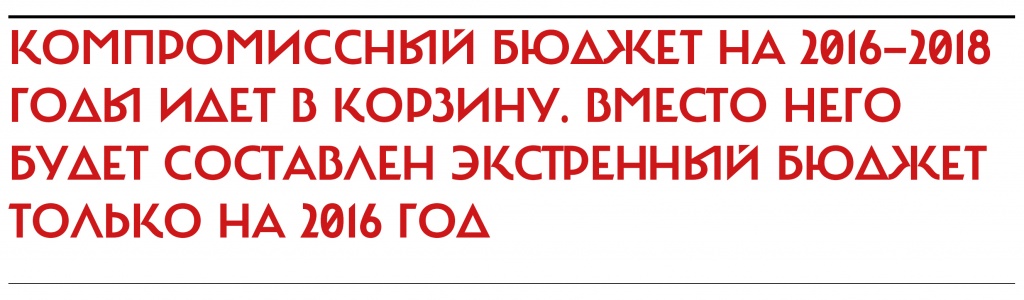
No. 27 of August 31, 2015 ) The average annual oil price in 2016 is $ 40 per barrel. True, the basic script was proposed to be considered (contrary, we note, obvious) not $ 40 per barrel, but $ 60. On August 31, Prime Minister Dmitry Medvedev, and after him, the Minister of Finance announced: the compromise budget for 2016-2018 goes to the basket. Instead, an emergency budget will be drawn up only for 2016, for which it will be necessary to rule the budget code.
Moreover, on October 1, as planned, the budget in the State Duma will not be presented: according to the Ministry of Finance, it will be drawn up from scratch, and the government takes an additional 25 days for its development.
Prayer for a barrel decision to replace a three -year budget with an annual - a rather eloquent evidence of the shock, which had a sudden, as always, falling prices for the main export goods of Russia - oil. According to the sources in the departments, the idea of moving to the annual budget has purely political reasons and is not offered by the Ministry of Finance or the Ministry of Economic Development - the assistant to the President of Economics Andrei Belousov with a “rather vague” motivation. The details of the emergency budget process are not completely disclosed. It is only known that the state program reduced in a three-year project will not yet be adjusted in the new budget, since there is simply no time for this-the Ministry of Finance expects to revise them in October-December 2015, that is, in the order of preparation of the next budget cycle. Otherwise, there is no clarity either in terms of further reduction in federal expenditures, or even by the scenario of the economic forecast, which will be the basis of the emergency budget. It seems that an additional 25 days taken to prepare a new budget is not needed in order to count and reduce something there-the government wants to wait and see what will happen to the oil price: the Ministry of Finance and the Ministry of Economicity has already stated that they would not lay the price of oil in the 2016 budget for a barrel-they will lay higher.
On the one hand, there is a certain logic in this: at the end of August, oil prices “bounced” to the level of $ 50 per barrel-with this the government is bad, but somehow learned to function. On the other hand, the refusal to recognize economic reality (and $ 40 per barrel during 2016 is, as the Augustus 2015, a fairly real option, though not the only one), shows the scale of the problem: there is simply no adequate response to such a reality in power. This is probably why Andrei Belousov announced on September 4 that the emergency budget would turn out with the price of oil of $ 50 per barrel, and, as follows from his words, regardless of how much oil will actually cost.
Transaero, in the flight, was one of the oldest private airlines in Russia - Transaero, first affected by the August collapse of oil prices. In early August, sources in the White House argued that the distressing family business of Olga and Alexander Pleshakov, as well as the head of the family and part -time head of the Interstate Aviation Committee Tatyana Anodina (she is the minority shareholder of Transaero and the mother of Alexander Pleshakov) will receive a state government for 70 billion rubles, which will cover the problematic problem Debts of the AVAIACUSIA to banks. At $ 40 for a barrel, a conversation about state guarantees became meaningless: in the last days of August, at a meeting of the First Deputy Prime Minister Igor Shuvalov, it was decided not to provide state support for Transaero-it will not be bankrupt, but for free (for debts) is absorbed by Aeroflot. In other words, since September, the problems of Transaero became the problems of Aeroflot.
The government will be explosive from the East with a high probability of October 25 to the State Duma a budget that is fundamentally not different from the summer design of the Ministry of Finance, but with some adjustment of social and military expenses - and, alas, with the accelerated spending of the reserve fund and, possibly, with printing for the needs of the pension system of the National Welfare Fund. The list of possible solutions in power is more short than ever. Since the traditional policy of reducing state expenses for the last three years without refusing to maintain a state of state in the economy is impossible, emphasis in the budget policy of 2016 can be made either on the rapid growth of funds involved in foreign and domestic markets, or on the privatization of state assets.
Both options are problematic and even bad. A significant increase in the public debt to cover the actual budget deficit, despite the low level of public debt now, is not only a threat to macroeconomic stability (in any case, the expansion of the state in the banking sector since 2009 was clearly not in order to begin to involve trillions of rubles in the market), but also the problem for companies that will be supplanted by the state from the market of internal zearing in the market of internal attempts to Conditions when external loans are neither for the Kremlin, nor for Gazprom, nor for private Russian companies are impossible.
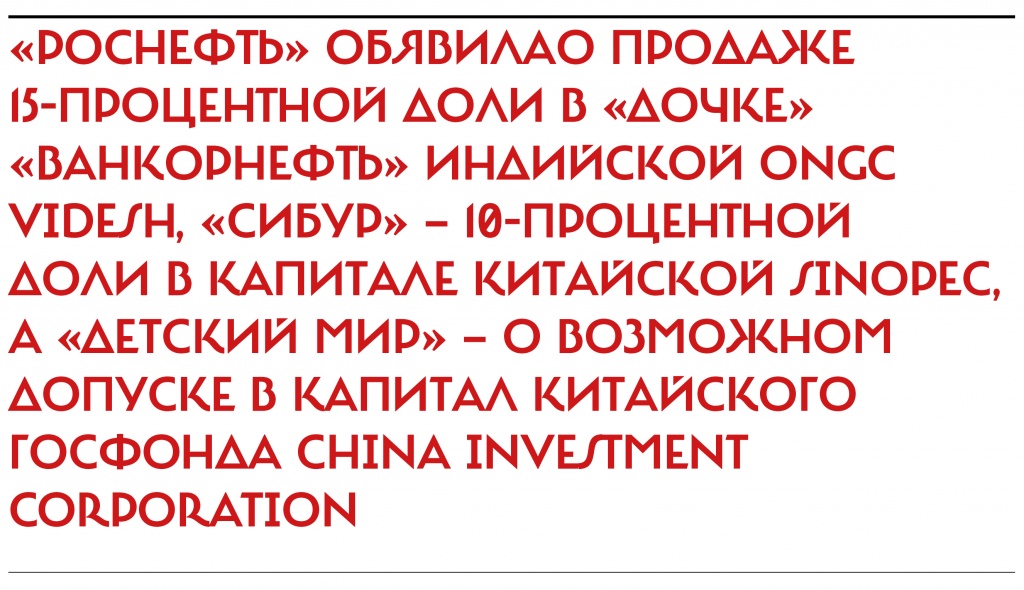
In the current conditions, privatization is the sale of resources at an extremely low price on the terms of the buyer. Judging by the results of the Eastern Economic Forum, which took place on September 3-5 in Vladivostok, Vladimir Putin is still choosing the second option. So, at the Rosneft forum announced the sale of a 15 percent share in Vankorneft's daughter, the Indian Ongc Videsh, Sibur-a 10 percent share in the capital of the Chinese SinoP, and the “children's world” Vladimir Yevtushenkov is about the possible admission to the capital of the Chinese state fund of China Investment Corporation. Of course, this is not yet privatization, but probing the soil for the possible opening of the market of the Russian Federation, primarily for Asian capital in 2016–2020. In the medium term, this may solve some problems, but the main thing will remain. Namely: the current personnel of the Russian authorities cannot solve the problems of the Russian economy at the price of oil of $ 40 per barrel. Therefore, he simply prefers to close the reality of the eye.