
Translated material
Post number zero

The Baksan neutrinum observatory of the Institute of Nuclear Research of the Russian Academy of Sciences ( BNO IAI RAS) has a rich, almost fifty -year history and a number of significant scientific achievements of the world level. For the creation of the observatory , a group of scientists of the Institute was awarded the State Prize of the Russian Federation. The laboratory of the Galli- German neutrinum telescope ( GGNT BNO) made a decisive contribution to the solution of the "riddles of the solar neutrino." GGNT, like other units of the observatory - a laboratory of low -phoned research, the laboratory of the underground scintillation telescope ( PST) - continue to work and play the leading roles in their fields of research.
From raiders to village
But a lot of problems were tested in BNO, not only a scientific or economic nature. The cause of serious incidents were illegal armed groups, and dealers in the hands of dealers, united with state authorities, and the usual element in their various manifestations. The observatory is located in the mountains (the Baksan gorge in Kabardino-Balkaria), which adds not only a romantic surroundings, but also difficulties in ensuring security. Moreover, safety should be complex - the observatory as an object, its employees, the BNO residential complex (the village of neutrino).
To great relief, scientists seriously did not affect the innovations similar to the fact that Russian cultural institutions overtook-when museums for some reason considered unworthy protection by the professional structures of the Ministry of Internal Affairs. The observatory in the 1990s survived the raider raid by the special services trying to remove the metal Gallium, which serves as a target for solar neutrinos. In the 2000s, bandits visited BNO for their vile affairs, which led to victims among the police and civilians. So, it is not required to bring additional arguments in favor of high -quality and professional security BNOs, although it is not cheap by the Academy of Sciences.

However, there is also nature, which in these beautiful places can be very capricious. In the summer of 2000, in the nearby city of Tyrnyauza, which is 30 km below the gorge, the village of Baksan River, which instantly emerged from the shores, came off. Half of the city was under a 3-4-meter layer of water. To the village. Neutrino, where BNO is located, the flood, fortunately, did not reach. But the entire upper part of the gorge (about 50 km of the residential area) was cut off from civilization - without electricity, water supply, products. Even the passage through Tyrnyaus became impossible. Upstairs could only be reached by a helicopter. The author with a group of comrades exclusively “successfully” had a chance to fly on a business trip on BNN exactly on the day when the village came down. We made their way up the day, it seems, on the third, before that found in a terrible Nalchik hotel. Our laboratory machine was the first to go upstairs when they laid a temporary aid through the rubble. But a whole column broke out from there.
There was no light and water in the observatory for a day. It must be understood that BNO is a complex scientific and technical complex, the main feature of which is underground workings: four-kilometer tunnels with deep chambers. Above the most distant laboratories, the thickness of the rocks reaches almost 2 km. To deprive BNO of energy supply means to create a serious threat to security both the observatory itself and the environment. PST is many tons of scintille, analogue of kerosene.
The GGNT contains hydrogen acid and hydrogen peroxide, as well as 50 tons of molten metal gallium (if it is not heated, it will freeze and destroy the special tanks in which it is stored). Measures, of course, were taken - both preventive and emergency - and in the end there were without technogenic problems, but there were a lot of nerves.

From avalanche to Ministry of Emergencies
A few years later, in March 2006, a powerful avalanche came right in the village of Neurino. In fact, in the snowy years they happen in the vicinity of dozens, but this scale is extremely rare. And the major luck that the avalanche came early in the morning, a little after six. The luck, alas, is that “only” three people died - the shift of the mining rescuers at their post. One and a half to two hours later, when the working day begins, the people are moving to work and the daily shift at the facilities changes, we could talk about dozens of victims. The avalanche was so powerful that a multi -ton electric locomotive delivering people underground was found in a river, a hundred meters from the foot of the mountain. A stone bus stop (on the other shore, on the highway) - as a cow licked in her tongue.

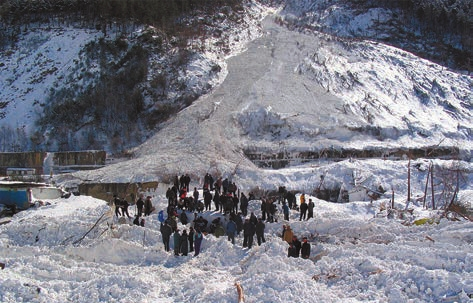
After such an incident, it was decided to build a stationary post of the Ministry of Emergencies at the observatory. Including for emergency assistance in similar cases. And indeed the village. The neutrino has all the necessary infrastructure and is located approximately in the middle of the high -mountain part of the gorge, so the construction of the post here looked logical. Part of a very pretty grove did not regret this matter right on the territory of the village, next to the laboratory corps (administrative center) of the BNO.

The post was a success. Large -scale and beautiful. Personally, I, however, could not find him at work. Even just notice people there is not easy task. And thank God that he was idle, thought sometimes, given his specifics. But recently, last August, work was found for fasting. A shed caught fire in the village. Whether, by negligence or at the hands of ill -wishers, in this case, the second thing. From the post of the Ministry of Emergencies to the barn in a straight line of 150 m up the slope of the mountain or five hundred meters along the road to the village. It would seem that just a shed, but it blazed on the half-tel. In the closest houses to him, fortunately, there were no residents - these are cottages specifically for the traveled employees of Iya RAS from the Moscow units. That is, "I must be in their place." However, the flame (the same mountains, in fact an aerodynamic pipe) diverged so much that five- and nine-story residential buildings, located a hundred meters from the hearth, could easily suffer. At least their inhabitants were already sitting on suitcases, ready for evacuation.


Local emphasics, of course, were notified immediately. Indeed, at the post, as expected, there is a fire engine and a duty calculation. Security experts reacted promptly and appeared at the scene. Together. On foot. And they were quite vividly discussed with responsible laboratory staff, who is to blame and what to do. In the process of creative discussion, it turned out that the fire engine - yes, there is, but without water (!). And to refuel it here, on a specially built huge structure, there is no technical opportunity (!!). And that the nearest gas station for such a car is located in the village. Tegenecli, which is 6 km above the gorge (!!!). Here and went there to refuel. And from there, which naturally, the caused additionally firefighters arrived earlier. About forty -five minutes after the fire is detected. It was very lucky that the fire did not spread anywhere from the barn, but, the burning of everything at hand went out by itself.
Here, in fact, is the whole story. The only thing I will clarify: the post of Ministry of Emergencies, although it is located in the territory of the BNO, has nothing to do with the observatory administratively. Accordingly, scientists can only influence the neighbors through spiritual conversations. Reluctance to read morality, nor to stigge with disgrace by name, nor replicate far -reaching conclusions. What to demand from the rescuers relaxing at the actually mountain resort, if we have a greater part of bureaucratic structures, starting with the government, works about the same. Continuous visibility. Potemkin village the size of the country.
Photo by the author
