
Translated material
Chekhov facial expressions and gestures
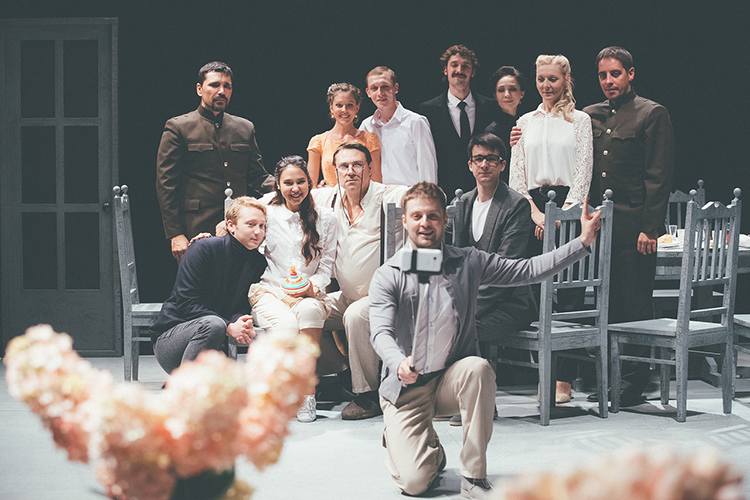
At one of the largest theatrical forums of the country, the “real theater” in Yekaterinburg, Timofey Kulyabin played the premiere of “three sisters”. Less than a month later, the new performance of the Novosibirsk Theater “Red Torch” will be shown in Moscow at the Territory festival. About the most anticipated premiere of the start of the season - Alexei Kiselev. Caution: spoilers.
Four actions of the textbook play by Anton Pavlovich Chekhov correspond to four acts of the performances of the experimenter Timofei Kulyabin. There is no extreme synthesis of genres at all - only psychological realism. Moreover: all the characters are in place, not a word is thrown out of the text, not a word is completed. The sisters behave chastely, and Jesus, if anything, also does not. But there is a nuance.
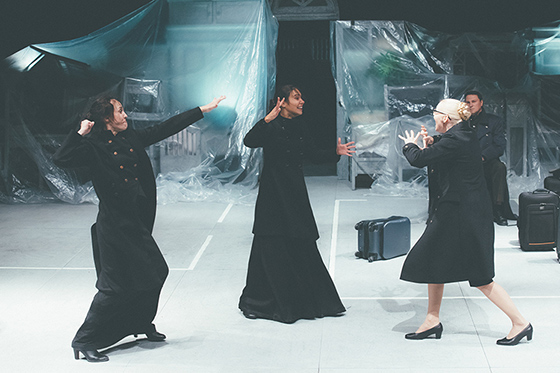
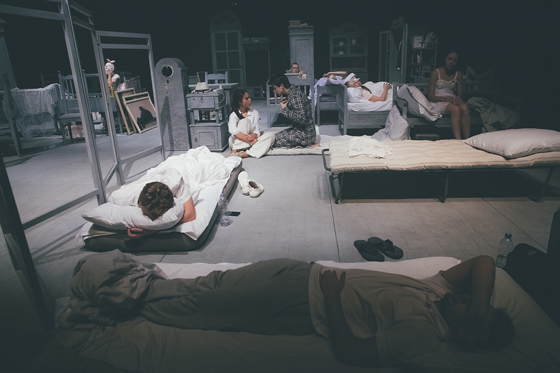
All the inhabitants of the Prozorovs house in the version of the Red Torch are deaf -mute. They quarrel, philosophize, bargain and admit love in a brutal language, listen to music with their feet and eavesdrop on their eyes, which, however, does not stop Irina from watching on TV Miley Cyrus, Masha - flirting with Vershinin on SMS, Andrei - to fill up the night with a laptop, and Chebutykin and Federal Hockey by means of an iPad, until they called for drinking tea. All this happens in the format of a reality show at the same time and continuously: Oleg Golovko’s scenography allows the viewer to see through all the rooms and corridors of the house, forced by vintage wooden furniture. And at the same time-to see and recall not so much by Alvis Hermanis with his experiments on the survey of apartment walls on the theater stage as, of course, Lars von Trier: the perimeters of the rooms of Kulyabin are outlined by a white line-exactly like in Dogville. The emptiness of the huge visual room is responsible for the Trierov Void, surrounding the unified place of action to the Novosibirsk performance, against which the performance, which was expanded at 180 degrees, is played right on the stage, with their backs to the back. And yes, to know the brutal language, like the “three sisters” by heart, is not necessary: the text of the play - that is, in this case, the translation is broadcast on the big screen from above.
 © Frol Podlesny
Yes, this is an original sample in the piggy bank “What doesn’t happen” and at the same time - to a ridiculous frontal illustration of truism: they say, Chekhov’s “no one hears anyone”. But at the same time - an experiment in the field of the psychological theater, which is crystal in its implementation, is, moreover, a suitable, I think, for any hackneyed dramatic material. As the Prince Hamlet will behave, say, deprivation of it, you can still dream of it, and for the Chekhov underwater currents, as it turned out, this technique serves at least a magnifying glass - and this, of course, is the main thing. The need to constantly gesticulating deprives the heroes of the possibility of existing intimately, while not a single remark can remain unheard, since the deaf-mute is forced to draw the attention of the interlocutor before the replica every time, and here the paradoxalist curtsy is discovered-it turns out that Chekhov actually hear each other well. However, the logical reason for the universal deafness in the concept proposed by Kulyabin may be the social status of the characters: what to talk about for girls who speak five languages, with the dense population surrounding their house? They are dumb for the world, and their house is nothing more than a reservation, a ghetto for a minority.
Jesus, if that, no. But there is a nuance.
But the light with a wedge on the deaf -mute of the Novosibirsk "three sisters", of course, did not agree. The motivator for a millimeter analysis of the text and the subsequent artistic feat was the decision to expose all the nooks of the hospitable dwelling, usually perhaps implied, thereby spilling light on the order of its inhabitants. This venture simply did not leave the artists the chances of the approximation of the role of the role: each hero Kulyabin literally composed his thorough extra -estimated life in Stanislavsky, and this background sometimes becomes decisive. While Andrei pours his soul to Ferapont, the only one hearing, but not understanding the character of the performance, Natasha in her room dries a fresh pedicure, anticipating the rendezvous with Protopopov. And the fact that Chebutykin got maliciously drunk, the audience will learn a lot earlier than households - the doctor broes alone with him, locked in the far room. Such causal revelations.
 © Frol Podlesny
There were not, however, without interpretative microsurgery. Anfisa, for example, is not an old woman here, but a young pregnant maid, and she almost knows how to says - because, apparently, that one step is closer to the people; Chebutykin makes it clear to Irina that he is her father; The salty is recognized by Irina in love, having previously closed her in the closet. Neither one nor the other, nor the third amount of meanings, however, does not change, and to the question “why is it” here is a reasonable answer “why, in fact, no”.
From the curious and masterful out -of -the -way performance of the Kulyabin, actors who have mastered the language of gestures and who managed to preserve household organics to such an extent that in each of the three enthrackers, the audience wisely clarify each other, where the director found so many professional healing actors. Vershinin Pavel Polyakova is modest, like young Van Damm, Tuzenbach Anton Voilovich - spilled Snowden, Irina Linda Akhmetzyanova - Pokakhontas of the Kramsky brush; Each is accurate and light in the best traditions of the first generation of “Fomen”.
 © Frol Podlesny
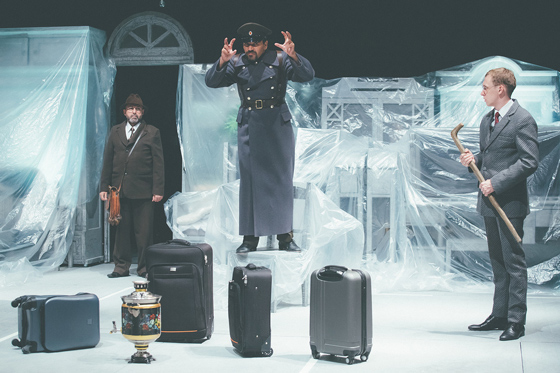
Those who saw the "electrra" or "#Sonneteshkspir" are well known to Kulyabin's tendency to gradual twisting of aesthetics inside out, to a systematic shift from the beautiful to cruel. In the "Electr", the meditative ritual breaks down into the bloody mess, in the "Sonetteshkaspir", the virgin black is turned into brutal violence. Three sisters begin with idyllic paintings of a cozy intellectual leisure with Scandinavian comfort, and end in literally a pre -revolutionary collapse outside of any way of life at all. The scenery is shifted deeper and covered with polyethylene, there is no fourth wall at all, from afar the brass band rumble. And if before that, a beautiful, but to a certain extent trivial maxim about people who sit on sofas, buried in a smartphone, and at that time collapsed, collapsed, then after such a chronological zigzag and a completely festamagoric scene of the collective ease of hearing (oh how the music plays! ”) The performance goes into a completely sudden and). A speculative experiment in one fell swoop turns into an epic parable about gaining harmony through suffering.
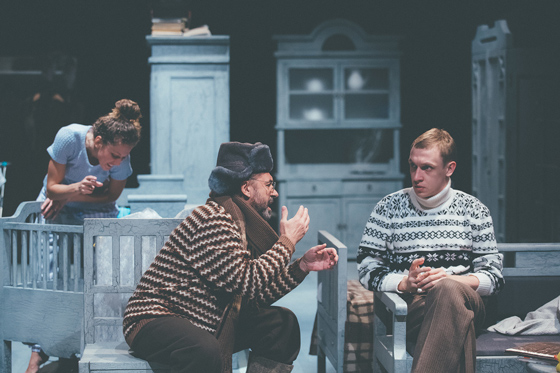 © Frol Podlesny
It is clear that the “three sisters” will not see the hundredths of those who followed the process of the Novosibirsk Theater of the opera and ballet (this, alas, is impossible physically), and Timofey Kulyabin in the wide information field will remain “the scandalous author of Tangayzer” for a long time - and it is a pity. However, such a state of affairs only builds to the Infronts the relevance of the topic of total deaf -mute.