
Translated material
A peacock hatched in the St. Petersburg colony
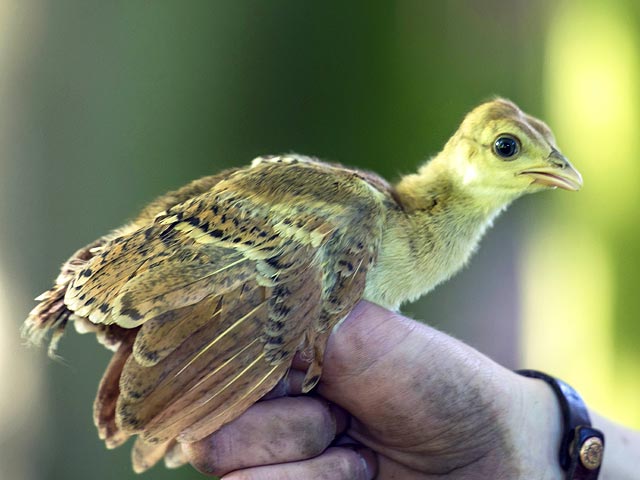
In the St. Petersburg correctional colony N4, the Pavlina Pavlin was born, in a hurry to share the joyful news of the regional Federal Penitentiary Service .
The newborn became the second cub of the pair of exotic birds. The head of the family is highlighted by Paul, he was taken to the colony from Moscow, and his passion Malvina arrived from Simferopol.
The first exotic birds were presented by former prisoners about ten years ago. Thus, the only Pavinov nursery in the regional penitentiary system appeared, and the tropical birds became a real IK-4 brand, the report said.
The convicts themselves take care of the pets. In the diet of birds - grain, fruits and even frogs, lists the Federal Penitentiary Service. “Now the leadership and convicts unofficially call this institution“ red peacock, ”the press release says.“ The leadership plans to expand their subsidiary farming and seriously engage in tribal dilution of exotic birds. ”
In addition to peacocks, in the auxiliary farm of this colony there are chickens and rabbits, as well as greenhouses and greenhouses with vegetables.
Earlier this year, in colony N22 in Primorye, they decided to engage in breeding decorativeVietnamese Vyslobryukhi pigs - for sale and for educational purposes. IR employees argue that communication and care for these cute animals favorably affect the educational process of convicts and allow them to develop positive qualities in them. There is a large “classic” pig farm in this colony where prisoners are busy.
A subsidiary farms exist in many domestic institutions of the penal system. There, pigs, chickens, rabbits, sheep are bred there, mainly for "satisfying elementary paramount needs", that is, for personal needs. Also in the colonies they are engaged in the cultivation of vegetables and fruits for the same purposes.
Meanwhile, last fall, the Federal Penitentiary Service of the Russian Federation announced that she intends to make production in places of imprisonment with a profitable business . In this regard, they achieved considerable successes in this regard, where the head of the regional Federal Penitentiary Service Oleg Simchenkov stated in October 2014 that after the introduction of Western sanctions against Russia, the correctional colonies of the region increased the production of products "to fill the niche." In the corrections of this region, convicts produce agricultural products, building materials, furniture, shoes, clothing, including a form for law enforcement agencies, and are also engaged in woodworking and processing of metals.
In one of the colonies of the Magadan region, at the end of last year, prisoners began to master the production of "anti -crisis" toilet paper , the demand for which, as announced, would not depend on the ruble exchange rate, or on the situation in global oil markets.
And in the penal colony, the N44 of the N44 in the Kemerovo region recently launched a workshop for the production of medium -carbonated non -alcoholic beverages - Pinocchio, Duchesi, Tarhun and others, which will sell the rest of such institutions of the region.